Viet Thanh Nguyen on 50 Years After Vietnam War

We mark 50 years since the end of the U.S. war on Vietnam with the acclaimed Vietnamese American writer Viet Thanh Nguyen. On April 30, 1975, North Vietnamese troops took control of the South Vietnamese capital of Saigon as video of U.S. personnel being airlifted out of the city were broadcast around the world. Some 3 million Vietnamese people were killed in the U.S. war, along with about 58,000 U.S. soldiers. Hundreds of thousands of Lao, Hmong and Cambodians also died, and the impact of the war is still being felt in Vietnam and the region.

Nguyen says while the Vietnam War was deeply divisive in the United States during the 1960s and ’70s, American interference in Southeast Asia goes back to President Woodrow Wilson in 1919, when he rejected Vietnamese demands for independence from France. “And from that mistake, we’ve had a series of mistakes over the past century, mostly revolving around the fact that the United States did not recognize Vietnamese self-determination,” says Nguyen.

We Are Here Because You Are There”: Viet Thanh Nguyen on How U.S. Foreign Policy Creates Refugees

Pulitzer Prize-winning Vietnamese American writer Viet Thanh Nguyen discusses why he chooses to use the term “refugee” in his books, and speaks about his own experience as a refugee. His new novel tells the story of a man who arrives in France as a refugee from Vietnam, and explores the main character’s questioning of ideology and different visions of liberation. Titled “The Committed,” the book is a sequel to “The Sympathizer,” which won the Pulitzer Prize for Fiction in 2016. Nguyen says his protagonist is “a man of two faces and two minds” whose ability to see beyond Cold War divisions makes him the perfect figure to satirize the facile stories people tell themselves about the world. “He’s always going beyond the surface binaries to look underneath.” Nguyen is the chair of English and professor of English and American studies and ethnicity at the University of Southern California. His other books include “The Refugees” and the edited collection “The Displaced: Refugee Writers on Refugee Lives.”

Viet Thanh Nguyen Interview: The Vietnam War Refugee Experience Behind The Sympathizer

Pulitzer Prize-winning author Viet Thanh Nguyen reflects on his childhood as a refugee in America, his writing career, and family: from the trauma of displacement to the healing found in fatherhood and literature. Nguyen shares how these experiences have shaped his life and work, from his novel The Sympathizer to his commentary on war, cultural identity, and American life.

00:00 Introduction to Viet Thanh Nguyen and The Sympathizer

00:49 Refugee journey, family separation, and overcoming trauma

03:43 Humor, cultural expectations, and Vietnamese Catholic roots 05:29 Cultural identity, rebellion, and hidden writing career

07:14 Family relationships, cultural silence, and lessons in parenting 09:35 Impact of fatherhood, learning from children, and rediscovering play

12:13 Art, personal identity, and American cultural values 14:49 Vietnamese American identity, racism, and vision for the future

17:27 Teaching about war, challenges of digital information overload

20:31 Apocalypse Now, self identity struggles, and power of storytelling

24:41 Vietnam War legacy, draft-era resistance vs. modern volunteer military

26:47 Family history, generational trauma, and refugee story from Vietnam

29:48 Writing, fatherhood, and healing

Gaza: Aid groups running out of food

For nearly 60 days, no food, fuel, medicine or other item has entered the Gaza Strip, blocked by Israel. Aid groups are running out of food to distribute. Markets are nearly bare. Palestinian families are left struggling to feed their children. We discussed that with out guest Arwa Damon, founder of the International Network for Aid, Relief and Assistance (INARA)

The World Food Programme runs out of food in Gaza as Israeli blockade continues

The World Food Programme has run out of food 54 days after Israel imposed a complete blockade on the Gaza Strip. NBC News’ Matt Bradley reports on what families in Gaza are facing as Israel’s blockade continues.

WFP runs out of food stocks in Gaza, warns of famine

Gaza’s stolen childhood – Who were the thousands of children Israel killed?

Aljazeera.com

INTERACTIVE - Gaza children killed Israel outside 16by9-1742978742
(Al Jazeera)

By Mohamed A. Hussein and Mohammed Haddad Published On 26 Mar 202526 Mar 2025

Israel kills a child in Gaza every 45 minutes.

That is an average of 30 children killed every day over the past 535 days. ​

Since October 7, 2023, Israel has killed at least 17,400 children, including 15,600 who have been identified. Many more remain buried under the rubble, most presumed dead.

Many of the surviving children have endured the trauma of multiple wars, and all of them have spent their lives under the oppressive shadow of an Israeli blockade, affecting every aspect of their existence from birth.

What is left of Gaza’s children?

About half of Gaza’s 2.3 million residents are children.

Over the past 17 months, Israeli attacks have left their homes in ruins, destroyed their schools, and overwhelmed their healthcare facilities.

To put this in perspective, if you had a room of 100 children:

  • 2 have been killed
  • 2 are missing, presumed dead
  • 3 have been wounded, many critically
  • 5 have been orphaned or separated from their parents
  • 5 require treatment for acute malnutrition

The rest of the children bear the invisible scars of war, trauma that affects their mental health, safety and future.

INTERACTIVE - Gaza children killed Israel what is left-1742978814
(Al Jazeera)

Who were these children Israel killed?

They were the sons and daughters of Gaza, each with a life that should have been filled with innocence and the joy of childhood.

Tiếp tục đọc “Gaza’s stolen childhood – Who were the thousands of children Israel killed?”

Letters from the great Frontline – Những Lá Thư Từ Tiền Tuyến Lớn

[See English translation below ]

Dưới đây mình chép lại một lá thư của liệt sĩ Đồng Thế Thức, gửi từ chiến trường (miền Nam) cho cha mẹ và gia đình ở miền Bắc trong thời gian kháng chiến chống Mỹ những năm 1970s.

Liệt sĩ Đồng Thế Thức là bác ruột của mình, bác là anh trai của mẹ. Bác Thức sinh năm 1942, lớn hơn mẹ 14 tuổi. Bác học xong cấp 3 là nhập ngũ. Theo mẹ kể lại, bác Thức hy sinh vào khoảng năm 1974 tại Tây Ninh. Bức thư này không ghi rõ ngày tháng, nhưng theo mẹ kể có lẽ bác viết tầm năm 1973. Trong thư bác nói về niềm tin ngày thống nhất đang rất gần rồi, “con sẽ trở về trên chuyến tàu Sài Gòn – Hà Nội”. Thêm nữa thời chiến, liên lạc rất khó khăn, cho nên có khi gửi thư cả vài năm mới đến được tay người nhà nên không biết chính xác thư viết khi nào. Đây là một bức thư hiếm hoi bác gửi về được tới gia đình trong những năm chiến đấu ở chiến trường miền Nam.

Lá thư này có đề địa chỉ là hòm thư. 86558YK – B11. Thời đó khi nói đến đi Bê (B) tức là đi vào chiến trường miền Nam. Từ năm 1960, các khu vực tác chiến quân sự có  tên gọi quy ước A là miền Bắc, B là miền Nam, C là Lào và Đ là Cam pu chia (sau đổi thành K). Tất cả cán bộ từ Bắc đi B đều phải đi theo những con đường tuyệt bí mật, không ai biết đường đi của ai. Hơn nữa, bác Thức đóng quân tại Tây Ninh, là nơi căn cứ của Trung Ương Cục Kháng Chiến Miền Nam, phải cực kỳ bí mật không thể biên thư tuỳ tiện để lộ tung tích. Những ai đi B là dù không nói, là biết không hẹn ngày trở về.

Trong thư có một số chữ bị mờ nhìn không còn rõ. Mình cố gắng chép lại để nguyên văn từng dấu chấm, phẩy, dấu cảm thán. Có một số câu đọc nghe có vẻ không hoàn chỉnh. Điều này có lẽ là do, như trong như bác nói, lá thư phải viết trong hoàn cảnh nhanh và rất vội để gửi cho người quen mang ra ngoài Bắc. Vì cơ hội này không hề dễ dàng gặp được trong chiến trường. Cho nên phải viết thật nhanh và vội, vì vậy có lẽ cũng rất nhiều hồi hộp và cảm xúc. 

Tiếp tục đọc “Letters from the great Frontline – Những Lá Thư Từ Tiền Tuyến Lớn”

A Million Cuts: India’s C-Section Epidemic – Dịch Bệnh Mổ Đẻ ở Ấn Độ

A C-section is the surgical method of delivering a baby, meant to be used in complicated pregnancies. It’s a lifesaving procedure, but in India, millions of mothers are going under the knife unnecessarily. The Cesarean section rate in India’s private hospitals is a whopping 47.4%, far greater than the 15% threshold recommended by the WHO. As private hospitals of all kinds mushroom across the country, C-sections have become a money-making racket. An increasing number of doctors have little patience for normal deliveries and are in a hurry to wield the scalpel. Hapless mothers in their hands are forced to undergo surgeries which comes with risks for both mother and baby.

Tỉ lệ sinh mổ tăng cao do quan niệm chọn ngày đẹp

Tỉ lệ sinh mổ tại Việt Nam gần 50% và ngày càng gia tăng

laodong.vn Thứ tư, 16/10/2024 10:54 (GMT+7)

Tỉ lệ sinh mổ ở Việt Nam tăng 37% do các sản phụ “quyết” chọn ngày đẹp, giờ đẹp để sinh con.

Tỉ lệ sinh mổ tăng cao do quan niệm chọn ngày đẹp
Tỉ lệ sinh mổ tăng cao do quan niệm chọn ngày đẹp. Ảnh: Hương Sơn

Quyết tâm “khép chân ở nhà” do kiêng đẻ mùng một

Một sản phụ 34 tuổi (Hà Nội) mang thai lần hai, đến tuần 40 của thai kỳ, chị không đi khám đúng hẹn. Nguyên nhân do gia đình không muốn sinh con mồng một, sợ sẽ khó nuôi nên cố chờ qua ngày. Chị nói bé đầu tiên cũng chọn ngày giờ, sinh mổ ở tuần 41 không vấn đề gì xảy ra nên yên tâm.

Khi tới khám, BS Nguyễn Trung Đạo – Khoa Sản bệnh A4, Bệnh viện Phụ sản Hà Nội – phát hiện ối xanh, đầu con lọt thấp và chỉ định nhập viện ngay. Nếu kéo dài, nguy cơ rủi ro tăng gấp 10 lần. May mắn, sản phụ chuyển dạ an toàn, sức khỏe mẹ và thai nhi ổn định. Bé trai chào đời nặng 3.8kg, khóc to, hồng hào.

Trước đó, Bệnh viện Phụ sản Hà Nội cũng tiếp nhận thai phụ 39 tuổi suýt tử vong do tiền sản giật nặng ở tuần thai 37 nhưng quyết không mổ vì kiêng ngày mùng một. Bác sĩ cấp cứu mất rất nhiều thời gian để thuyết phục. May mắn bé gái chào đời an toàn, sức khỏe người mẹ ổn định.

Tỉ lệ sinh mổ ở Việt Nam tăng lên 37%

PGS.TS Vũ Văn Du – Phó giám đốc Bệnh viện Phụ sản Trung ương – cho biết: “Tại Việt Nam, tỉ lệ mổ lấy thai tăng liên tục trong 15 năm qua, từ 12% năm 2005 lên 37% vào năm 2022. Bên cạnh các chỉ định từ bác sĩ, nhiều thai phụ và gia đình yêu cầu được sinh mổ chủ động.

Tỉ lệ sinh mổ cao đã trở thành một vấn đề cấp bách, làm dấy lên mối lo ngại về tác động của nó đối với sức khỏe của bà mẹ cũng như hậu quả lâu dài”.

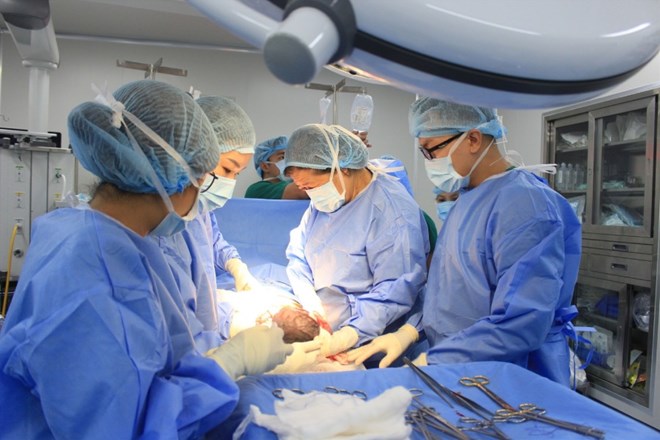
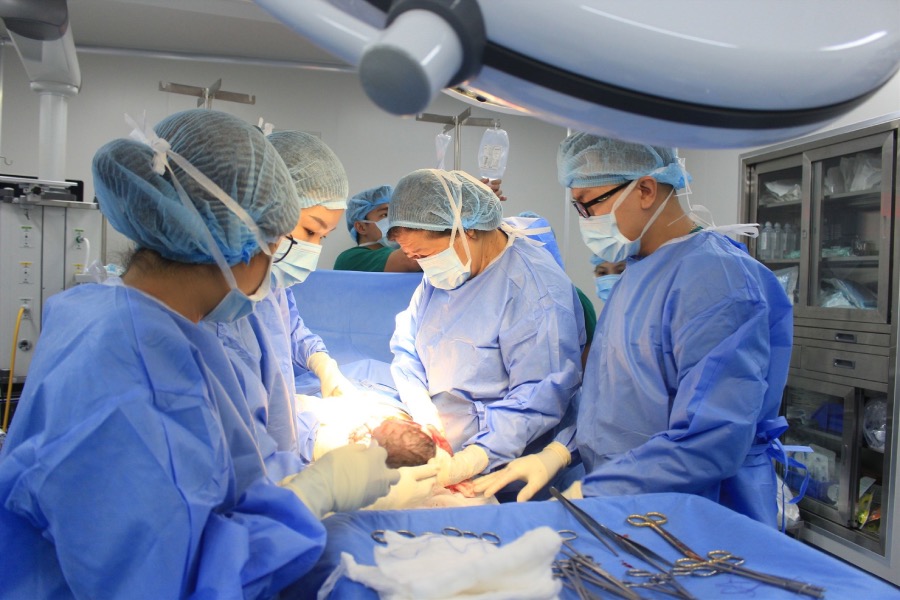
Bác sĩ mổ lấy thai sớm. Ảnh: Hương Sơn
Bác sĩ phẫu thuật lấy thai cho sản phụ sinh mổ. Ảnh: Hương Sơn

Theo Tổ chức Y tế thế giới (WHO) khuyến nghị, tỉ lệ sinh mổ chỉ từ 10-15%. Trong y khoa, khi vượt quá 15% được coi là không cần thiết. Tuy nhiên, trong những thập niên gần đây, tỉ lệ sinh mổ tăng trên toàn thế giới. Theo dự báo, năm 2030, tỉ lệ mổ lấy thai toàn cầu là 29%.

PGS Trần Danh Cường – bác sĩ sản phụ khoa – cho biết, người mẹ sinh thường không gặp các biến chứng của sinh mổ như gây tê màng cứng, gây mê, chảy máu vết mổ sau đẻ.

Sau sinh thường, sản phụ sữa sẽ về nhiều do được kích hoạt hệ thống nội tiết trong quá trình chuyển dạ. Mặt khác, thời gian hồi phục của sản phụ đẻ thường sẽ nhanh hơn. Em bé sinh thường phải trải qua một thời gian dài trong quá trình chuyển dạ nên phổi hoạt động tốt, hệ hô hấp tốt hơn trẻ sinh mổ.

Các bác sĩ khuyến cáo, khi không có chỉ định sinh mổ, sản phụ nên lựa chọn sinh thường. Bác sĩ sẽ cân nhắc lợi ích giữa việc sinh thường và sinh mổ chủ động một cách hợp lý nhất. Do khi tỉ lệ sinh mổ lặp lại cao, sản phụ thường có nguy cơ mắc rau tiền đao, rau cài răng lược và cắt bỏ tử cung khi có thai tăng lên sau mỗi lần sinh mổ.

Mẹ bầu và gia đình không nên quá mê tín, chọn ngày đẹp, giờ đẹp để sinh mổ chủ động. Đứa trẻ ra đời sớm có thể khiến bé bị thiếu tháng, hệ hô hấp chưa hoàn thiện, viêm phổi, ảnh hưởng phát triển sau này. Chưa kể, đẻ mổ để lại nhiều biến chứng ở mẹ, như nhiễm trùng, sẹo, vết mổ không lành, ngứa, nguy cơ vỡ tử cung khi có sẹo mổ cũ hai lần cao gấp đôi so với sẹo mổ cũ một lần.

Soldiers Of Fortune: Mercenaries From China, Nepal Fight In Russia-Ukraine War

00:00 Introduction

01:54 Why one Nepali man joined into the Russian army 04:07 Is this human trafficking?

05:45 Nepali soldiers fighting for foreign armies

07:36 Chinese mercenaries share their experiences on Douyin

12:51 Fighters from Central Asia killed on the frontlines

13:55 Kyrgyz prisoners summoned to war

15:55 What happened to a fallen Kyrgyz prisoner?

19:29 A contract only in Russian with a hidden clause

22:35 Amateur soldiers face the horrors of war

25:03 Mercenaries captured by Ukraine

26:08 Inside a Ukrainian POW camp

26:58 Why one POW joined the Russian army

28:19 Infantry soldier turned POW

29:16 Russia is not claiming its POWs

30:38 Mercenary’s family hopes for his return to Nepal

33:51 Prisoners promised freedom if they survived

36:04 Arrested in Kyrgyzstan for participating in a foreign war

36:53 Russia’s influence in Central Asia

38:22 Nepali activists fight to bring their men home

39:41 Hunting for a missing Nepali mercenary

41:58 Families meet with members of parliament

43:58 What are the mercenaries doing now?

==========

About Undercover Asia: CNA’s award-winning investigative series Undercover Asia uncovers the hard truths in the underbelly of Asia, and exposes the unintended fallout of change in the fast-moving continent.

Atomic Bomb Survivors Win Nobel Peace Prize, Say Gaza Today Is Like Japan 80 Years Ago

Nobel Peace Prize Winner Toshiyuki Mimaki: “I thought the prize would go to those working hard in Gaza. In Gaza, bleeding children are being held by their parents. It’s like Japan 80 years ago.” 36,000 tons of explosives were dropped on Hiroshima/Nagasaki 82,000 tons have been dropped on Gaza

A Japanese group of atomic bomb survivors, Nihon Hidankyo, has won the Nobel Peace Prize as fears grow of a new nuclear arms race. The head of the group has compared Gaza today to Japan 80 years ago when the U.S. bombed Hiroshima and Nagasaki. We feature a Democracy Now! interview with Setsuko Thurlow, a survivor of the U.S. atomic bombing of Hiroshima and an anti-nuclear activist, and get response from Joseph Gerson, president of the Campaign for Peace, Disarmament and Common Security, a U.S. nuclear disarmament activist who has spent decades working closely with the group.

Thảm kịch lũ quét và sạt lở sau bão Yagi: Sự cố hi hữu hay vấn đề hệ thống? 

tia sáng – 8-10-2024 – Hà Thị Hằng – Lưu Thị Diệu Chinh

Từ thực tế ảnh hưởng của cơn bão Yagi, đã đến lúc, chúng ta cần suy nghĩ đến việc cần thiết phải bảo vệ các khu vực miền núi trước thiên tai theo một cách khác.

Trận lũ phá tan hoang khu vực bản trung tâm của xã Hồ Bốn, Mù Cang Chải, Yên Bái vào tháng 8 năm 2023. Ảnh: Việt Cường

Tiếp tục đọc “Thảm kịch lũ quét và sạt lở sau bão Yagi: Sự cố hi hữu hay vấn đề hệ thống? “

Từ tâm chấn động đất – 3 kỳ

  • Từ tâm chấn động đất – kỳ 1: Những đêm không ngủ
  • Từ tâm chấn động đất – Kỳ 2: Những ngôi nhà treo vách núi
  • Từ tâm chấn động đất – Kỳ cuối: Mù mờ ‘thủ phạm’
Nhà chị Y Dô bị nghiêng hẳn sang một bên sau những trận động đất.

***

Từ tâm chấn động đất – kỳ 1: Những đêm không ngủ

TPO – 22/08/2024 | 06:44

Những trận động đất vẫn diễn ra bất thình lình, không kể ngày đêm uy hiếp tinh thần, tính mạng của người dân huyện Kon Plông (Kon Tum) nói riêng các tỉnh lân cận nói chung. Sự hoang mang, lo lắng của người dân ngày một dày thêm khi chưa có một lời giải thích thỏa đáng về nguyên nhân gây ra động đất.

Khi đi vào vùng được xác định là tâm chấn động đất, ám ảnh nhất với chúng tôi là những đôi mắt thâm quầng trên gương mặt của người dân sau nhiều đêm mất ngủ. Cuộc sống khó khăn, lại thêm những cơn địa chấn bất thình lình luôn rình rập khiến nơi đây càng thêm bức bí.

Tiếp tục đọc “Từ tâm chấn động đất – 3 kỳ”

83 earthquakes recorded in July in Kon Tum and Thanh Hóa provinces

VNN – August 01, 2024 – 13:35

An expert said earthquakes in Kon Tum are expected to continue and affect densely populated areas and key infrastructure, especially near the epicentre.

A view of Kon Plong District in the central highland province of Kon Tum. A total of 82 earthquakes occurred in the district in July. VNA/VNS Photo Dư Toán

KON TUM – A total of 83 earthquakes occurred in July, with 82 reported in Kon Plong District, Kon Tum Province, the Institute of Geophysics under the Việt Nam Academy of Science and Technology announced on Thursday.

Only one earthquake was recorded in Ngọc Lạc District in Thanh Hoá Province. Most of the earthquakes ranged in magnitude from 2.5 to 5.0.

Tiếp tục đọc “83 earthquakes recorded in July in Kon Tum and Thanh Hóa provinces”