Former Australian diplomat John Lander returns to CITIZENS INSIGHT in the wake of the Israel-Gaza war to discuss the broader global geopolitical ramifications.
Interview with John Lander, Former Deputy Ambassador to China (1974-76), Former Ambassador to Iran (1985–87) Hosted by Robert Barwick, Research Director of the Australian Citizens Party
From Israel-Hamas War of Genocide to China-Taiwan issue, analysis to see the “rule-based order” of the US and Its allies, in which the “rules” keep changing to serve US’ and ít allies’ interests and no one really knows what the rules are.
After the Youtube clip is the computer-generated transcrip of the talk.
The countries’ opposing ideologies amid clashing sovereignty claims could lead to years of militarisation and confrontation in the region if not contained, analysts warn
Manila has been boosting defence ties with various countries with the aim of building ‘collective deterrence’ in the event of conflict in the region
The recent trading of barbs between China and the Philippines over ideological differences highlights the “perennial mistrust” between the two neighbours, experts say, noting that their disparate approaches to democracy and authoritarianism are likely to further escalate tensions in the South China Sea.
The Belt and Road Initiative wasn’t a sinister plot. It was a blueprint for what every nation needs in an age of uncertainty and disruption.
JANUARY 20, 2024, 5:46 AM
By Parag Khanna, the founder and CEO of Climate Alpha. FP
An aerial view shows stranded ships dotting bright blue water as they wait to cross the narrow Suez Canal seen in the distance at its southern entrance in the Red Sea.
Over the past two months, a sudden surge in Houthi rebel attacks in the strategic Bab el-Mandeb Strait connecting the Red Sea to the Arabian Sea prompted the world’s largest shipping carriers to halt transit through the Suez Canal for several weeks—with even more rerouting their vessels as the United States and Britain launched strikes on Yemen and the situation has escalated.
Trong một động thái đáng chú ý ở khu vực Nam Á, Maldives yêu cầu Ấn Độ rút binh sĩ đang đồn trú tại nước này trước ngày 15/3.
Maldives là quốc đảo nhỏ ở khu vực Nam Á, vốn phụ thuộc đáng kể vào nước láng giềng Ấn Độ về nguồn cung lương thực, xây dựng hạ tầng và công nghệ. Tuy nhiên mối quan hệ này gần đây xuất hiện dấu hiệu căng thẳng.
Tổng thống Maldives Mohamed Muizzu. Ảnh: AP
Trong khi đó, trong chuyến thăm Trung Quốc hồi tuần trước của Tổng thống Maldives, hai bên nhất trí nâng cấp lên “quan hệ đối tác hợp tác chiến lược toàn diện”. Các nhà phân tích cho rằng động thái của Maldives phản ánh phần nào sự chuyển hướng chính sách của một số quốc gia ở Nam Á trước cuộc cạnh tranh ảnh hưởng giữa các nước lớn.
Ngày nay, chúng ta thường xuyên được chứng kiến những màn đối đầu ngoại giao xung quanh vấn đề Tân Cương. Trong khi nhiều nước liên tục chỉ trích, thậm chí trừng phạt Trung Quốc vì vấn đề người Duy Ngô Nhĩ, thì Trung Quốc bác bỏ cáo quốc và luôn bảo vệ ”sự thống nhất toàn vẹn Trung Quốc”, tố cáo ”chủ nghĩa ly khai Duy Ngô Nhĩ” bị các nước phương Tây lợi dụng chống Trung Quốc.
Nhưng nếu để ý, sẽ thấy một nước lớn là Nga lại khá im tiếng trong vấn đề này, không hùa theo chống Trung Quốc, nhưng cũng không công khai ủng hộ Trung Quốc về vấn đề Tân Cương. Có gì khó lý giải ở đây? Điều đó hoàn toàn lý giải được nếu biết được lịch sử vùng đất Tân Cương từ những năm 1930-1950, để thấy rằng: không ai khác ngoài Stalin và Liên Xô đã đỡ đầu cho Tân Cương độc lập. Và thậm chí trước kia, chính Đảng Cộng sản Trung Quốc của Mao Trạch Đông từng ủng hộ Tân Cương ly khai khỏi Trung Hoa.
The National Task Force West Philippine Sea (NTFWPS) vehemently condemns the illegal and aggressive actions carried out by the Chinese Coast Guard and Chinese Maritime Militia against the civilian Bureau of Fisheries and Aquatic Resources (BFAR) vessels Datu Sanday, Datu Bankaw, and Datu Tamblot today during a regular BFAR humanitarian and support mission of providing oil subsidy and grocery packs to over 30 Filipino fishing vessels near Bajo De Masinloc in the West Philippine Sea. As of this reporting the mission is on-going. Tiếp tục đọc “STATEMENT OF THE NATIONAL TASK FORCE FOR THE WEST PHILIPPINE SEA”→
Defaults by Chinese borrowers have surged to a record high since the outbreak of the coronavirus pandemic, highlighting the depth of the country’s economic downturn and the obstacles to a full recovery.
A total of 8.54mn people, most of them between the ages of 18 and 59, are officially blacklisted by authorities after missing payments on everything from home mortgages to business loans, according to local courts. That figure, equivalent to about 1 per cent of working-age Chinese adults, is up from 5.7mn defaulters in early 2020, as pandemic lockdowns and other restrictions hobbled economic growth and gutted household incomes.
The soaring number of defaulters will add to the difficulty of shoring up consumer confidence in China, the world’s second largest economy and a crucial source of global demand. It also throws a spotlight on the country’s lack of personal bankruptcy laws that might soften the financial and social impact of soaring debt.
Under Chinese law, blacklisted defaulters are blocked from a range of economic activities, including purchasing aeroplane tickets and making payments through mobile apps such as Alipay and WeChat Pay, representing a further drag on an economy plagued by a property sector slowdown and lagging consumer confidence. The blacklisting process is triggered after a borrower is sued by creditors, such as banks, and then misses a subsequent payment deadline.
“The runaway increase in defaulters is a product of not only cyclical but also structural problems,” said Dan Wang, chief economist at Hang Seng Bank China. “The situation may get worse before it gets better.” The personal debt crisis follows a borrowing spree by Chinese consumers. Household debt as a percentage of gross domestic product almost doubled over the past decade to 64 per cent in September, according to the National Institution for Finance and Development, a Beijing-based think-tank. But mounting financial obligations have become increasingly unmanageable as wage growth has stalled or turned negative in the midst of the economic malaise.
As a growing number of cash-strapped Chinese consumers have struggled to make ends meet, many have stopped paying their bills. More Chinese residents are also struggling for work: youth unemployment hit a record 21.3 per cent in June, prompting authorities to stop reporting the data. “I will pay my Rmb28,000 ($4,000) credit card balance when I have a job,” said John Wang, a Shanghai-based office worker who defaulted on his payments after being laid off in May. “I don’t know when that will happen.” China Merchants Bank said this month that bad loans from credit card payments that were 90 days overdue had increased 26 per cent in 2022 from the year before.
By ZHAO LEI | China Daily | Updated: 2023-12-06 23:09
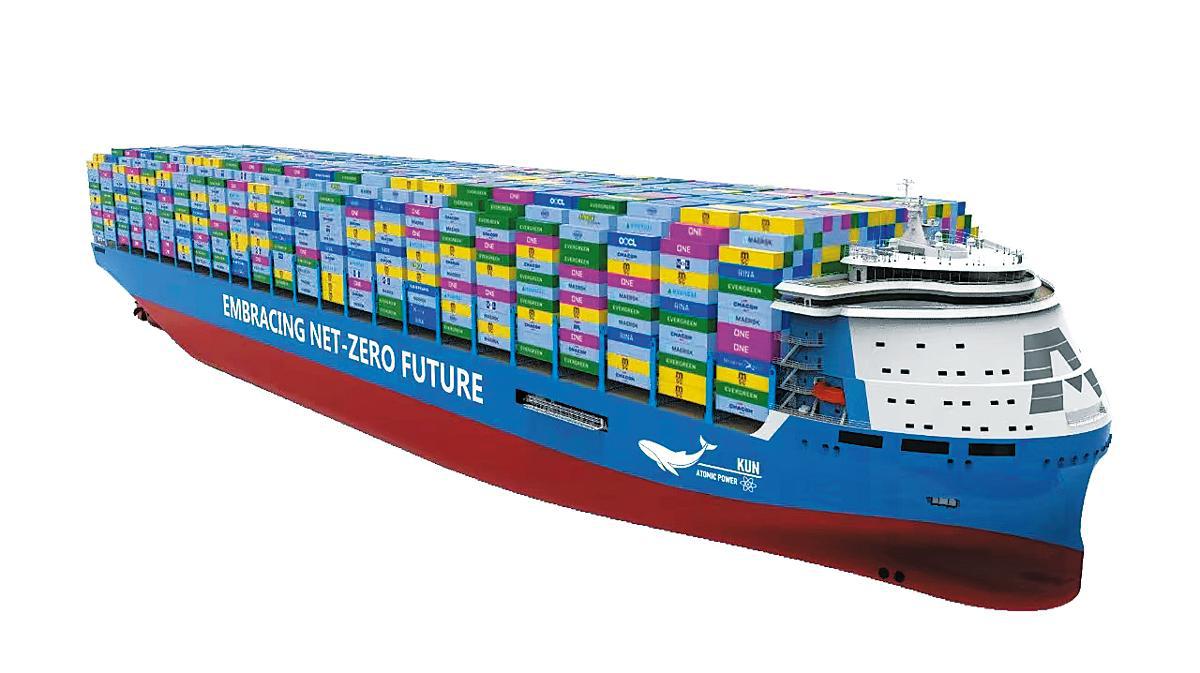
An illustration of the large nuclear-powered container ship, which can carry 24,000 standard containers. [Photo provided to China Daily]
China has unveiled a conceptual design for what could potentially become the world’s largest nuclear-powered container ship.
The vessel, which has yet to be named, will be powered by molten salt reactors and will have the capacity to carry 24,000 standard containers. In other words, it will be able to hold more than 1 billion boxes of Apple iPhones.
The conceptual design, made by China State Shipbuilding Corp’s Jiangnan Shipyard in Shanghai, was published on Tuesday, as the four-day Marintec China 2023 exhibition opened in the city.
The ship’s design earned an Approval in Principle certificate from the DNV, one of the world’s leading classification societies, at an unveiling ceremony.
A senior researcher at Jiangnan Shipyard, who asked to be identified only as Hu, told China Daily on Wednesday that the idea for a nuclear-powered container ship was the result of the shipyard’s endeavor to seek clean energy solutions for its products.
“Shipbuilders around the world have been under huge pressure from shipping businesses, investors and environmentalists to find cleaner fuel solutions. It is only natural for us to take nuclear power into consideration,” he said.
According to industry statistics, shipping operations account for about 3 percent of global greenhouse gas emissions. The International Maritime Organization has repeatedly pledged to reduce the emissions caused by shipping businesses.
II. An Answer to the Call of the Times and a Blueprint for the Future
III. Deep Roots in History and Cultural Traditions
IV. Direction and Path
V. China’s Action and Contribution
Conclusion
Preface
In the universe there is only one Earth, the shared home of humanity. Unfortunately, this planet on which we rely for our subsistence is facing immense and unprecedented crises, both known and unknown, both foreseeable and unforeseeable. Whether human civilization can survive these has become an existential issue that must be squarely faced. More and more people have come to the realization that rather than amassing material wealth, the most pressing task is to find a guiding beacon for the sustainable development of human civilization, because we all care about our future.
Ten years ago President Xi Jinping propounded the idea of building a global community of shared future, answering a question raised by the world, by history, and by the times: “Where is humanity headed?” His proposal lights the path forward as the world fumbles for solutions, and represents China’s contribution to global efforts to protect our shared home and create a better future of prosperity for all.
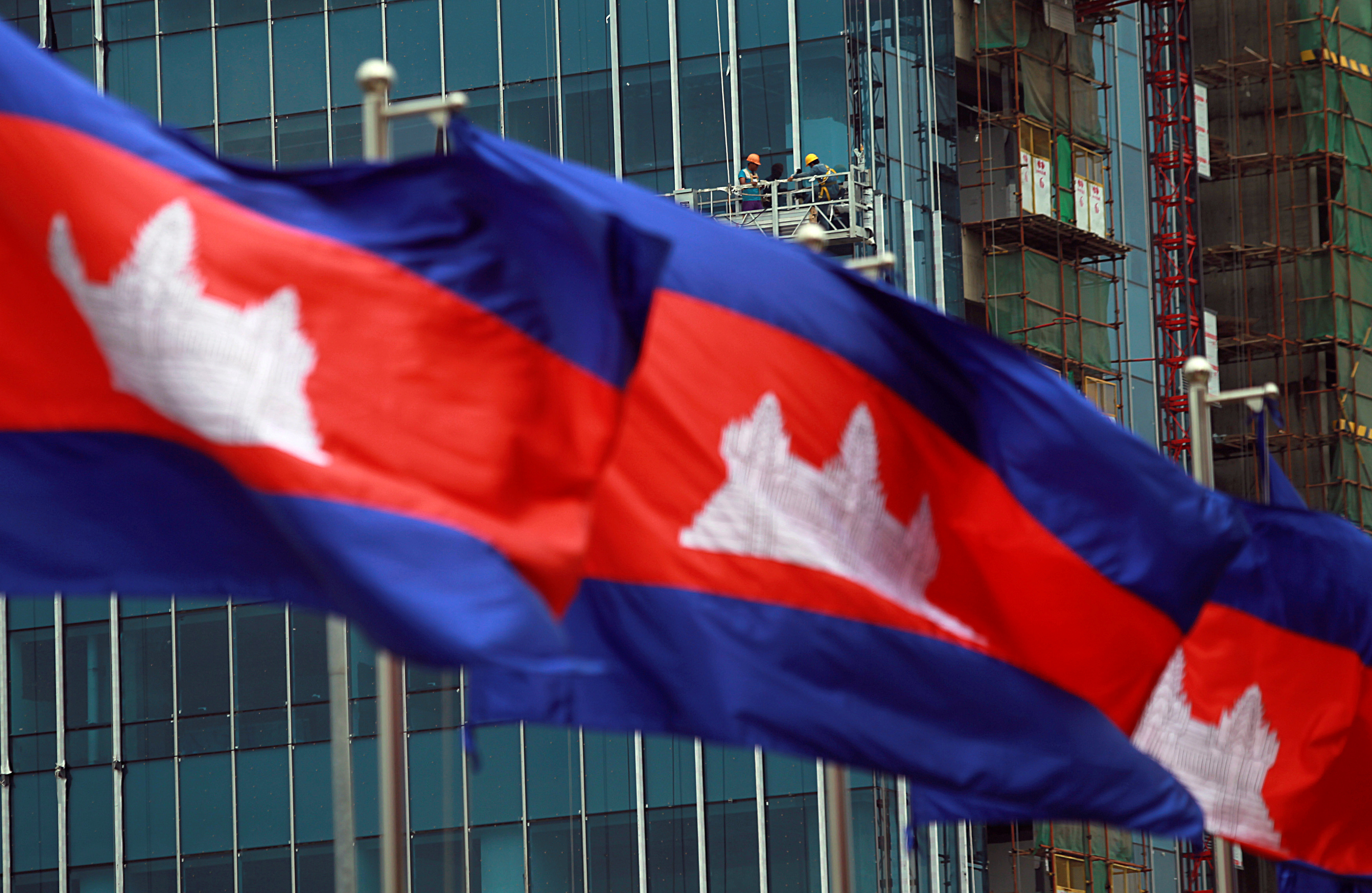
SINGAPORE, Nov 29 (Reuters) – Cambodia has abandoned plans to build a $1.5 billion 700 megawatt (MW) coal-fired power project in a protected reserve along the southwestern coast and will build an 800 MW natural-gas fired plant instead, its energy minister told Reuters.
As part of the project, Cambodia is exploring construction of a liquefied natural gas (LNG) terminal to import the super-chilled fuel and re-gasify it for use in the power plant, Energy Minister Keo Rottanak told Reuters.
The planned LNG terminal, likely to be a fixed land-based facility, would be Cambodia’s first and would make it a new import market in Southeast Asia. Vietnam and the Philippines took their first shipments this year.
“The Cambodian Prime Minister Hun Manet will announce on Nov. 30 the cancellation of the 700 MW coal power plant project in Koh Kong and the plan to replace it with an 800 MW LNG to be commissioned after 2030,” Rottanak told Reuters.
Scientists expected a surge in respiratory disease, but what is happening in China is unusual.
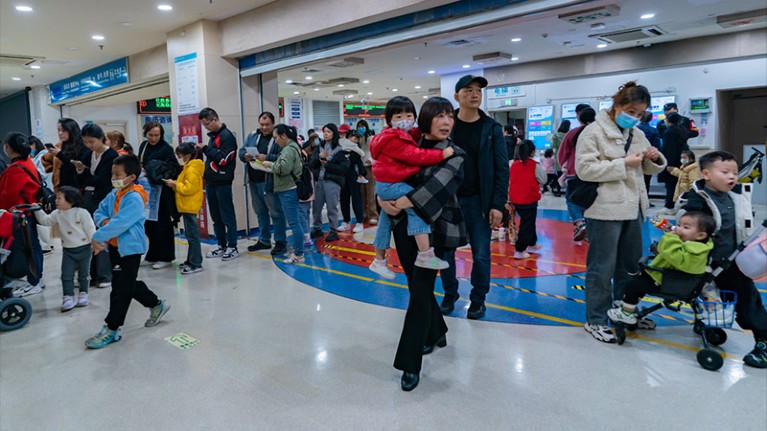
Parents wait for their children to be treated for respiratory disease in Chongqing, China.Credit: Costfoto/NurPhoto via Getty
China is grappling with a surge in respiratory illnesses, including pneumonia, in children. The World Health Organization (WHO) said last week that common winter infections — rather than any new pathogens — are behind the spike in hospitalizations. A surge of infections was expected in the country this winter, China’s first without COVID-19 restrictions since the pandemic began in 2020. What is unusual, say epidemiologists, is the high prevalence of pneumonia in China. When COVID-19 restrictions were eased in other countries, influenza and respiratory syncytial virus (RSV) drove most spikes in illness.
The WHO requested information, including laboratory results and data on recent trends in the spread of respiratory illnesses, from China’s health authorities last week. This followed reports from the media and the Program for Monitoring Emerging Diseases — a publicly available system run by the International Society for Infectious Diseases — about clusters of “undiagnosed pneumonia”.
In a 23 November statement, the WHO said that China’s health authorities have attributed the rise in hospitalizations since October to known pathogens, such as adenoviruses, influenza virus and RSV, which tends to cause only mild, cold-like symptoms. However, an increase in children being admitted to hospital since May, particularly in northern cities such as Beijing, is mainly due to Mycoplasma pneumoniae, a bacterium that infects the lungs. It is a common cause of ‘walking pneumonia’, a form of the disease that is usually relatively mild and doesn’t require bed rest or hospitalization, but that is hitting children hard this year.
Benjamin Cowling, an epidemiologist at the University of Hong Kong, is not surprised by the wave of illness. “This is a typical ‘winter surge’ in acute respiratory infections,” he says. “It is happening slightly earlier this year, perhaps because of increased population susceptibility to respiratory infections resulting from three years of COVID measures.”
(KTSG) – Tốc độ tăng giá nhà luôn gần như gấp đôi tốc độ tăng trưởng thu nhập bình quân đầu người của Trung Quốc trong vòng 20 năm qua, nó cũng tăng gấp tám lần mức độ tăng trưởng của đô thị hóa. Nhưng khi các chính sách siết chặt tài chính với tên gọi “ba lằn ranh đỏ” được công bố vào năm 2021, cộng với thời gian dài phong tỏa để thực hiện chính sách zero-Covid, các trục trặc đã xuất hiện. Rất nhanh chóng, phản ứng domino xảy ra giữa các công ty bất động sản và lan sang ngân hàng bóng mờ (shadow banking).
A delicious dish that’s more controversial in some months than others.Ray Kachatorian/Stone RF/Getty Images
Editor’s Note: Sign up for CNN’s Meanwhile in China newsletter, which explores what you need to know about the country’s rise and how it impacts the world.Hong Kong CNN —
Light, tasty and simple to make, egg fried rice has long been a beloved dish in China and one of most recognizable icons of Chinese cuisine around the world.
But in recent years, the popular stir-fry has become a highly sensitive subject for China’s online nationalists, especially around the months of October and November.
TTCT – Tham vọng tiến ra biển của Campuchia đã có người giúp, đó là Trung Quốc, với một dự án cực kỳ tham vọng.
Hôm 17-10, tại thủ đô Phnom Penh của Campuchia, Ủy ban liên bộ Campuchia do Phó thủ tướng Sun Chanthol đứng đầu đã ký kết thỏa thuận với đại diện Tổng công ty Cầu đường Trung Quốc (CRBC) về dự thảo khung xây dựng kênh đào nối ra biển Phù Nam Techo.
Thỏa thuận này sẽ cho phép CRBC tiến hành nghiên cứu chuyên sâu về tất cả các khía cạnh của dự án trong vòng 8 tháng. Dự án kênh đào Phù Nam Techo ước tính sẽ tiêu tốn khoảng 1,7 tỉ USD và mất 4 năm để hoàn thành.
Đây là dự án cơ sở hạ tầng lớn đầu tiên của Campuchia kết nối sông Mekong với đường biển, nhằm mở rộng tiềm năng vận tải biển của đất nước chùa tháp.
Cao tốc Phnom Penh – Sihanouvkville. Ảnh: Twitter
Trước đây, dự án này mang tên Hệ thống giao thông và hậu cần sông Bassac (BRNLS). Tại phiên họp toàn thể lần thứ 6 của Quốc hội Campuchia ngày 19-5-2023, dự án được đặt tên lại là “Kênh đào Phù Nam Techo”.
Đây cũng là tên chính thức của kênh đào đến nay. Ngày 7-6, thủ tướng sắp mãn nhiệm Hun Sen thành lập ủy ban liên bộ nghiên cứu và thực hiện dự án gồm 37 thành viên để xem xét và tư vấn về thủ tục, khung pháp lý và đánh giá hiệu quả kinh tế nhằm thúc đẩy sự phát triển của ngành vận tải đường thủy và đường biển của Campuchia.







 CVD
CVD 