VNY – Aug 26, 2016
Sau một loạt các hành động xích lại gần Trung Quốc của Campuchia, nhiều cư dân Việt đã đặt ra câu hỏi rằng có khi nào Campuchia sẽ giúp Trung Quốc đánh Việt Nam từ sau lưng hay không?
Conversations on Vietnam Development

VNY – Aug 26, 2016
Sau một loạt các hành động xích lại gần Trung Quốc của Campuchia, nhiều cư dân Việt đã đặt ra câu hỏi rằng có khi nào Campuchia sẽ giúp Trung Quốc đánh Việt Nam từ sau lưng hay không?
Thứ hai, 11 Tháng 4 2016 17:32
(LLCT) – Đông Nam Á là khu vực duy nhất để Trung Quốc thực hiện chiến lược ngoại giao của mình. Tuy nhiên, Đông Nam Á cũng có lợi thế kinh tế quan trọng đối với Mỹ và Nhật Bản, vì vậy khu vực này trở thành nơi cạnh tranh chiến lược giữa các nước lớn.

Tiếp tục đọc “Về quan hệ Trung Quốc – ASEAN từ sau chiến tranh lạnh đến nay”
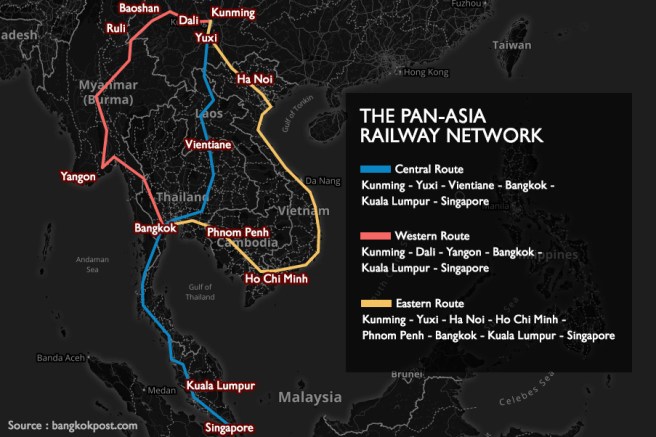
(GDVN) – Nhà ga đường sắt cao tốc từ điểm khởi đầu ở Côn Minh đã sắp hoàn thành thì phần đường sắt chạy qua lãnh thổ Lào đến nay vẫn chưa có…
Tiếp tục đọc “Ý tưởng “Một vành đai, một con đường” tắc ngay ở Đông Nam Á”

“Nếu Trung Quốc định hình một mạng lưới cơ sở hạ tầng từ Vân Nam qua Lào, Campuchia rồi xuống Thái Lan, Malaysia, Singapore thì mạng lưới cơ sở hạ tầng mà Việt Nam đang đầu tư theo trục Bắc – Nam có thể sẽ mất đi ưu thế hiện thời khi không có kết nối theo hướng Đông – Tây. Bên cạnh đó, các khoản đầu tư lớn của Trung Quốc vào cảng biển của Campuchia và Thái Lan có thể làm các cảng biển quan trọng của Việt Nam mất đi lợi thế trong tương lai.” Tiếp tục đọc “Việt Nam mất lợi thế khi Trung Quốc đầu tư vào cảng biển Campuchia?”
HCC-WTO – ngày Thứ năm, 11 Tháng 8 2016 07:34

ASEAN đang ở ngã ba đường. Khi 2 gã khổng lồ là Trung Quốc và Ấn Độ đang thống trị trong các cuộc tranh luận về thế kỷ của châu Á, đôi khi Hiệp hội các quốc gia Đông Nam Á – ASEAN có thể bị bỏ qua. Nhưng điều này là không đúng. Tiếp tục đọc “Tại sao ASEAN là quan trọng?”
VNY – Aug 6, 2016
Trả lời bình luận của một cư dân mạng Việt Nam, Thủ tướng Hun Sen đã viết trên fanpage facebook của ông rằng Việt Nam không phải ông chủ của tôi thì sao có thể đòi hỏi tôi trung thành được?
VE – Ảnh hưởng kinh tế lớn của Trung Quốc tại Lào đặt ra câu hỏi về và tác động đến vấn đề Biển Đông, khi Lào là chủ tịch ASEAN năm nay.

Tiếp tục đọc “Dấu chân Trung Quốc tại Lào gây nghi ngại về vấn đề Biển Đông”
VNY – Aug 5, 2016
Bắt đầu từ những ngày đầu tháng 8, có vẻ các bên liên quan ở Biển Đông mà trước hết là Trung Quốc đã đi những nước cờ đầu tiên ở Biển Đông trong ván cờ hậu phán quyết của PCA.
 Dự kiến ngày 7-7 tới đây, Tòa Trọng tài Thường trực sẽ ra phán quyết vụ Philippines kiện TQ và việc TQ nếu có rút khỏi UNCLOS cũng không tránh được các hệ quả pháp lý của phán quyết này. Ảnh: Internet
Tiếp tục đọc “Ra khỏi UNCLOS: Thế giới sẽ quay lưng với Trung Quốc”
VNY – Jun 17, 2016
Bản tuyên bố chung của ASEAN đã được các ngoại trưởng thông qua trước khi hội nghị diễn ra và dự kiến sẽ công bố trong cuộc họp báo sau hội nghị. Tuy nhiên vào phút chót hai nước là Lào và Campuchia đã đổi ý khiến ASEAN không ra được tuyên bố chung.
VNY – Jun 16, 2016
Việc ASEAN rút lại tuyên bố chung về Biển Đông tại hội nghị Côn Minh hôm 14/6 thể hiện khối ASEAN chưa tìm kiếm được tiếng nói chung về vấn đề này. Tuy nhiên khác với năm 2012 khi hội nghị thượng đỉnh ở Campuchia không ra được tuyên bố chung, lần này tuy tuyên bố chung không được công bố nhưng các nước đã thảo sẵn một tuyên bố và cho phép các nước có quyền ra tuyên bố riêng sau hội nghị nếu muốn. Đặc biệt việc Malaysia cung cấp nội dung tuyên bố cho thông tấn quốc tế rồi sau đó Ban thư ký ASEAN thu hồi đã khiến câu chuyện trở thành tâm điểm truyền thông.

by Chris Flynn
We have just passed through a major pivot of history. As is often the case, even when we know great changes are coming, we don’t always see them until we’re on the other side. While we still have a way to go, the axis of this particular pivot is now just behind us. Tiếp tục đọc “The rules of the Great Game with China are just about to change”
lowyinterpreter – Thailand has a long tradition of balancing its relations with major powers and, since the 2014 coup, it has been shifting towards China. However, with the two countries now involved in a complicated collaboration on high speed rail, the Thai public has started to question whether China is truly its best ally. Indeed, once one looks beyond perceptions and emotions and examines the detail of the Thailand-China relations, the best friend status is puzzling.

Thailand and China drew closer back in the late 1970s when Bangkok needed Beijing’s military and strategic support to cope with an expansionist Vietnam. The friendship strengthened when China withdrew its support of the communist movement in Thailand, removing red threats from within and outside of the country. Cordial relations strengthened further in the last decade. Then, when other friends — like the US, UK, Australia and Japan — condemned the 2014 coup, China stated that Thailand should resolve its domestic conflicts peacefully. This reaction was welcomed by many Thais who supported the overthrow of the Shinawatra government, even by unconstitutional means.
Tiếp tục đọc “The curious case of Thai-Chinese relations: Best friends forever?”
In response to a request from Vietnam, China is discharging water from a dam in Yunnan.

thediplomat_ China has promised to discharge water from a dam along the Lancang River (better known as the Mekong) to help alleviate drought conditions in Southeast Asia. Foreign Ministry spokesperson Lu Kang announced Tuesday in a regular press conference that China will release water from the Jinghong hydropower station in Yunnan province from March 15 to April 10, to provide water “for emergency use” by countries downstream.
“People living along the Lancang-Mekong River are nourished by the same river,” Lu noted. “It goes without saying that friends should help each other when help is needed.”
Yet the question of dams on the Mekong has not been as friendly as Lu makes it seem. As The Diplomat’s Luke Hunt noted last week, Thailand, Vietnam, Laos, and Cambodia have been squabbling over dam construction and water usage, particularly as a severe drought threatens rice crop yields across the Indochina Peninsula.
China is also a part of that conversation – a major part, as the Mekong (called the Lancang in China) originates on the Tibetan plateau and flows through the provinces of Qinghai, Tibet, and Yunnan before ever reaching Southeast Asia. China opened its first large dam on the Lancang, the Manwan in Yunnan, in 1994, and added the Dachaoshan dam in 2003. In recent years, hydropower construction has revved into high gear, with China completing four additional dams since 2009 — and plans for another seven in the works. Tiếp tục đọc “Facing Mekong Drought, China to Release Water From Yunnan Dam”
Simon Long
Mon Nov 02 2015
http://cms-worldin.economist.com/sites/default/files/styles/1190x560l/public/Asia-Trying-not-to-choose-3570×1680.jpg?itok=7M4J9Efm
ASIA
East Asia is the scene for an unprecedented experiment in international relations. Never before have so many countries been so intertwined economically with one big power (China) while looking to another (America) as the ultimate guarantor of their security. So far the experiment has seemed a stunning success. For 40 years, America has not just kept the peace; it has enabled a continental economic boom. And the biggest beneficiary of that has been China. Yet that order is now fraying, as China chafes under what it sees as an American-led world order that is impeding its rise and its natural regional predominance. In 2016 the tensions that this fraying produces may become acute, posing awkward questions for other countries in Asia.
When Xi Jinping, China’s president, paid his first state visit to America in September 2015, the two countries were already at odds on a number of issues: the perennial bugbears such as China’s human-rights record and repression in Tibet and Xinjiang; and new concerns over cyber-security and the militarisation of space. The visit was marked, as always, by an effort to stress areas of co-operation, for example on climate change; but the two big powers are now rivals in a growing number of spheres. Asia is where the rivalry is most intense. It will become more so in 2016 for three main reasons.
Tiếp tục đọc “Trying not to choose: A region pulled between China and America”
 CVD
CVD 
