Hiệp định về biển cả là văn kiện đầu tiên điều chỉnh toàn diện việc khai thác, chia sẻ lợi ích và bảo tồn nguồn gen biển tại các vùng biển quốc tế. Việt Nam là một trong những nước đầu tiên ký hiệp định trong khuôn khổ Tuần lễ cấp cao Đại hội đồng LHQ.
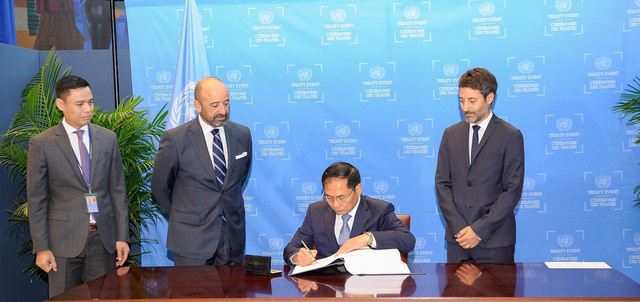
Bộ trưởng Bộ Ngoại giao Bùi Thanh Sơn ký Hiệp định về bảo tồn và sử dụng bền vững đa dạng sinh học ở vùng biển nằm ngoài quyền tài phán quốc gia – Ảnh: VGP
Sáng 20-9 (giờ New York, Mỹ), trong khuôn khổ hoạt động của Tuần lễ cấp cao Đại hội đồng Liên Hiệp Quốc khóa 78, Bộ trưởng Bộ Ngoại giao Bùi Thanh Sơn đã ký Hiệp định về bảo tồn và sử dụng bền vững đa dạng sinh học ở vùng biển nằm ngoài quyền tài phán quốc gia (Hiệp định về biển cả).
Minister of Foreign Affairs Bui Thanh Son signs the High Sea Treaty, a United Nations agreement on the conservation and sustainable use of marine biological diversity of areas beyond national jurisdiction. Photo by Thu HongVietnam on Wednesday signed the United Nations agreement on the conservation and sustainable use of marine biological diversity of areas beyond national jurisdiction, the High Sea Treaty.
The signing by Minister of Foreign Affairs Bui Thanh Son made Vietnam one of the first countries to sign the international-legally binding instrument under the 1982 United Nations Convention on the Law of the Sea (UNCLOS). It conveyed the message that Vietnam is a positive and responsible member of the international community as well as the country’s efforts to join hands with countries to deal with global issues, contributing to peace, prosperity and sustainable development.
More than 60 countries are scheduled to sign the agreement during the underway high-level week of the 78th UN General Assembly.
This PacNet was developed as a part of the United States-Japan-Republic of Korea Trilateral Next-Generation Leaders Dialogue to encourage creative thinking about how this vital partnership can be fostered. For previous entries please click here and here.
The AUKUS security agreement, cemented between Australia, the United States, and the United Kingdom in September 2021, enhances regional partnership in the Indo-Pacific by facilitating technology sharing, strengthened supply chains, and the acquisition of nuclear powered, conventionally armed submarines for Australia. The pact also creates a pathway to establish engagements focused on renewing, strengthening, and expanding military cooperation between AUKUS, South Korea, and Japan.
Hunter Marston is an Adjunct Research Fellow at La Trobe Asia with La Trobe University, Melbourne, a PhD candidate in International Relations at Australian National University in the Coral Bell School of Asia-Pacific Affairs, and an Associate with 9DashLine. He was previously a 2021 nonresident WSD-Handa Fellow at the Pacific Forum in Honolulu and the recipient of a Robert J. Myers Fellows Fund from the Carnegie Council for Ethics in International Affairs. From 2015-2019, he was a Senior Research Assistant for the Center for East Asia Policy Studies and The India Project at the Brookings Institution. He also worked in the Center for Strategic & International Studies’ (CSIS) Southeast Asia program. He completed his Masters in Southeast Asia Studies and Masters in Public Administration at the University of Washington in 2013. In 2012 Hunter was a Harold Rosenthal Fellow in International Relations in the U.S. Embassy in Myanmar. He is the co-host of the Undiplomatic Podcast on international affairs and writes regularly on Southeast Asian politics and U.S. foreign policy. His work has appeared in Contemporary Southeast Asia, the New York Times, Foreign Affairs, Foreign Policy, and the Washington Post.
Dr. Bich Tran is a postdoctoral fellow at the Lee Kuan Yew School of Public Policy, National University of Singapore. In addition to being an adjunct fellow at the Center for Strategic and International Studies (CSIS) in Washington DC, she has been a visiting fellow at the East West Center, International Institute for Strategic Studies (IISS-Asia), and ISEAS-Yusof Ishak Institute among others. Dr. Tran obtained her PhD in Political Science from the University of Antwerp in Belgium. Her research interests include Vietnam’s grand strategy, Southeast Asian states’ relations with major powers, and political leadership. She has published on various platforms, including Asia Pacific Issues, Asian Perspective, Asian Politics & Policy, The Diplomat, East Asia Forum, and Fulcrum. Dr. Tran is the author of “Vietnam’s Strategic Adjustments and US Policy” (Survival 64, no. 6, 77–90)
Elina Noor is a senior fellow in the Asia Program at Carnegie where she focuses on developments in Southeast Asia, particularly the impact and implications of technology in reshaping power dynamics, governance, and nation-building in the region. Previously, Elina was director of political-security affairs and deputy director of the Washington, D.C. office at the Asia Society Policy Institute. Prior to that, Elina was an associate professor at the Daniel K. Inouye Asia-Pacific Center for Security Studies in Honolulu. She spent most of her career at the Institute of Strategic and International Studies Malaysia, where she last held the position of director, foreign policy and security studies. Elina was also formerly with the Brookings Institution’s Project on U.S. Relations with the Islamic World. Between 2017 and 2019, Elina was a member of the Global Commission on the Stability of Cyberspace. She currently serves on the ICRC’s Global Advisory Board on digital threats during conflict.
Javad Heydarian is a Senior Lecturer at the University of the Philippines, Asian Center, a columnist at the Philippine Daily Inquirer, and a Television Host at TV5 Network. He has written for the world’s leading publications, including The New York Times, Washington Post, The Guardian, and Foreign Affairs. He is the author of, among others, “Asia’s New Battlefield” (Zed, 2015), The Rise of Duterte: A Populist Revolt against Elite Democracy” (Palgrave Macmillan, 2017) and “The Indo-Pacific: Trump, China, and the New Global Struggle for Mastery” (Palgrave Macmillan, 2019). He is also a regular contributor to leading global think tanks such as Center for Strategic and International Studies (CSIS), Brooking Institution, and Council on Foreign Relations (CFR). His forthcoming book is “China’s New Empire” (Melbourne University Press)
INTRODUCTION
Sailors have an expression, “fair winds and following seas,” to describe the favourable conditions which they desire when setting out to sea. Much like these seafarers, Southeast Asian maritime nations seek stable and peaceful waters for their security and prosperity. The South China Sea has long vexed regional policymakers and security strategists due to both the number and complexity of overlapping maritime territorial claims among regional actors, including Brunei, China, Malaysia, the Philippines, Taiwan and Vietnam.
In the past two decades, China’s increasingly expansionist tendencies and willingness to use force to coerce or intimidate smaller claimants has reinforced growing threat perceptions vis-à-vis Beijing and fuelled hedging strategies. In February 2023, a Chinese Coast Guard (CCG) vessel targeted Filipino counterparts with a military-grade laser in the Spratly Islands.1 The following month, a CCG vessel caused a dangerous encounter with Vietnamese patrol boats during a patrol of Vietnamese oil and gas fields around Vanguard Bank. Around this time, a CCG vessel was also seen operating in close proximity to Malaysia’s Kasawari gas project near Luconia Shoals, prompting the Malaysian Navy to dispatch a Keris-class littoral ship to the area.
As a result of Chinese intimidation, Southeast Asian states have begun to prioritise maritime security as a central component of national defence and security strategies. While power asymmetry between regional states and China makes a concerted pushback against Chinese coercion unpalatable, arguably no state has mounted a consistent or coherent response to deal with this security challenge. Rather, Southeast Asian countries have adopted an array of hedging tactics to deepen engagement with China while bolstering their own domestic defence capabilities and simultaneously expanding security cooperation with a variety of external partners, including Australia, Japan, and Korea.
Hedging refers to insurance-seeking behaviour meant to signal ambiguity in a state’s alignment while cultivating fall-back options to preserve maximum autonomy. Few existing studies of hedging have considered the central role that maritime security plays in regional countries’ foreign policies. This paper therefore clarifies the maritime security strategies of three Southeast Asian claimant states (Malaysia, the Philippines, and Vietnam) to assess how such strategies map onto or deviate from existing notions of hedging. In each of the case studies below, maritime security strategy is reflective of a state’s broader hedging strategy and mirrors the same fundamental tensions: power asymmetry, geographic proximity to a security threat, lack of political consensus, and profound strategic uncertainty, namely fears of abandonment or entrapment in a great power conflict. Seen in this light, maritime security strategy is a manifestation of states’ deeply ingrained preferences for ambiguity and unwillingness to choose sides in brewing superpower competition.
The paper concludes with a brief summary assessing the parallels between the three case studies and what they tell us about hedging and maritime security strategy
This post explains how the AIS vessel tracking system works and how bad actors abuse the system.
Miao Shou, Gaute Friis | AUGUST 21, 2023
Miao Shou
Analyst
Gaute Friis
Analyst
Tracking vessels’ Automatic Information System (AIS) signals is a core means SeaLight and other open-source intelligence collectors use to monitor maritime activity. AIS is a broadcast system that maritime authorities use to identify a vessel’s unique identification number, type, position, course, speed and navigation status.
The International Maritime Organization (IMO) mandates the use of AIS to ensure maritime safety and direct marine traffic more efficiently. According to the International Maritime Organization’s International Convention for the Safety of Life at Sea (SOLAS) Regulation V/19.2.4, all vessels over 300 gross tons (or 500 tons for those not on international voyages) and passenger ships of any size are required to “carry automatic identification systems capable of providing information about the ship to other ships and to coastal authorities.”
“Going dark” refers to the gray zone tactic of strategically turning off a vessel’s Automatic Information System (AIS) transponder to avoid detection.
Miao Shou | AUGUST 17, 2023
Vessels operating without AIS inside a country’s Exclusive Economic Zone (EEZ). (Credits: Unseenlabs)
Miao Shou
Analyst
“Going dark” refers to the gray zone tactic of turning off a vessel’s Automatic Information System (AIS) transponder to avoid detection. AIS is a signaling system used to identify a vessel’s type, position, course, speed and other navigation safety information, and is required by the International Maritime Organization for larger non-military ships operating in international waters. Read our primer on the AIS system here.
Going Dark in the Recent Water Cannon Incident
In a recent incident that involved the blockade and water-cannoning of a small Philippine resupply vessel and its escorts, six of the blockading ships were from the China Coast Guard. Of these, only one ship (CCG 5402) remained AIS-visible during the entire engagement, while two other ships (CCG 4203 and CCG 3302) broadcast AIS only intermittently.
This tactic consists of blasting another ship with a powerful stream of water using a high-pressure water cannon.
Gaute Friis | AUGUST 7, 2023
CCG 31101 blasts a VCG vessel with water cannon, May 5, 2014. (Source: VCG)
Gaute Friis
Analyst
As of this writing, the Philippines has just produced evidence that its coast guard and resupply vessels were subjected to assault by water cannons from China Coast Guard ships on 5 August 2023. This occurred during the regular rotation and resupply mission to the Philippine Navy’s outpost aboard the grounded BRP Sierra Madre at Second Thomas (Ayungin) Shoal, and is reminiscent of a similar incident in November 2021.
While China’s use of maritime gray zone tactics is well known, few resources describe the actual tactics in detail. We’ve developed a publicly available systematic examination of these concrete tactics, which we will roll out for you in the coming weeks.
Spoofing is the act of deceptively and deliberately falsifying a vessel’s AIS identifying information or location.
Gaute Friis | SEPTEMBER 3, 2023
A China Coast Guard (CCG) cutter transmits fraudulent AIS signals to nearby vessels, appearing as a fishing boat on their monitoring equipment (Credit: Gaille Powell).
Gaute Friis
Analyst
Spoofing is a deception tactic meant to disrupt monitoring of maritime activities. It is frequently employed by Chinese gray zone actors in the South China Sea. In contrast to the “going dark” tactic of simply disabling a vessel’s Automatic Information System (AIS) broadcast, the spoofing tactic involves manipulating transmitting signals in order to falsify a vessel’s identity and/or location.
Cable-cutting is a sabotage and harassment tactic in which a ship will attempt to sever the cable to another ship’s trailing equipment, such as trawler lines or towed array sonars.
Gaute Friis | JULY 26, 2023
Chinese fisherman using a boat hook pole in an attempt to snag the cable connecting U.S ocean surveillance ship USNS Impeccable’s towed sonar array, March 8, 2009. (Source: USN)
Gaute Friis, analyst
This tactic is an act of sabotage which aim to cut the cables to a ship’s trailing equipment, such as trawler lines or towed array sonars.
Cable-cutting is most frequently used against commercial research vessels conducting survey operations in disputed maritime zones, such as within China’s huge “nine-dash line” claim in the South China Sea.
Dazzlers are non-lethal laser weapons meant to cause temporary blindness in humans or confound sensors. Recently employed against the Philippine Coast Guard, laser dazzlers have also been employed against U.S. and Australian military helicopters and surveillance planes operating in the region.
Gaute Friis | SEPTEMBER 12, 2023
CCG 5205 firing laser at Philippine Coast Guard cutter BRP Malapascua, February 6, 2023 (Source: Philippine Coast Guard)
Gaute Friis Analyst
Dazzlers are an emerging category of non-lethal but potentially dangerous weapons and a relatively recent addition to China’s gray zone arsenal. They can be used as a harassment tool; for destroying sensitive electro-optical sensors as an electronic warfare component; or as a weapon of psychological warfare.
Dazzlers are not themselves considered illegal. The U.S. military — which refers to them as “non-lethal optical distractors” — considers them an essential capability to “minimize fatalities, protect the innocent and limit collateral damage” when the alternative is lethal force, with the caveat that:
“Prior to fielding, all previously and currently fielded lasers or distracter devices have undergone legal reviews to ensure compliance with obligations assumed by the U.S. under applicable treaties, customary international law, and the law of armed conflict.”
China has used dazzlers to temporarily blind the crew of other countries’ ships. Because dazzlers have both physical and psychological effects their use against vessels at sea is hazardous, eroding their crews’ ability to navigate and react to maritime contingencies.
As detailed in our “going dark” playbook entry, a Chinese Coast Guard cutter used a dazzler to harass a Philippine resupply escort mission on February 6th, 2023.
The Philippine Coast Guard later clarified that was the second time this had occurred during a resupply mission.
Note: Any use of lasers to permanently blind personnel is illegal under Protocol IV (Blinding Laser Weapons) under the Convention on Certain Conventional Weapons, which China joined in 1998.
The latest “standard map” released by China on August 28, 2023, has sparked a rare display of unity among its neighbours against the expanded territorial claims by Beijing. Japan joined a list of countries, which also include India, Malaysia, the Philippines and Vietnam, that have lodged protests against territorial claims by China in disputed areas in the region. The release of the new map came ahead of the attendance of Chinese Premier Li Qiang at two key summits: Asean and the Group of 20.
An armada of poorly regulated, scrapyard-ready tankers is hauling sanctioned oil through the region’s bustling shipping lanes. With that, they’re carrying an ever-present threat of environmental catastrophe
Smoke rises from the oil tanker Pablo after it suffered from multiple explosions on 1 May off the coast of Malaysia. The ship was registered to Gabon and was part of the so-called “ghost fleet” of little-regulated tankers. Photo courtesy of the Malaysian coast guard.
On the morning of 3 May, residents of Batam, Indonesia, the largest city of the country’s Riau Islands, woke up to beaches black with oil.
The South China Sea is a crucial waterway in Asia – and a source of regional tensions. Without a code of conduct, Filipinos living in or near disputed waters say they are being impacted by overlapping territorial claims.
Near Scarborough Shoal, fishermen are struggling to eke out a living, as they cannot easily enter some fishing grounds. A tour to the Spratly Islands shows how tensions are playing out, with radio challenges and the constant presence of vessels from some claimant states.
Thitu Island, also known as Pagasa – meaning “hope” – is a crucial outpost for the Philippines in the Spratlys. But infrastructure is limited; and while there are plans to ramp up the building of facilities, this also means pressure on the marine ecosystem, in a region where conflicting claims risk overshadowing the need for marine conservation. CNA Correspondent travels to the contested waters of the South China Sea to find out how the dispute is affecting the Philippines and its people
0:00 Introduction 0:48 Fishing challenges in Scarborough Shoal 6:58 Tourism in trouble at Spratly Islands? 15:25 Limited infrastructure on remote outpost 18:52 Amid conflicting claims, hope for marine protection?





 CVD
CVD 