Tracking China’s Control of Overseas Ports

cfr.org

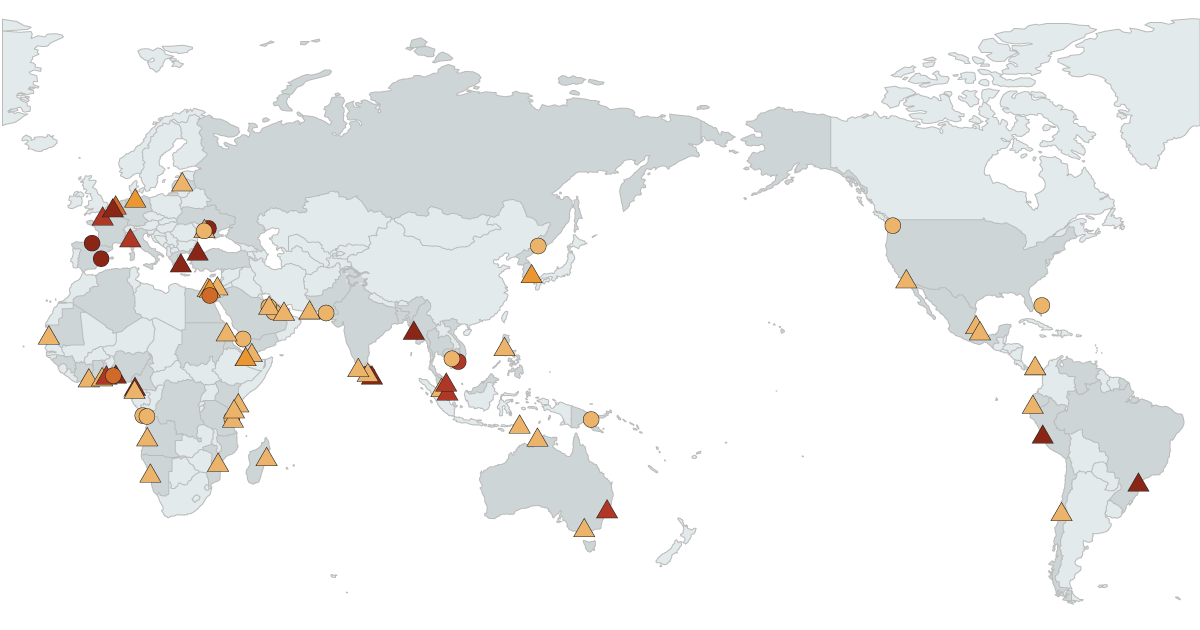
This interactive map tracks China’s growing maritime influence through investments in strategic overseas ports. Users can plot the location of each port and view satellite images alongside detailed information on the share of Chinese ownership, the total amount of Chinese investment, and the port’s suitability for use by the Chinese military.

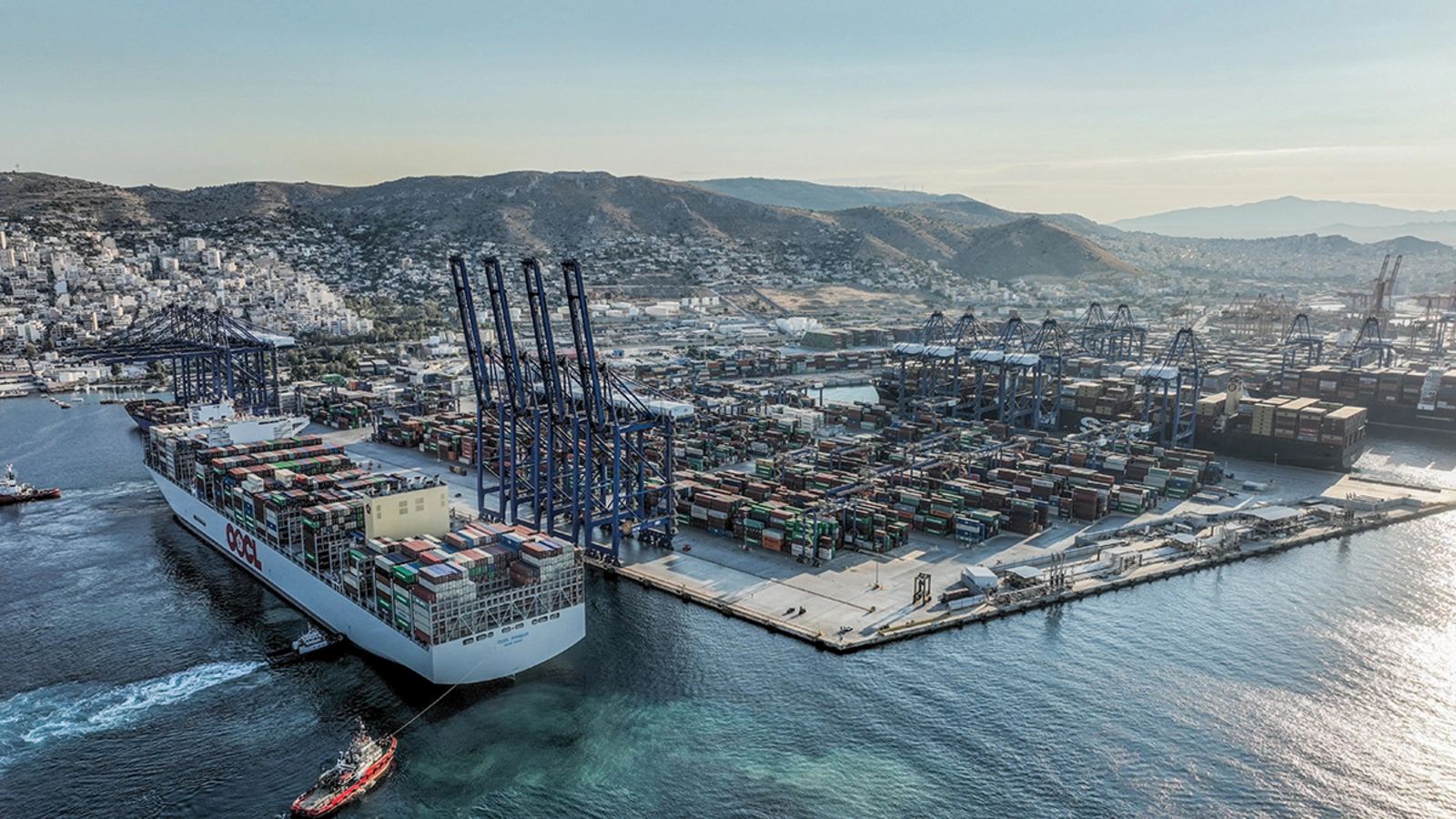
The new container ship, OOCL Piraeus, docks at the Port of Piraeus in Greece in 2023.

The new container ship, OOCL Piraeus, docks at the Port of Piraeus in Greece in 2023. Xinhua via Getty Images

The China Overseas Ports interactive visualizes degrees of China’s overseas port ownership by types of investment across regions and time. It also evaluates the dual-use (commercial and military) potential of ports owned, constructed, or operated by Chinese entities. The database supporting this interactive includes 101 port projects of which Chinese entities have acquired varied equity ownership or operational stakes. China operates or has ownership in at least one port in every continent except Antarctica. Of the 101 projects, 92 are active, whereas the remaining 9 port projects have become inactive due to cancellation or suspension by the end of September 2023. Reasons for cancellation or suspension include environmental concerns, souring of political relations, financial problems, and security issues raised domestically and internationally. Suspended projects, such as China’s construction of the Khalifa Port in the United Arab Emirates, could resume construction.

92 Port projects total (port projects outside China with Chinese investment)

13 Port projects with majority Chinese ownership

10 Port projects with majority Chinese ownership where there is physical potential for naval use

Excludes cancelled port projectsChineseownership0–12.5%12.5–25%25–37.5%37.5–50%Over 50%The share of the port project that is owned by the Chinese government or Chinese companiesPhysicalpotential for naval useWhether the port project is located at a port that includes berths with enough depth for a naval vesselYesNoData is as of September 2023.

Icon Description

Tiếp tục đọc “Tracking China’s Control of Overseas Ports”

Maritime Heist

China’s predatory fishing fleets are denuding fish stocks and marine ecosystems on an unprecedented industrial scale. International collective action is urgently needed.

Kevin Edes | NOVEMBER 14, 2023

Maritime Heist

Kevin Edes

Maritime Security Analyst Sealight

The desecration of maritime habitats and life-sustaining coral reefs is a clear and present threat at the hands of China’s massive fishing fleet. The maritime equivalent to poisoning a sovereign nation’s local farms, this threat has already had multi-generational impacts to the economy, climate and food supplies. Collaborative and bold solutions are imperative.

Admiral Linda Fagan, Commandant of the U.S. Coast Guard, identified China as one of the prime culprits in illegal, unregulated and unreported fishing, committing “theft of a nation’s natural resources.” Chinese fishing vessels steal coral for jewelry, giant clams for the ivory industry, and fish stocks to feed its own population. This is theft on a grand scale, unrestricted warfare on natural resources. The pilfering is happening across Asia, throughout the Pacific as far west as the Galapagos Islands, and off the West African coast, even within exclusive economic zones (EEZ) to which countries have a sovereign right to all natural resources.

Do not clam up on this issue just because it is only coral, clams and fish. Coral and giant clams are the life source of the ocean, easing the impacts of climate change, providing a protective breeding ground for fish, and serving as water filters. Giant clams increase the biodiversity of the coral which supports vital fisheries in the South China Sea. These fisheries account for 12% of the world’s catch and 28% of the protein to sustain human life in the region. The ongoing destruction at the hands of Chinese fishermen guarantees a loss of environmental and food security for future generations across the region.

Tiếp tục đọc “Maritime Heist”

When titans clash 2 (3 parts)

US-China: Is A New NATO Emerging In Asia? | When Titans Clash 2 – Part 1/3 | CNA Documentary

CNA Insider – 29-4-2022

As the Ukraine crisis unfolds, China accuses the US of creating an Indo-Pacific version of NATO, and warns of a “Ukraine style tragedy” for Asia. On the other hand, countries like Japan, Philippines, India, Australia and South Korea, seek closer ties to the US as concerns emerge over China’s actions. Could Asia witness a war in the years ahead? Tiếp tục đọc “When titans clash 2 (3 parts)”

Preparing for Dangerous Storms – 3 Parts

Inside China’s People’s Liberation Army | Preparing For Dangerous Storms – Part 1 | CNA Documentary


CNA Insider
6-5-2023

China’s People’s Liberation Army celebrates its centenary in 2027, what are its goals for this date? The PLA is already the largest army in the world with over 2 million soldiers. It also has the biggest number of warships. But China’s defense budget is still climbing amidst increasing geopolitical tensions. How exactly is the PLA “preparing for Dangerous Storms” as tasked by President Xi?

Tiếp tục đọc “Preparing for Dangerous Storms – 3 Parts”

Philippines welcomes more US troops at home: Will it be worth it?

Philippines Welcomes More US Troops At Home: Will It Be Worth It? | Insight | Full Episode

FROM THE COC TO A CODE OF CONDUCT FOR MARITIME ENGAGEMENTS IN SOUTHEAST ASIA

BY VU HAI DANG | SEPTEMBER 25, 2023
AMTI UPDATE

At the 56th ASEAN Ministerial Meeting and its related meetings in Jakarta in July, it was announced that negotiations for the Code of Conduct of Parties in the South China Sea (COC) had achieved progress on two fronts. First, the second reading of the Single Draft COC Negotiating Text was completed. Second, a set of Guidelines for Accelerating the Early Conclusion of an Effective and Substantive Code of Conduct in the South China Sea was adopted at the Post Ministerial Conference 10+1 Meeting with China. As a matter of fact, these developments are rather more procedural (and perhaps political) than substantive.

Tiếp tục đọc “FROM THE COC TO A CODE OF CONDUCT FOR MARITIME ENGAGEMENTS IN SOUTHEAST ASIA”

Anatomy of China’s Maritime Strategy: Threatening the Maritime Order Through Its National Legislation and Self-Centered Interpretation of UNCLOS

International Naval & Maritime News, @NavalNews

Anatomy of China’s Maritime Strategy: Threatening the Maritime Order Through Its National Legislation and Self-Centered Interpretation of UNCLOS

U.S. Naval War College, 2023

DOWNLOAD FULL REPORT HERE:

https://digital-commons.usnwc.edu/cgi/viewcontent.cgi?article=3048&context=ils…

Image

Việt Nam ký hiệp định mang tính lịch sử về biển cả

tuoitre.vn

Hiệp định về biển cả là văn kiện đầu tiên điều chỉnh toàn diện việc khai thác, chia sẻ lợi ích và bảo tồn nguồn gen biển tại các vùng biển quốc tế. Việt Nam là một trong những nước đầu tiên ký hiệp định trong khuôn khổ Tuần lễ cấp cao Đại hội đồng LHQ.

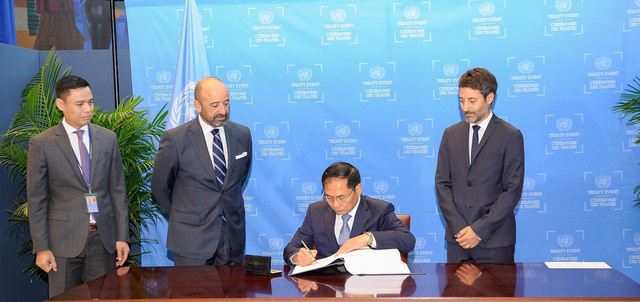
Bộ trưởng Bộ Ngoại giao Bùi Thanh Sơn ký Hiệp định về bảo tồn và sử dụng bền vững đa dạng sinh học ở vùng biển nằm ngoài quyền tài phán quốc gia - Ảnh: VGP
Bộ trưởng Bộ Ngoại giao Bùi Thanh Sơn ký Hiệp định về bảo tồn và sử dụng bền vững đa dạng sinh học ở vùng biển nằm ngoài quyền tài phán quốc gia – Ảnh: VGP

Sáng 20-9 (giờ New York, Mỹ), trong khuôn khổ hoạt động của Tuần lễ cấp cao Đại hội đồng Liên Hiệp Quốc khóa 78, Bộ trưởng Bộ Ngoại giao Bùi Thanh Sơn đã ký Hiệp định về bảo tồn và sử dụng bền vững đa dạng sinh học ở vùng biển nằm ngoài quyền tài phán quốc gia (Hiệp định về biển cả).

Hiệp định về biển cả là gì?

Tiếp tục đọc “Việt Nam ký hiệp định mang tính lịch sử về biển cả”

Vietnam becomes one of first nations to sign High Sea Treaty

vnexpress.net By VNA   September 21, 2023 | 12:03 pm GMT+7

Vietnam becomes one of first nations to sign High Sea Treaty

Minister of Foreign Affairs Bui Thanh Son signs the High Sea Treaty, a United Nations agreement on the conservation and sustainable use of marine biological diversity of areas beyond national jurisdiction. Photo by Thu HongVietnam on Wednesday signed the United Nations agreement on the conservation and sustainable use of marine biological diversity of areas beyond national jurisdiction, the High Sea Treaty.

The signing by Minister of Foreign Affairs Bui Thanh Son made Vietnam one of the first countries to sign the international-legally binding instrument under the 1982 United Nations Convention on the Law of the Sea (UNCLOS). It conveyed the message that Vietnam is a positive and responsible member of the international community as well as the country’s efforts to join hands with countries to deal with global issues, contributing to peace, prosperity and sustainable development.

More than 60 countries are scheduled to sign the agreement during the underway high-level week of the 78th UN General Assembly.

Tiếp tục đọc “Vietnam becomes one of first nations to sign High Sea Treaty”

An AUKUS-Japan-ROK framework for the Indo-Pacific

Download Document

  • Jasmin Alsaied

MEDIA QUERIES

Shanna Khayat
Communications and Outreach Manager

 (808) 852-2595

August 17, 2023

This PacNet was developed as a part of the United States-Japan-Republic of Korea Trilateral Next-Generation Leaders Dialogue to encourage creative thinking about how this vital partnership can be fostered. For previous entries please click here and here.

The AUKUS security agreement, cemented between Australia, the United States, and the United Kingdom in September 2021, enhances regional partnership in the Indo-Pacific by facilitating technology sharing, strengthened supply chains, and the acquisition of nuclear powered, conventionally armed submarines for Australia. The pact also creates a pathway to establish engagements focused on renewing, strengthening, and expanding military cooperation between AUKUS, South Korea, and Japan.

Tiếp tục đọc “An AUKUS-Japan-ROK framework for the Indo-Pacific”

Blue Security – Fair Winds and Following Seas: Maritime Security & Hedging in the South China Sea

Read & download full report >>

MARITIME AFFAIRS SERIES AUTHORS

Hunter Marston is an Adjunct Research Fellow at La Trobe Asia with La Trobe University, Melbourne, a PhD candidate in International Relations at Australian National University in the Coral Bell School of Asia-Pacific Affairs, and an Associate with 9DashLine. He was previously a 2021 nonresident WSD-Handa Fellow at the Pacific Forum in Honolulu and the recipient of a Robert J. Myers Fellows Fund from the Carnegie Council for Ethics in International Affairs. From 2015-2019, he was a Senior Research Assistant for the Center for East Asia Policy Studies and The India Project at the Brookings Institution. He also worked in the Center for Strategic & International Studies’ (CSIS) Southeast Asia program. He completed his Masters in Southeast Asia Studies and Masters in Public Administration at the University of Washington in 2013. In 2012 Hunter was a Harold Rosenthal Fellow in International Relations in the U.S. Embassy in Myanmar. He is the co-host of the Undiplomatic Podcast on international affairs and writes regularly on Southeast Asian politics and U.S. foreign policy. His work has appeared in Contemporary Southeast Asia, the New York Times, Foreign Affairs, Foreign Policy, and the Washington Post.Dr. Bich Tran is a postdoctoral fellow at the Lee Kuan Yew School of Public Policy, National University of Singapore. In addition to being an adjunct fellow at the Center for Strategic and International Studies (CSIS) in Washington DC, she has been a visiting fellow at the East West Center, International Institute for Strategic Studies (IISS-Asia), and ISEAS-Yusof Ishak Institute among others. Dr. Tran obtained her PhD in Political Science from the University of Antwerp in Belgium. Her research interests include Vietnam’s grand strategy, Southeast Asian states’ relations with major powers, and political leadership. She has published on various platforms, including Asia Pacific Issues, Asian Perspective, Asian Politics & Policy, The Diplomat, East Asia Forum, and Fulcrum. Dr. Tran is the author of “Vietnam’s Strategic Adjustments and US Policy” (Survival 64, no. 6, 77–90)
Elina Noor is a senior fellow in the Asia Program at Carnegie where she focuses on developments in Southeast Asia, particularly the impact and implications of technology in reshaping power dynamics, governance, and nation-building in the region. Previously, Elina was director of political-security affairs and deputy director of the Washington, D.C. office at the Asia Society Policy Institute. Prior to that, Elina was an associate professor at the Daniel K. Inouye Asia-Pacific Center for Security Studies in Honolulu. She spent most of her career at the Institute of Strategic and International Studies Malaysia, where she last held the position of director, foreign policy and security studies. Elina was also formerly with the Brookings Institution’s Project on U.S. Relations with the Islamic World. Between 2017 and 2019, Elina was a member of the Global Commission on the Stability of Cyberspace. She currently serves on the ICRC’s Global Advisory Board on digital threats during conflict.Javad Heydarian is a Senior Lecturer at the University of the Philippines, Asian Center, a columnist at the Philippine Daily Inquirer, and a Television Host at TV5 Network. He has written for the world’s leading publications, including The New York Times, Washington Post, The Guardian, and Foreign Affairs. He is the author of, among others, “Asia’s New Battlefield” (Zed, 2015), The Rise of Duterte: A Populist Revolt against Elite Democracy” (Palgrave Macmillan, 2017) and “The Indo-Pacific: Trump, China, and the New Global Struggle for Mastery” (Palgrave Macmillan, 2019). He is also a regular contributor to leading global think tanks such as Center for Strategic and International Studies (CSIS), Brooking Institution, and Council on Foreign Relations (CFR). His forthcoming book is “China’s New Empire” (Melbourne University Press)

INTRODUCTION

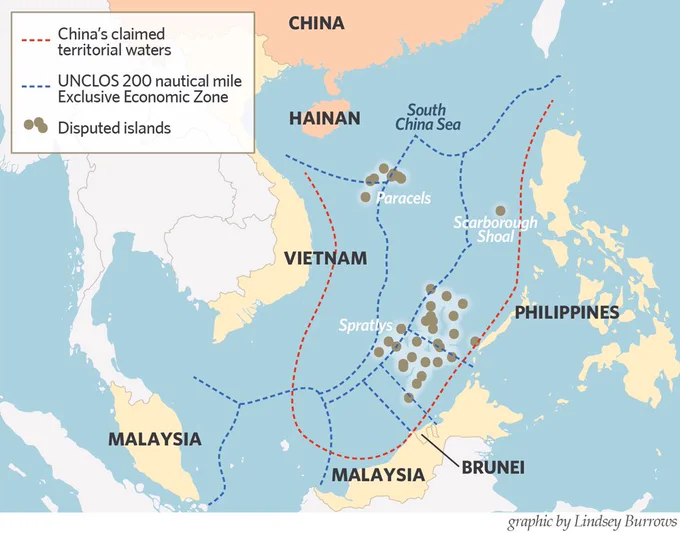
Sailors have an expression, “fair winds and following seas,” to describe the favourable conditions which they desire when setting out to sea. Much like these seafarers, Southeast Asian maritime nations seek stable and peaceful waters for their security and prosperity. The South China Sea has long vexed regional policymakers and security strategists due to both the number and complexity of overlapping maritime territorial claims among regional actors, including Brunei, China, Malaysia, the Philippines, Taiwan and Vietnam.

In the past two decades, China’s increasingly expansionist tendencies and willingness to use force to coerce or intimidate smaller claimants has reinforced growing threat perceptions vis-à-vis Beijing and fuelled hedging strategies. In February 2023, a Chinese Coast Guard (CCG) vessel targeted Filipino counterparts with a military-grade laser in the Spratly Islands.1 The following month, a CCG vessel caused a dangerous encounter with Vietnamese patrol boats during a patrol of Vietnamese oil and gas fields around Vanguard Bank. Around this time, a CCG vessel was also seen operating in close proximity to Malaysia’s Kasawari gas project near Luconia Shoals, prompting the Malaysian Navy to dispatch a Keris-class littoral ship to the area.

As a result of Chinese intimidation, Southeast Asian states have begun to prioritise maritime security as a central component of national defence and security strategies. While power asymmetry between regional states and China makes a concerted pushback against Chinese coercion unpalatable, arguably no state has mounted a consistent or coherent response to deal with this security challenge. Rather, Southeast Asian countries have adopted an array of hedging tactics to deepen engagement with China while bolstering their own domestic defence capabilities and simultaneously expanding security cooperation with a variety of external partners, including Australia, Japan, and Korea.

Hedging refers to insurance-seeking behaviour meant to signal ambiguity in a state’s alignment while cultivating fall-back options to preserve maximum autonomy. Few existing studies of hedging have considered the central role that maritime security plays in regional countries’ foreign policies. This paper therefore clarifies the maritime security strategies of three Southeast Asian claimant states (Malaysia, the Philippines, and Vietnam) to assess how such strategies map onto or deviate from existing notions of hedging. In each of the case studies below, maritime security strategy is reflective of a state’s broader hedging strategy and mirrors the same fundamental tensions: power asymmetry, geographic proximity to a security threat, lack of political consensus, and profound strategic uncertainty, namely fears of abandonment or entrapment in a great power conflict. Seen in this light, maritime security strategy is a manifestation of states’ deeply ingrained preferences for ambiguity and unwillingness to choose sides in brewing superpower competition.

The paper concludes with a brief summary assessing the parallels between the three case studies and what they tell us about hedging and maritime security strategy

Read & download full report >>

What is AIS tracking? A SeaLight primer

This post explains how the AIS vessel tracking system works and how bad actors abuse the system.

Miao Shou, Gaute Friis | AUGUST 21, 2023

What is AIS tracking? A SeaLight primer

Miao Shou

Analyst

Gaute Friis

Analyst

Tracking vessels’ Automatic Information System (AIS) signals is a core means SeaLight and other open-source intelligence collectors use to monitor maritime activity. AIS is a broadcast system that maritime authorities use to identify a vessel’s unique identification number, type, position, course, speed and navigation status. 

The International Maritime Organization (IMO) mandates the use of AIS to ensure maritime safety and direct marine traffic more efficiently. According to the International Maritime Organization’s International Convention for the Safety of Life at Sea (SOLAS) Regulation V/19.2.4, all vessels over 300 gross tons (or 500 tons for those not on international voyages) and passenger ships of any size are required to “carry automatic identification systems capable of providing information about the ship to other ships and to coastal authorities.” 

Tiếp tục đọc “What is AIS tracking? A SeaLight primer”