A Decade After the Paris Agreement, Climate Promises Still Leave the Poor Behind

time.com

Thousands of people take part in the so-called "Great People's March" in the sidelines of the COP30 UN Climate Change Conference in Belem, Para State, Brazil on November 15, 2025.

Thousands of people march in the sidelines of the COP30 UN Climate Change Conference in Belém, Brazil on Nov. 15, 2025.Pablo Porciuncula—AFP via Getty Image

by Brian Mukhaya Brian Mukhaya is the Africa Program Manager at Clean Air Task Force.

Ten years after the landmark Paris Agreement, the world is still trying to solve two crises as if they were separate: climate change and economic development. That’s a dangerous illusion. Climate progress cannot succeed if billions of people remain in poverty, without electricity, stable food systems, or the means to build better lives. And development, if it ignores climate risk, is little more than a short-term fix that will collapse under the weight of future disasters.

I saw this tension firsthand at COP30 in Belém, Brazil, the annual UN climate summit. The energy there was unmistakable—a mixture of urgency and frustration. Delegates from across Africa reminded the world that promises made in Paris have not been kept. Wealthy nations pledged to support developing countries as they cut emissions and adapted to rising temperatures. Yet, a decade later, those commitments remain largely unfulfilled.

At COP29 in Baku last year, developed countries agreed to mobilize at least $300 billion annually by 2035 for developing countries’ climate action, part of a broader aspirational target of $1.3 trillion per year. While this represents a tripling of the previous $100 billion goal, representatives from developing countries remain skeptical. More fundamentally, the $300 billion commitment falls far short of actual needs. The Independent High-Level Expert Group on Climate Finance estimates that developing countries (excluding China) need approximately $2.7 trillion annually by 2030 to meet climate and nature-related goals. The gap between promise and reality remains vast—and widening

But money is only part of the problem. Even when funding arrives, it often misses the mark. A new analysis by the Clean Air Task Force looked at 52 African countries’ climate and development plans. It found that the two rarely intersect. Climate strategies focus on emissions and energy transitions, while national development plans emphasize job creation and economic growth—but without embedding climate targets. The result is a patchwork of policies that fail to deliver either lasting prosperity or real emissions cuts.

As Bill Gates noted in a recent memo, global climate policy increasingly risks sidelining development altogether. Today, more than 600 million Africans lack access to electricity, while 900 million do not have clean cooking technologies—conditions that undermine productivity, constrain public services, and contribute to preventable deaths. 

Crucially, this should not be understood as an either/or dilemma. Wealthy nations already recognize that decarbonization must go hand in hand with economic growth to be politically viable at home. The same is true globally. Emerging and developing economies cannot be expected to choose between climate progress and economic progress. Insisting on a tradeoff between the two as a trade-off is both unrealistic and unjust.

When climate and development are treated as separate silos, everyone loses. Fragmented planning leads to inefficient allocation of scarce resources, missed opportunities for infrastructure investments with broad benefits, and policies that fail to produce either meaningful emissions reductions or durable socio-economic progress. Importantly, this is not a challenge restricted to Africa but a blind spot in international climate governance.  Even wealthy countries are discovering that climate action divorced from economic realities is politically unsustainable. When climate action appears to threaten economic growth, job creation, or living standards, political support erodes quickly. 

As negotiations in Belém draw to a close, one truth should be clear: climate and development are not competing agendas—they are the same story. Sustainable development is the foundation of lasting climate progress. And climate resilience is the only path to enduring prosperity. Any strategy that treats them separately is doomed to fail.

Development without climate action is a short-term fix. And climate action without development is an empty promise.

10 Years After a Breakthrough Climate Paris Agreement, Here’s Where We Are

nytimes.com Nov. 7, 2025

Almost exactly 10 years ago, a remarkable thing happened in a conference hall on the outskirts of Paris: After years of bitter negotiations, the leaders of nearly every country agreed to try to slow down global warming in an effort to head off its most devastating effects.

The core idea was that countries would set their own targets to reduce their climate pollution in ways that made sense for them. Rich, industrialized nations were expected to go fastest and to help lower-income countries pay for the changes they needed to cope with climate hazards.

So, has anything changed over those 10 years? Actually, yes. Quite a bit, for the better and the worse. For one thing, every country remains committed to the Paris Agreement, except one. That’s the United States.

Tiếp tục đọc “10 Years After a Breakthrough Climate Paris Agreement, Here’s Where We Are”

COP28 DELIVERS HISTORIC CONSENSUS IN DUBAI TO ACCELERATE CLIMATE ACTION

COP28.com

  • “The world needed to find a new way. By following our North Star, we have found that path,” said COP28 President, Dr. Sultan Al Jaber during his closing speech, “We have worked very hard to secure a better future for our people and our planet. We should be proud of our historic achievement.”
  • COP28 has concluded with a final consensus that lays out an ambitious response to the Global Stocktake and puts forward a plan to close the gaps to 2030. It calls on Parties to transition away from fossil fuels to reach net zero, encourages them to submit economy-wide Nationally Determined Contributions (NDCs), includes a new specific target to triple renewables and double energy efficiency by 2030, and builds momentum behind a new architecture for climate finance.
  • The COP28 Presidency took bold and decisive steps to deliver beyond the negotiated text through its ‘Action Agenda,’ which spans the four pillars of the Paris Agreement: fast tracking a just and orderly energy transition; fixing climate finance to make it more available, affordable, and accessible; focusing on people, nature, lives and livelihoods; and fostering full inclusivity in climate action.
  • COP28 has mobilized over $85 billion in funding for climate action, secured a historic agreement on Loss and Damage, advanced the Global Goal on Adaptation (GGA) and overseen breakthrough agreements on the energy transition.
  • This has been the most inclusive COP to-date, ensuring all voices could participate in the process.

Dubai, December 13, 2023

Tiếp tục đọc “COP28 DELIVERS HISTORIC CONSENSUS IN DUBAI TO ACCELERATE CLIMATE ACTION”

COP28 Ends With Deal on Transition Away From Fossil Fuels

bloomberg.com By Jennifer A DlouhyJess Shankleman, and Laura Millan Updated on 

  • First time fossil fuels have made it to a global climate deal
  • Steps needed to turn agreement into tangible actions: Al Jaber
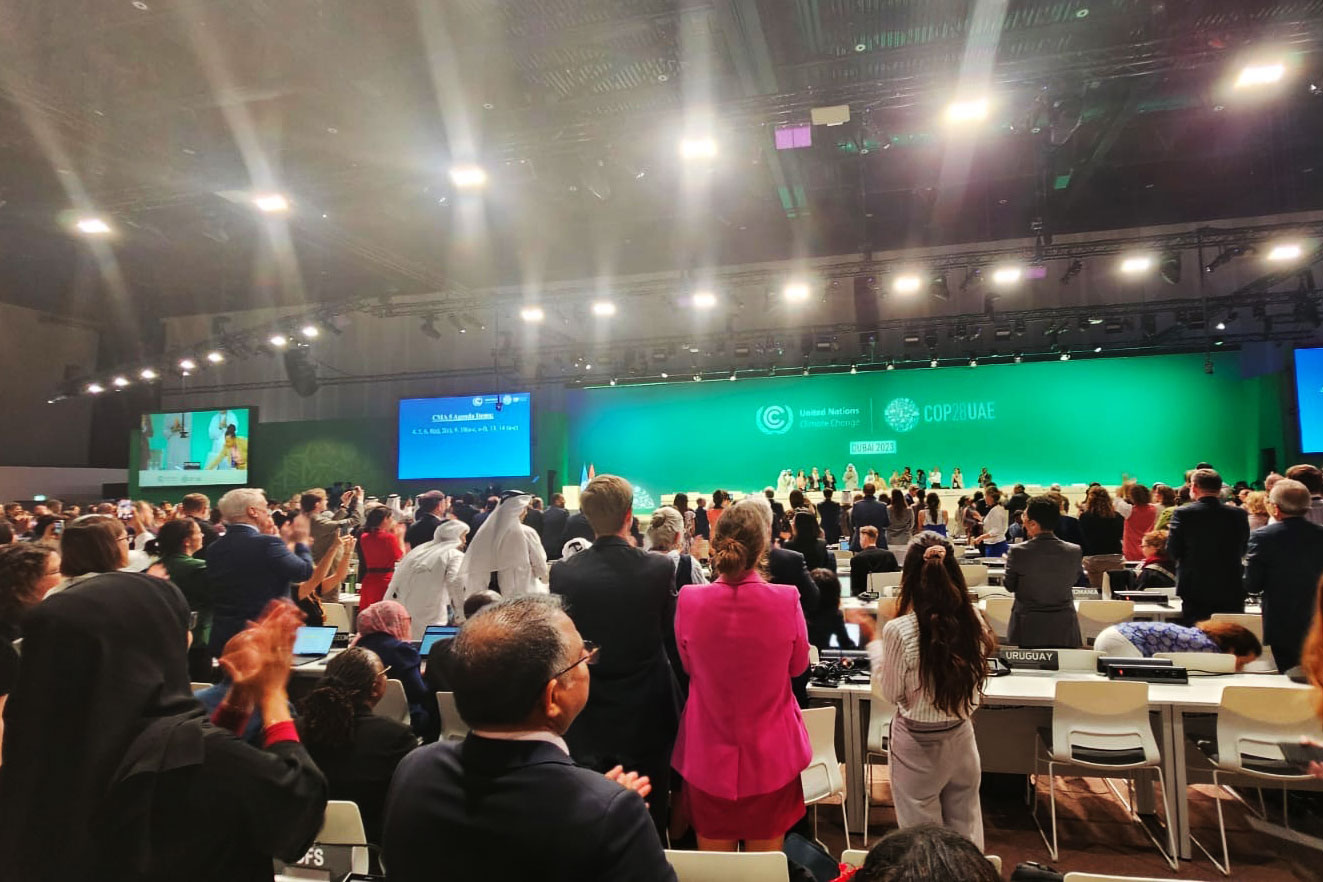
Standing ovation after COP28 President Sultan Al Jaber brokered an agreement to a commitment to transition away from fossil fuels.
Standing ovation after COP28 President Sultan Al Jaber brokered an agreement to a commitment to transition away from fossil fuels.Photographer: Nayla Razzouk/Bloomberg

The COP28 climate talks in Dubai ended in a deal that saw a commitment to transition away from all fossil fuels for the first time.

The president of this year’s UN-sponsored summit, the UAE’s Sultan Al Jaber, brokered an agreement that was strong enough for the US and European Union on the need to dramatically curb fossil fuel use while keeping Saudi Arabia and other oil producers on board.

The agreement calls for countries to quickly shift energy systems away from fossil fuels in a just and orderly fashion, qualifications that helped convince the skeptics. Under the deal, countries also are called to contribute to a global transition effort — rather than being outright compelled to make that shift on their own.

Tiếp tục đọc “COP28 Ends With Deal on Transition Away From Fossil Fuels”

COP28 climate summit just approved a ‘loss and damage’ fund. What does this mean?

theconversation.com Published: December 1, 2023 2.24am GMT

Day one of the COP28 climate summit saw the first big breakthrough: agreement on a “loss and damage” fund to compensate poor states for the effects of climate change.

Met with a standing ovation in Dubai, the agreement means wealthy states and major polluters will put millions of dollars towards a fund that will in turn distribute funds to poor states harmed by climate change. The fund will be administered by the World Bank. Initial commitments amount to US$430 million.

It will come as a huge relief to the United Arab Emirates, the summit’s host. The country was under pressure even before talks began about its fossil fuel expansion plans and the fact the president of the climate talks is chief executive of a national oil company. This undoubtedly featured in the UAE’s decision to commit US$100 million to the fund.

Other countries to make initial commitments to the fund include the United Kingdom ($75 million), United States ($24.5 million), Japan ($10 million) and Germany (also US$100 million). Pressure will now build on other wealthy countries, including Australia, to outline their own commitments to the fund.

Tiếp tục đọc “COP28 climate summit just approved a ‘loss and damage’ fund. What does this mean?”

COP28: four key issues that will dominate the latest UN climate summit

theconversation.com Published: November 29, 2023 4.56pm GMT

The United Nations Environment Programme recently published a report with an unusually strong title for a UN body: “Emissions Gap Report 2023: Broken Record – Temperatures hit new highs, yet world fails to cut emissions (again)”. Yet again, it highlights how far countries are off track from safeguarding the planet – and us.

As the world gathers in the United Arab Emirates for the annual UN climate change conference (or, more formally, Conference of the Parties, COP), the stakes are as high as ever. The head of the UN climate change secretariat Simon Stiell has urged for this meeting – COP28 – to be a “turning point.”

Can this COP deliver on that goal? Perhaps.

As an academic focused on international climate governance, I’ve seen how trust is vital for an ambitious outcome. Delegates negotiate all night. They trade off issues against another. And at the end of the long summit, negotiators and ministers rely on each other to uphold bargains made over hundreds of hours of talks. But, though COP28 will be my 11th climate COP, I’ve never seen trust so low among countries.

Tiếp tục đọc “COP28: four key issues that will dominate the latest UN climate summit”

24 hours with … climate negotiator Vicente Paolo Yu III

eco-business.com

Brokering for the environment for the G77, the biggest negotiating bloc of low-income countries, comes with both challenges and triumphs, says the Filipino lawyer. He shares what it is like to spend sleepless nights at the climate meetings, ahead of COP28.

Vice Yu COP24
Vicente Paolo Yu III, known by his nickname Vice, at COP24 in Katowice, Poland in 2018. Image: Vice Yu

By Hannah Alcoseba Fernandez

It is 12 midnight on the last Saturday before the conclusion of the world’s biggest climate summit. 

The Conference of the Parties (COP) to the United Nations Framework Convention on Climate Change (UNFCCC) are two-week gatherings that have been held yearly for almost three decades in a bid to make major resolutions to combat worsening impacts of global warming.

The crowd of delegates from nearly 200 countries, dozens of world leaders and hundreds of the biggest companies and nonprofits has dissipated. At the venue, negotiators, however, are huddling in a room to grapple with the final wording of text that could potentially shift the discourse on climate change for the long term. Most of them have not eaten a proper meal, and are surviving on energy bars and the water served for free at the venue.

This is a typical scene into the last hours at  the COPs, said Vicente Paolo Yu III, coordinator for the biggest negotiating bloc of low-income countries at the conference, the Group of 77 (G77) and China. The Asian superpower is not classified a developed country under international standards and has provided consistent support to the G77 on climate issues.

Tiếp tục đọc “24 hours with … climate negotiator Vicente Paolo Yu III”

What The Ozone Layer Teaches Us About Climate Action

06 APR, 2021

when it comes to the Paris Agreement and climate action; namely that when individuals change their behaviour by consuming differently they can drive industries to change, as those industries are then caught between a ‘greening’ consumer demand and international and governmental policies focusing on climate action. 

UNFCCC

Credit: NOAA / Unsplash

Back in the 1980s, everyone was talking about the hole in the ozone layer, so what happened, and what can the international agreement to ban CFCs teach us about the importance of multilateral cooperation when it comes to climate action?

What exactly is the ozone layer?

The ozone layer is the part of the Earth’s atmosphere that protects the planet from ultraviolet radiation. It’s found in the Stratosphere which is around 10-50km above the surface of the earth. Think of it as a layer of sunscreen that protects us from all manner of harmful rays. Without it, life on Earth would be extremely unpleasant.

So, I’m guessing a hole in it is not a good thing

Exactly right, in fact it’s a very bad thing.

So what caused it?

Tiếp tục đọc “What The Ozone Layer Teaches Us About Climate Action”

Hoàn thành cập nhật Đóng góp do quốc gia tự quyết định (NDC): Nâng mức đóng góp của Việt Nam cho ứng phó với BĐKH toàn cầu

baotainguyenmoitruong.vn

(TN&MT) – Ngày 24/7/2020, Thủ tướng Chính phủ đã phê duyệt Đóng góp do quốc gia tự quyết định (NDC) cập nhật của Việt Nam. Bằng nguồn lực trong nước, đến năm 2030 Việt Nam sẽ giảm 9% tổng lượng phát thải khí nhà kính so với Kịch bản phát triển thông thường (BAU) quốc gia, tương đương 83,9 triệu tấn CO2tđ.

Mức đóng góp 9% này có thể được tăng lên thành 27% so với BAU quốc gia (tương đương 250,8 triệu tấn CO2tđ) khi nhận được hỗ trợ quốc tế thông qua hợp tác song phương, đa phương và các cơ chế trong khuôn khổ Thỏa thuận Paris về biến đổi khí hậuNDC cập nhật của Việt Nam xác định các biện pháp giảm nhẹ phát thải khí nhà kính giai đoạn 2021-2030 và các nhiệm vụ chiến lược về thích ứng với biến đổi khí hậu, các giải pháp thích ứng nhằm giảm thiểu thiệt hại do các tác động liên quan đến những thay đổi của khí hậu gây ra trong tương lai được xác định cụ thể cho từng lĩnh vực. Tiếp tục đọc “Hoàn thành cập nhật Đóng góp do quốc gia tự quyết định (NDC): Nâng mức đóng góp của Việt Nam cho ứng phó với BĐKH toàn cầu”

Cuộc đua thực thi Thỏa thuận Paris

Thứ năm – 30/07/2020 16:42
Cuộc đua thực thi Thỏa thuận Paris
Theo số liệu từ Ngân hàng Thế giới, hiện có 30 quốc gia/vùng lãnh thổ đã áp dụng thuế các bon và 31 quốc gia/vùng lãnh thổ áp dụng hệ thống trao đổi tín chỉ các bon (ETS). Việt Nam đang nghiên cứu lựa chọn công cụ định giá các bon phù hợp với điều kiện của quốc gia, làm cơ sở phát triển thị trường các bon trong nước và đảm bảo tuân thủ các cam kết quốc tế từ sau năm 2020.

Đáp ứng yêu cầu chương trình tín chỉ các bon
Tiếp tục đọc “Cuộc đua thực thi Thỏa thuận Paris”

Sea-level legacy: 20cm more rise by 2300 for each 5-year delay in peaking emissions

02/20/2018 – Peaking global CO2 emissions as soon as possible is crucial for limiting the risks of sea-level rise, even if global warming is limited to well below 2°C. A study now published in the journal Nature Communications analyzes for the first time the sea-level legacy until 2300 within the constraints of the Paris Agreement. Their central projections indicate global sea-level rise between 0.7m and 1.2m until 2300 with Paris put fully into practice. As emissions in the second half of this century are already outlined by the Paris goals, the variations in greenhouse-gas emissions before 2050 will be the major leverage for future sea levels. The researchers find that each five year delay in peaking global CO2 emissions will likely increase median sea-level rise estimates for 2300 by 20 centimeters.

Sea-level legacy: 20cm more rise by 2300 for each 5-year delay in peaking emissions

Every delay in peaking emissions by 5 years between 2020 and 2035 could mean additional 20 cm of sea-level rise (Mengel et al 2018)

Tiếp tục đọc “Sea-level legacy: 20cm more rise by 2300 for each 5-year delay in peaking emissions”

The Climate – Justice – Cooperation Nexus: 10 Cornerstones of the Great Transformation towards Sustainability

IIASA

The challenge of our generation: Avert dangerous global warming – invest in social cohesion and wellbeing of people – build local, national, and transnational alliances for transformative change towards sustainability

1. We can reach the goals of the Paris Agreement – but ambitious action is needed now! Climate change is a threat to humanity. Irreversible Earth systems changes need to be avoided. This is a civilisational challenge which requires unprecedented joint action around the globe. We are under huge time pressure. Global CO2 emissions must decline to zero by mid-century in order to achieve the ambitious Paris goal, aimed at stabilising the global mean temperature well below 2 degrees C, and if possible at 1.5 degrees C. This translates into a stylised “carbon law”, whereby emissions must be halved every decade in analogy to the Moore’s law of semiconductors. We have the resources and the technology to achieve this, but do we have the political will and the resolve? Recent developments, such as the declaration by the US President to withdraw from the Paris Agreement, can be interpreted as a major setback. At the same time, they may inspire counter-movements, strengthening the determination to vigorously combat climate change. In particular, OECD countries and emerging economies should make commitments within the G 20 and within their national policies to ensure the achievement of global decarbonisation by the middle of the century. Tiếp tục đọc “The Climate – Justice – Cooperation Nexus: 10 Cornerstones of the Great Transformation towards Sustainability”

Low-carbon economy in VN’s updated NDC

vietnam news

Update: June, 29/2017 – 10:52

Việt Nam plans to develop a low-carbon economy and include climate-change resistance work in its updated Nationally Determined Contribution (NDC) for the Paris climate accords. — Photo kienviet.net

HÀ NỘI — Việt Nam plans to develop a low-carbon economy and include climate-change resistance work in its updated Nationally Determined Contribution (NDC) for the Paris climate accords.

The information was released by Phạm Văn Tấn deputy head of the Meteorology, Hydrology and Climate Change Department under the Ministry of Natural Resources and Environment at a workshop held yesterday in Hà Nội. Tiếp tục đọc “Low-carbon economy in VN’s updated NDC”

Climate change forecast to shrink rice yield

vietnamnews

Update: June, 16/2017 – 09:00

Part of a protected forest in the southernmost province of Cà Mau risks being swept away as a result of drought, salt water intrusion and sea level rise. — VNA/VNS Photo An Hiếu

Viet Nam News HÀ NỘI — Việt Nam risks a loss of 7.2 million tonnes of rice yield and 3.2 per cent of its agricultural land by the late 21st century as a result of climate change, according to a Ministry of Agriculture and Rural Development forecast.

The forecast was delivered yesterday in Hà Nội at a conference on responsive activities to climate change in the agricultural sector in the context of implementing the Paris Climate Accord. Tiếp tục đọc “Climate change forecast to shrink rice yield”

Trump Was Right to Leave the Paris Agreement. Why He Shouldn’t Have Had to Withdraw in the First Place.

(TĐH: The Daily Signal is the online paper of Heritage Foundation, most influential conservative thinktank of the US,located in Washington DC)

President Donald Trump announced on June 1 that the U.S. will withdraw from the Paris Agreement, which would have required the U.S. to ramp up energy regulations in coming years. (Photo: Kevin Dietsch/UPI/Newscom)

Supporters of the Paris Agreement have expressed considerable angst over President Donald Trump’s decision to leave the climate agreement last week.

Regardless of the merits of that decision—although for the record, Heritage Foundation analysts recommended that the U.S. withdraw—Trump should not have had to make that call.

The Paris Agreement had all the hallmarks of a treaty and should have been submitted by President Barack Obama to the Senate for advice and consent, as required under Article II of the U.S. Constitution.

Instead, Obama signed the Paris Agreement as an executive agreement. Tiếp tục đọc “Trump Was Right to Leave the Paris Agreement. Why He Shouldn’t Have Had to Withdraw in the First Place.”