
A C-section is the surgical method of delivering a baby, meant to be used in complicated pregnancies. It’s a lifesaving procedure, but in India, millions of mothers are going under the knife unnecessarily. The Cesarean section rate in India’s private hospitals is a whopping 47.4%, far greater than the 15% threshold recommended by the WHO. As private hospitals of all kinds mushroom across the country, C-sections have become a money-making racket. An increasing number of doctors have little patience for normal deliveries and are in a hurry to wield the scalpel. Hapless mothers in their hands are forced to undergo surgeries which comes with risks for both mother and baby.
Chuyên mục: Những vấn đề vệ sinh và sức khỏe – Sanitation and Health problems
COP28: The climate crisis is also a health crisis
COP28: The climate crisis is also a health crisis
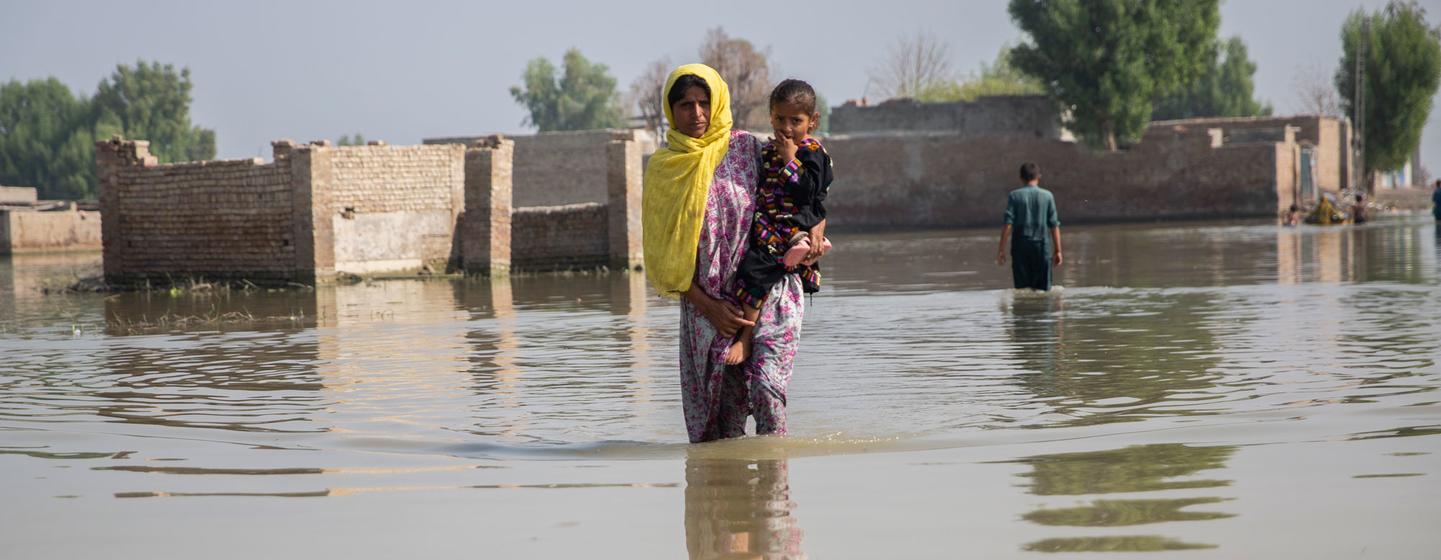
© UNICEF/Saiyna Bashir Malaria and other diseases were on the rise after floods earlier in the year in Sindh province, Pakistan.
3 December 2023Climate and Environment
Health has made it onto the agenda of a UN climate conference, and health advocates at COP28 in Dubai on Sunday said the topic was long overdue for discussion as climate inaction is costing lives and impacting health every single day.
Our planet has logged higher mean temperatures each year, with 2023 set to be the hottest on record. Ice sheets are melting at an unprecedented rate. Wildfires have made the air hazardous in some regions, while in others, floods regularly threaten to contaminate drinking water.
Tweet URL
Against this backdrop, more and more people are being affected by disasters, climate-sensitive diseases and other health conditions.
Climate change exacerbates some existing health threats and creates new public health challenges. Worldwide, only considering a few health indicators, an additional 250,000 deaths per year will occur in the next decades because of climate change, according to the UN World Health Organization (WHO).
WHO Director General Dr. Tedros Adhanom Ghebreyesus told delegates at COP28 that it was long overdue for talks around environmental health, rising sea levels, and melting glaciers to include the direct impacts of such climate shocks on human health.
Tiếp tục đọc “COP28: The climate crisis is also a health crisis”Asia’s climate-driven health crisis raises alarm ahead of COP28

New Delhi residents use clothes and books to protect their faces from the scorching sun on a hot June day in India. 2023 could be the hottest year on record. © EAP/Jiji
Summit’s first health ministerial follows record summer spike in heatstroke and dengue cases
SAYUMI TAKE, Nikkei staff writerNOVEMBER 22, 2023 06:00 JST
TOKYO — 2023 is set to be the world’s hottest year on record, and the consequences for the human body are deadly.
Record-shattering temperatures can cause headaches, dizziness and nausea. Disease-carrying mosquitoes flourish after torrential rain and devastating floods. Polluted air causes shortness of breath and respiratory illnesses. The health emergencies that accompany climate change are shaking communities across the globe.
The impact on Asia is already profound. The continent has warmed at twice the speed of the global average in the past 30 years due to its huge land mass, according to the World Meteorological Organization (WMO).
More people in Asia are dying or falling ill than ever before due to high temperatures, the United Nations scientific body Intergovernmental Panel on Climate Change (IPCC) reported in 2022. Heat stress is one of many health risks. Dengue and malaria are increasing in Thailand and Malaysia, while respiratory diseases caused by air pollution are rising in Indonesia. Even mental disorders like depression and anxiety are associated with climate change, according to a 2022 report by the IPCC.
“These impacts that we’re seeing today could be just a symptom of a very dangerous future unless we tackle climate change urgently,” warned Marina Romanello, executive director of the authoritative Lancet Countdown on Health and Climate Change report.
Tiếp tục đọc “Asia’s climate-driven health crisis raises alarm ahead of COP28”Biến đổi khí hậu làm thay đổi mô hình lây truyền các bệnh truyền nhiễm
(SK&MT) – Biến đổi khí hậu tác động đến sức khỏe con người theo nhiều cách khác nhau, như làm tăng nguy cơ mắc các bệnh liên quan đến nhiệt, thay đổi mô hình lây truyền và mức độ các bệnh truyền nhiễm. Nhiệt độ tăng 1oC sẽ làm tăng khoảng 7%-11% nguy cơ mắc bệnh sốt xuất huyết, 5,6% mắc bệnh tay chân miệng.
PGS.TS Nguyễn Thị Liên Hương -Thứ trưởng Bộ Y tế tại cuộc họp nhóm đối tác về biến đổi khí hậu và sức khỏe do Bộ Y tế tổ chức với sự hỗ trợ của Tổ chức Y tế thế giới (WHO) và Liên minh Châu Âu.
 |
| PGS.TS Nguyễn Thị Liên Hương -Thứ trưởng Bộ Y tế phát biểu. |
Dengue will ‘take off’ in southern Europe, US, Africa this decade, WHO scientist says
By Jennifer Rigby October 6, 2023
LONDON, Oct 6 (Reuters) – Dengue fever will become a major threat in the southern United States, southern Europe and new parts of Africa this decade, the WHO’s chief scientist said, as warmer temperatures create the conditions for the mosquitoes carrying the infection to spread.
The illness has long been a scourge in much of Asia and Latin America, causing an estimated 20,000 deaths each year. Rates of the disease have already risen eight-fold globally since 2000, driven largely by climate change as well as the increased movement of people and urbanization.
Many cases go unrecorded, but in 2022 4.2 million cases were reported worldwide and public health officials have warned that near-record levels of transmission are expected this year. Bangladesh is currently experiencing its worst-ever outbreak, with more than 1,000 deaths.
Tiếp tục đọc “Dengue will ‘take off’ in southern Europe, US, Africa this decade, WHO scientist says”
Review highlights lifelong health impacts of air pollution
Imperial College London by Ryan O’Hare18 April 2023


A new review of evidence highlights the impact air pollution has on health across the life course, from before birth through to old age.
The report was commissioned by the Greater London Authority via Imperial Projects and carried out by researchers from Imperial College London’s Environmental Research Group.
Bringing together the findings from a range of key studies, the review highlights the serious and life-limiting risks of air pollution and how it affects multiple aspects of physical and mental health over the course of pregnancy and birth, child development, through to adulthood.
The authors looked at studies focused on the links between air pollution and ill health, including pollutants such as black carbon (or soot), small particulate matter (PM2.5), Nitrogen Dioxide (NO2), and Sulphur Dioxide (SO2).
Tiếp tục đọc “Review highlights lifelong health impacts of air pollution”WHO cảnh báo số ca mắc sốt xuất huyết kỷ lục do sự nóng lên toàn cầu
nhandan.vn – WHO cho biết, tỷ lệ mắc sốt xuất huyết ngày càng gia tăng trên phạm vi toàn cầu, với 4,2 triệu ca bệnh được ghi nhận trong năm 2022, cao hơn gấp 8 lần so với con số thống kê năm 2000.
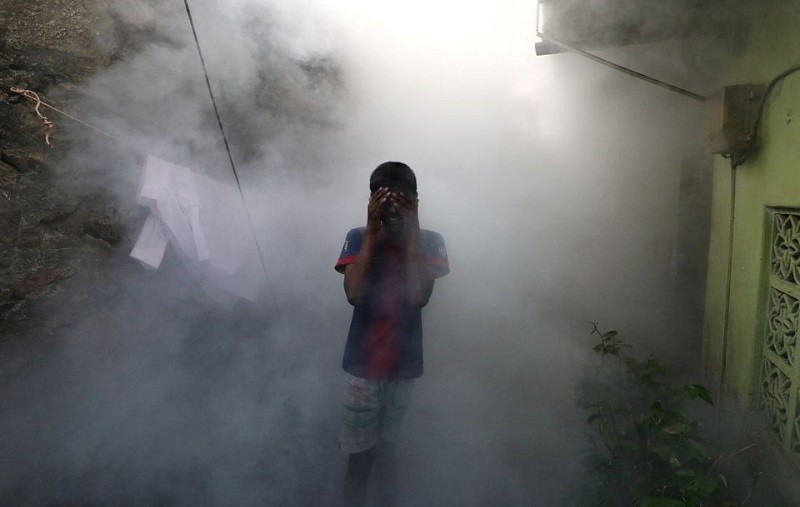 |
| Một cậu bé che mặt để tránh khói khi khi nhân viên y tế hun khói đuổi muỗi phòng sốt xuất huyết tại một khu dân cư ở Colombo, Sri Lanka, ngày 12/7/2023. (Ảnh: Reuters) |
Tổ chức Y tế Thế giới (WHO) ngày 21/7 cảnh báo, số ca mắc bệnh sốt xuất huyết trên thế giới có thể đạt mức cao kỷ lục trong năm nay, một phần là do sự nóng lên toàn cầu tạo môi trường có lợi cho loài muỗi truyền bệnh.
Theo báo cáo của WHO hồi tháng 3, bệnh sốt xuất huyết đã lần đầu tiên xuất hiện tại thủ đô Khartoum của Sudan. Châu Âu gần đây ghi nhận số ca mắc tăng đột biến, trong khi Peru đã phải tuyên bố tình trạng khẩn cấp về dịch bệnh ở hầu hết các khu vực.
Đầu năm nay, WHO đã cảnh báo sốt xuất huyết là bệnh nhiệt đới lây lan nhanh nhất thế giới, và đồng thời là một “mối đe dọa đại dịch”.
Chia sẻ tại họp báo ở Geneva, Thụy Sĩ ngày 21/7, Tiến sĩ Raman Velayudhan, chuyên gia thuộc bộ phận kiểm soát các bệnh nhiệt đới bị lãng quên của WHO, cho biết khoảng một nửa dân số thế giới đang đối mặt với nguy cơ nhiễm bệnh sốt xuất huyết.
Năm 2019, số ca mắc sốt xuất huyết toàn cầu đạt mức cao nhất trong lịch sử với 5,2 triệu trường hợp được ghi nhận tại 129 quốc gia. Sau 4 năm, thế giới một lần nữa chứng kiến sự bùng phát mạnh mẽ của căn bệnh này khi số người nhiễm bệnh đang trên đà chạm mốc 4 triệu.
Tiến sĩ Velayudhan thông tin thêm, gần 3 triệu trường hợp mắc sốt xuất huyết đã được báo cáo ở châu Mỹ, đồng thời bày tỏ quan ngại về sự lây lan của dịch bệnh xuống khu vực phía nam sang các nước Bolivia, Paraguay và Peru.
“Tình hình sốt xuất huyết đang diễn biến khá tồi tệ ở khu vực châu Mỹ. Chúng tôi hy vọng khu vực châu Á có thể kiểm soát được dịch bệnh”, chuyên gia của WHO cho hay.
Theo WHO, các trường hợp mắc sốt xuất huyết được báo cáo cho đến nay chỉ chiếm một phần nhỏ trong tổng số ca nhiễm toàn cầu vì hầu hết đều không có triệu chứng, trong đó tỷ lệ số ca tử vong chưa đến 1%.
Khí hậu ấm hơn được cho là nguyên nhân giúp muỗi sinh sôi nhanh hơn và tạo điều kiện cho virus trong cơ thể chúng phát triển. Ngoài ra, nhu cầu vận chuyển hàng hóa và di chuyển của con người ngày càng cao, quá trình đô thị hóa và các vấn đề liên quan đến vệ sinh cũng là những yếu tố dẫn đến sự gia tăng số ca bệnh.
Trả lời câu hỏi về tình trạng nắng nóng hiện nay ở Bắc bán cầu ảnh hưởng thế nào đến sự lây lan của dịch sốt xuất huyết, Tiến sĩ Velayudhan cho biết còn quá sớm để nói về điều này.
Chuyên gia của WHO giải thích, về lý thuyết, ở nhiệt độ trên 45 độ C, số lượng muỗi bị tiêu diệt nhiều hơn số muỗi sinh ra. Tuy nhiên, muỗi là loài côn trùng rất thông minh, và nó có thể sinh sản trong các vật chứa nước nơi nhiệt độ không tăng đến mức như vậy.
Mosquito-borne dengue grows deadlier in South Asia as planet warms
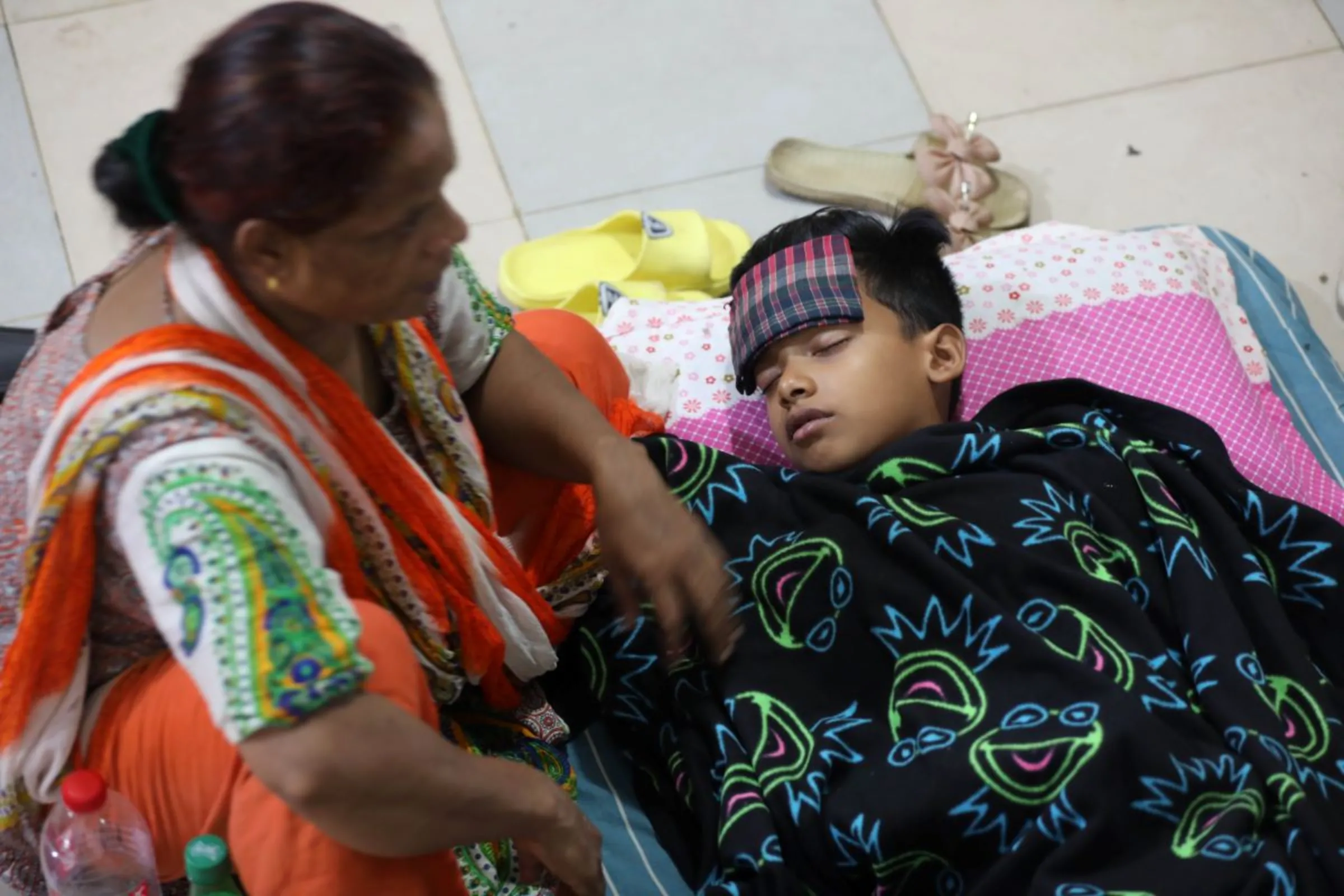
A grandmother keeps her vigil at the side of her sick grandchild at the dengue wards at the Mugda Medical College and Hospital, Dhaka, August 30, 2023, Thomson Reuters Foundation/Mosabber Hossain
What’s the context?
Virus is posing an ever-greater threat in Bangladesh and Nepal where rise and spread of cases are linked to climate change impacts
- Dengue on the rise and spreading in Bangladesh, Nepal
- Heat and longer monsoon linked to worsening outbreaks
- Authorities struggle to respond but aid groups helping
DHAKA/KATHMANDU – Mosquito-borne dengue fever is taking a heavy toll on South Asian nations this year as Bangladesh grapples with record deaths and Nepal faces cases in new areas, with disease experts linking worsening outbreaks to the impacts of climate change.
Authorities in the two countries are scrambling to contain and treat the disease – which is also known as “breakbone fever” for the severe muscle and joint pains it induces. Entomologists and epidemiologists say rising temperatures and longer monsoon seasons are providing ideal breeding conditions for mosquitoes.
The threat is not restricted to South Asia as dengue rates are rising globally with 4.2 million cases reported in 2022 – up eight-fold from 2000 – the World Health Organization (WHO) says.
Tiếp tục đọc “Mosquito-borne dengue grows deadlier in South Asia as planet warms”Toilet Gods and Demons in Japan
In Japanese folklore there are both toilet gods and toilet demons. The toilet gods are household deities, the toilet demons are water demons. Let’s look at the gods first, then the demons.
Toilet Gods
There is only very limited livestock on Japan farms. Human waste has traditionally been collected in cesspits and used as fertilizer. This meant that there was a risk of falling into a cesspit and possibly drowning. Protection was needed against this dreadful fate. Also, since the collected waste was used for fertilizer, the toilet was connected with fertility in general.
The kawaya no-kami or toilet god was asked for help. Special rituals at the new year asked for the kawaya no-kami to bring a good harvest. Keeping the toilet clean was thought to lead to more attractive children.
The specific name and rituals associated with the toilet god vary with location. The name is Takagamisama around Nagano, Setchinsan in Hiroshima, Kamu-taka on Ishigaki Island, Sechinbisan in Ōita, and Usshimasama in Ehime. In some places the family sit in front of the toilet on a straw mat and eat a rice cake, in other places they would put an offering of food into the toilet.
In far northern Japan the Ainu people believed that their toilet god, the Rukar Kamuy, would be the first deity to provide help in times of danger. The Rukar Kamuy is one of many Kamuy or household gods. There is Apasamn Kamuy the husband and wife god and goddess who keep evil spirits out of the house entrance. Cisepannokianpa Kamuy and Cisepennokianpa Kamuy, the husband and wife god and goddess of the eaves of the roof, protect the house from earthquakes and typhoons. Cisekor Kamuy, a male god, sits in the east corner of the house and watches over everything. He is the husband of Apehuci Kamuy, the goddess of fire. Colpep Kamuy is the god of containers, thanks are given to this god when containers are retired.
Cop28 will be the first to dedicate a day to health and climate
By Fiona Harvey | May 4, 2023
 Photo by Jérémy Stenuit on Unsplash
Editor’s note: This story was originally published by The Guardian. It appears here as part of the Climate Desk collaboration.
The next UN climate summit will be the first to consider health issues in depth, with a meeting of global health ministers to highlight the consequences of the climate crisis for wellbeing.
Sultan Al Jaber, the president of Cop28, which will take place in Dubai this November, said on Tuesday: “We will be the first Cop to dedicate a day to health and the first to host a health and climate ministerial. And we need to broaden our definition of adaptation to enable global climate resilience, transform food systems and enhance forestry land use and water management.”
Tiếp tục đọc “Cop28 will be the first to dedicate a day to health and climate”
Jacinda Ardern’s resignation shows burnout is real – and it’s nothing to be ashamed of

Analysis by Hilary Whiteman, CNN
Updated 7:33 AM EST, Thu January 19, 2023

New Zealand Prime Minister Jacinda Ardern delivers her victory speech after being re-elected in a historic landslide win on October 17, 2020.Lynn Grieveson/Newsroom/Getty ImagesCNN —
Burnout is real – and it’s nothing to be ashamed of. That’s the conclusion trailblazing New Zealand leader Jacinda Ardern seems to have reached after almost six brutal years in office.
Tiếp tục đọc “Jacinda Ardern’s resignation shows burnout is real – and it’s nothing to be ashamed of”World toilet day: In Praise of Toilets

A Dalit woman stands outside a dry toilet located in an upper caste villager’s home in Mainpuri, in the northern Indian state of Uttar Pradesh. Credit: Shai Venkatraman/IPS
MADRID, Nov 14 2022 (IPS) – For those who have it, a toilet is that ‘thing’ in the bathroom, next to the bidet, the hand-washing sink with hot and cold water faucets, and the bathtub.
Given their ‘unprestigious’ function, some billionaires, in particular in the Gulf oil-producer kingdoms, fancy to pose their buttocks on a solid-gold toilet. Once they are there, why not also solid-gold faucets?
Many others prefer a more comfortable use of their toilets, thus endowing them with both automatic heating and flushing. And anyway, being given-for-granted, nobody would give a thought to the high importance of all these ‘things’.
The other side of the coin shows an entirely different picture. A shocking one by the way.
Billions of humans without one
And it is a fact that close to 4 billion people –or about half of the world’s total population of 8 billion– still live without access to a safe toilet and other sanitation facilities.
Nearly a full decade ago, the international community, represented in the United Nations General Assembly, decided to declare 19 November every single year, as a world day to address such a staggering problem.
58% of human infectious diseases can be worsened by climate change – we scoured 77,000 studies to map the pathways
Published: August 8, 2022 4.00pm BST
Climate change can exacerbate a full 58% of the infectious diseases that humans come in contact with worldwide, from common waterborne viruses to deadly diseases like plague, our new research shows
Our team of environment and health scientists reviewed decades of scientific papers on all known pathogenic disease pathogens to create a map of the human risks aggravated by climate-related hazards.
The numbers were jarring. Of 375 human diseases, we found that 218 of them, well over half, can be affected by climate change.
Flooding, for example, can spread hepatitis. Rising temperatures can expand the life of mosquitoes carrying malaria. Droughts can bring rodents infected with hantavirus into communities as they search for food.
With climate change influencing more than 1,000 transmission pathways like those and climate hazards increasingly globally, we concluded that expecting societies to successfully adapt to all of them isn’t a realistic option. The world will need to reduce the greenhouse gas emissions that are driving climate change to reduce these risks.
Khi nhà vệ sinh trường học thành nỗi sợ của con trẻ 
Hiện nay có khoảng 7,7 triệu học sinh từ bậc học mầm non đến THPT trên cả nước không được tiếp cận với xà phòng và nước sạch ở trường học. Mặc dù, một số trường đã đầu tư, cải tạo các nhà vệ sinh đạt chuẩn, tuy nhiên công tác quản lý, vận hành, bảo quản các nhà vệ sinh còn nhiều bất cập…
Nghe nội dung chi tiết tại đây:

Khảo sát nhà vệ sinh tại một số trường học công lập trên địa bàn Hà Nội xây dựng cách đây hàng chục năm, phóng viên VOVGT ghi nhận, nhà vệ sinh đã xuống cấp, đường ống nước không đảm bảo nên bốc mùi, tường nứt, thấm dột. Với số lượng học sinh đông, nhà vệ sinh thường xuyên rơi vào tình trạng quá tải.
Tiếp tục đọc “Khi nhà vệ sinh trường học thành nỗi sợ của con trẻ ”
2 in 5 schools around the world lacked basic handwashing facilities prior to COVID-19 pandemic — UNICEF, WHO
NEW YORK/GENEVA/HA NOI, 14 August 2020 – As schools worldwide seek to put in place safety measures that allow them to reopen, the latest data from the WHO/UNICEF Joint Monitoring Programme (JMP) reveals that 43 per cent of schools around the world lacked access to basic handwashing with soap and water in 2019 – a key condition for schools to be able to operate safely in the midst of the COVID-19 pandemic.
“Global school closures since the onset of the COVID-19 pandemic have presented an unprecedented challenge to children’s education and wellbeing,” said Henrietta Fore, UNICEF Executive Director. “We must prioritize children’s learning. This means making sure that schools are safe to reopen – including with access to hand hygiene, clean drinking water and safe sanitation.”
 CVD
CVD 