LOS ANGELES – United States Trade Representative Katherine Tai and Secretary of Commerce Gina M. Raimondo hosted counterparts from the 13 Indo-Pacific Economic Framework for Prosperity (IPEF) partner countries – representing over 40% of the global economy – at the first official in-person Ministerial meeting. The ministers had positive and constructive discussions, and announced a substantial milestone in their pursuit of a high-standard and inclusive economic framework.
“This meeting was a chance to deepen our partnerships and fill in the details about how we will work collectively to address the challenges and opportunities that will define the 21st century,” said Ambassador Katherine Tai. “After several days of intensive discussions, we have made real progress toward that goal and I am excited to continue developing this Framework, which will unlock enormous economic value for our region and serve as a model for the rest of the world to follow.”
In the small, secluded country of Bhutan, happiness is not just a traditional way of life – it is a national statistic.
Bhutan’s government introduced “Gross National Happiness” as a measure of the nation’s progress.
Opening the country up to international tourism has allowed for some development, but the weight of tradition still weighs heavily on the kingdom’s young generation. Not everyone gets to enjoy the perks of a modern lifestyle.
101 East explores the cost of happiness in this hermit kingdom.
foreignpolicy – This week, Uzbekistan has hosted two major summits with consequences for South Asia. The first was an international conference on Afghanistan held on Monday and Tuesday. And now, the foreign ministers from the Shanghai Cooperation Organization (SCO)—a multilateral group that aims to promote stability across Eurasia—have gathered in Tashkent, the capital, for a meeting on Thursday and Friday focused on regional peace and security and global inflation.
By Tran Đinh Hoanh Tran Đinh Hoanh is an international litigator and writer in Washington DC.
[TĐH: I’ve tried to make this piece ultra-short, simple, and easy
to remember, with sufficient citations for those who’d like to dig
deeper into UNCLOS]
During China Foreign Ministry Spokesperson Wang Wenbin’s Regular Press Conference on June 13, he responded to a Bloomberg question concerning the legal status of the Taiwan Strait. Asked about Chinese military officials’ contention that the Taiwan Strait does not constitute “international waters,” he said that Taiwan is “an inalienable part of China’s territory. …According to UNCLOS and Chinese laws, the waters of the Taiwan Strait, extending from both shores toward the middle of the Strait, are divided into several zones including internal waters, territorial sea, contiguous zone, and the Exclusive Economic Zone. China has sovereignty, sovereign rights and jurisdiction over the Taiwan Strait.”
He went on to say that calling the strait international waters is “a false claim” by “certain countries” searching for a pretext for “threatening China’s sovereignty and security.”
Demonstrators carry pictures of former Pakistani President Pervez Musharraf, during a protest in Karachi on Dec. 24, 2019. RIZWAN TABASSUM/AFP VIA GETTY IMAGES
This week brought news that the health of two former South Asian leaders has taken a turn for the worse. Former Pakistani President Pervez Musharraf, who ruled the country as a military dictator for nearly a decade in the 2000s, is hospitalized with a rare and incurable disease that causes organ damage. In Bangladesh, former Prime Minister Khaleda Zia, who served two separate terms, had a heart attack.
That many South Asian leaders have reached old age speaks to the relative improvement in the region’s political stability, after decades when executions by coup or assassinations were not uncommon in some countries. Former Indian Prime Minister Manmohan Singh and former Pakistani Prime Minister Nawaz Sharif have each recently experienced health issues. India lost one former prime minister in 2018, and Pakistan has lost two formerleaders since 2020.
Responding to widespread criticism of the Biden administration’s paltry offer of funding for Southeast Asian partners at a recent summit, a wise friend offered a colorful metaphor: “If we’re dating and I sense that you’re being transactional, then I want you to take me to the best restaurant in town and get the priciest bottle of wine. If you want a long-term relationship, buy me a cheap bottle of Chianti and we can sit on the roof and watch the sunset.”
My friend is right: no amount of money will win hearts and minds in the vital Indo-Pacific region unless it comes with a credible demonstration of long-term commitment to the region.
The Joe Biden administration has unveiled its Indo-Pacific Economic Framework, but it doesn’t look like a traditional trade deal and could end up falling short of its ambitions.
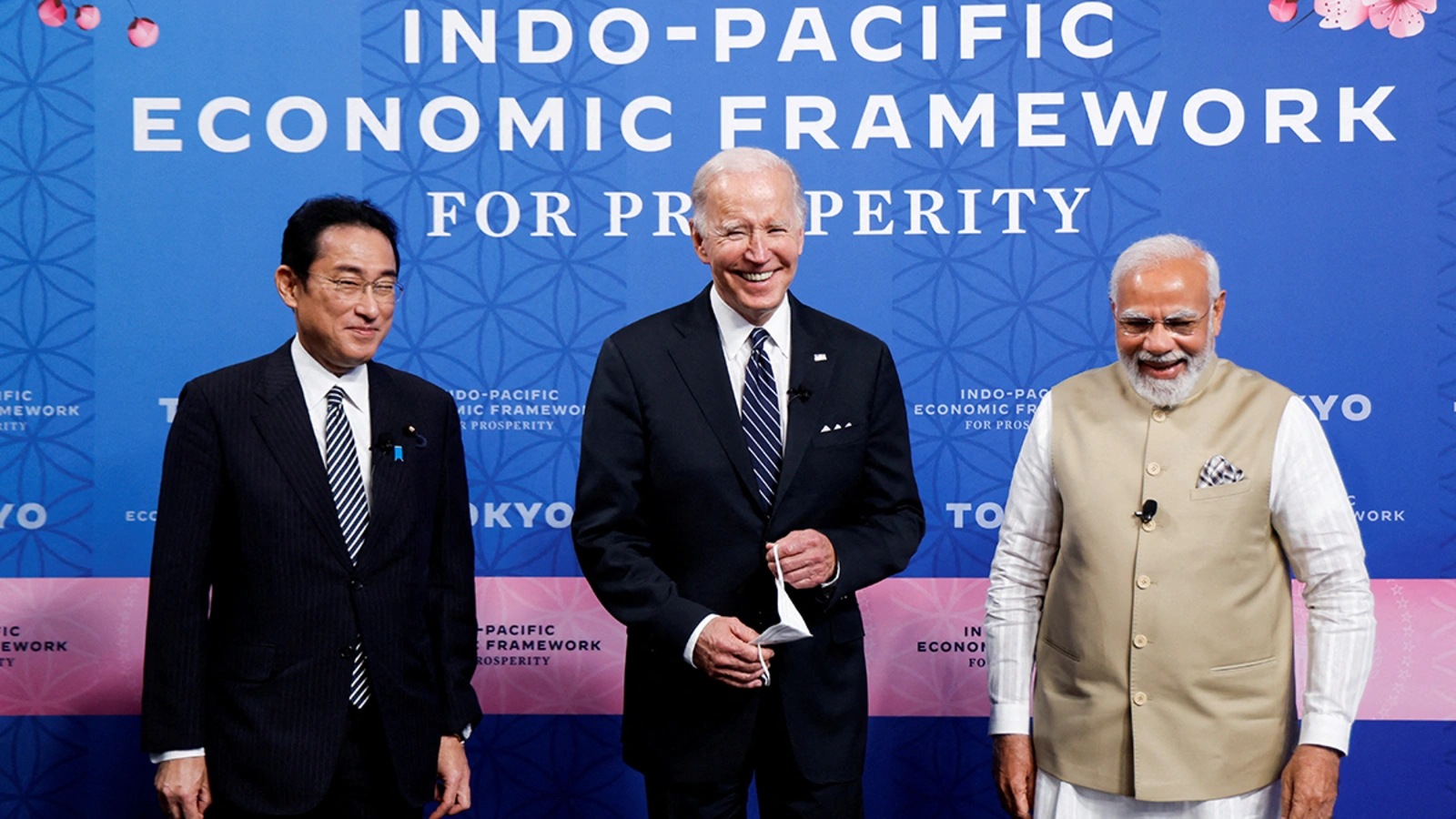
From left to right, Japanese Prime Minister Fumio Kishida, U.S. President Joe Biden, and Indian Prime Minister Narendra Modi attend the Indo-Pacific Economic Framework (IPEF) launch event in Tokyo in May 2022. Jonathan Ernst/Reuters
In late May, the Joe Biden administration launched its first major trade initiative: the Indo-Pacific Economic Framework (IPEF). The IPEF is billed as an effort to expand U.S. economic leadership in the Indo-Pacific region. This was also the objective of the Trans-Pacific Partnership (TPP), a trade deal that was negotiated during the Barack Obama administration. But President Donald Trump withdrew from the TPP in 2017, and the Biden administration has made clear that it does not intend to reenter that trade pact, which is now renamed the Comprehensive and Progressive Agreement for Trans-Pacific Partnership, or CPTPP.
If there was one common challenge to unite the Asia Pacific region, it would be corruption. From campaign pledges to media coverage to civil society forums, corruption dominates discussion. Yet despite all this talk, there’s little sign of action. Between Australia’s slipping scores and North Korea’s predictably disastrous performance, the 2015 index shows no significant improvement. Has Asia Pacific stalled in its efforts to fight corruption?
This year’s poor results demand that leaders revisit the genuineness of their efforts and propel the region beyond stagnation.
The public desire for change is huge. In India, Sri Lanka and elsewhere, we’ve seen a host of governments coming to power on anti-corruption platforms. As corruption continues to dominate media coverage across and beyond the region, increasing interest in the issue has sparked a raft of new research into both public and private sector corruption.
The bad
So why this picture of zero progress? Despite boastful efforts on petty corruption, Malaysia’s 1MBD scandal brought the crux of the challenge into sharp focus: is political leadership genuinely committed to fighting corruption throughout society? The Malaysian prime minister’s inability to answer questions on the US$700 million that made its way into his personal bank account is only the tip of the iceberg.
In India and Sri Lanka leaders are falling short of their bold promises, while governments in Bangladesh and Cambodia are exacerbating corruption by clamping down on civil society. In Afghanistan and Pakistan a failure to tackle corruption is feeding ongoing vicious conflicts, while China’s prosecutorial approach isn’t bringing sustainable remedy to the menace. This inability to tackle root causes holds true across the region – witness, for example, Australia’s dwindling score in recent years.
Malaysia’s 1MBD scandal brought the challenge into sharp focus: is political leadership genuinely committed to fighting corruption throughout society?
Reversing corruption is clearly not solely down to governments, but they’re the ones with the largest role and the power to create enabling environments for others. This year’s poor results demand that leaders revisit the genuineness of their efforts and propel the region beyond stagnation. They must fulfil promises, and ensure efforts aren’t undermined in practice. Anti-corruption commissions are a prime example here: while their creation across the region is commendable, ongoing political interference and inadequate resources has meant many are unable to fulfil their mandate. This has to be addressed.
Rising prices are hurting wallets across the world. The crisis is particularly bad in Sri Lanka and Turkey, and in Japan, people are facing inflation for the first time in decades.
Nikkei staff writersMay 20, 2022 07:38 JST
NEW YORK — Welcome to Nikkei Asia’s podcast: Asia Stream.
Every episode, Asia Stream tracks and analyzes the Indo-Pacific with a mix of expert interviews and original reporting by our correspondents from across the globe.
In Tokyo on May 23, President Biden announced the formation of the Indo-Pacific Economic Framework for Prosperity (IPEF). The framework will bring together the United States and a dozen other Indo-Pacific countries. The agreement will cover both traditional and digital trade standards, decarbonization and infrastructure, supply chain resiliency, taxation, and anti-corruption.
By Graeme DobellGraeme Dobell (graemedobell@aspi.org.au) is Journalist Fellow at the Australian Strategic Policy Institute. He has been reporting on Australian and international politics, foreign affairs and defense, and the Asia-Pacific since 1975.
Australia’s election: Quad continuity and climate alignment, with nuclear disagreements
Sworn-in as Australia’s new prime minister, within hours Anthony Albanese was flying to Japan for the summit of the Quadrilateral Security Dialogue (“Quad”).
An accident of timing—the May 24 summit following Australia’s May 21 election—offered the leader of the Australian Labor Party plenty of flying-start symbolism.
On February 11, 2022, the Biden administration released its Indo-Pacific Strategy. The document covers a vast geographic area including many nations and touches on a wide range of issues. What does the new strategy mean for U.S.-Vietnam cooperation?
Diplomatic Cooperation
The strategy names Vietnam as one of the United States’ leading regional partners. Keen observers have anticipated the U.S.-Vietnam Comprehensive Partnership signed in 2013 to be upgraded to a strategic partnership. Although some U.S. and Vietnamese officials have said that the name does not matter, formally upgrading to a strategic partnership with a written joint statement will assure both sides’ commitments.
Economic Cooperation
Vietnam’s digital economy is rapidly expanding. In 2011, only 35 percent of the Vietnamese population used the internet, which doubled to 70 percent by 2020. According to the e-Conomy SEA 2021 report, 71 percent of Vietnamese internet users have made at least one purchase online. The report projected Vietnam’s gross merchandise value (GMV) to reach a total value of $21 billion in 2021, when all sectors, except online travel, experienced double-digit growth. E-commerce is leading the pack, with a 53 percent increase from $8 billion to $13 billion. Vietnam’s GMV is expected to grow from $21 billion in 2021 to $57 billion in 2025.
Today, we – Prime Minister Anthony Albanese of Australia, Prime Minister Narendra Modi of India, Prime Minister Fumio Kishida of Japan, and President Joe Biden of the United States – convene in Tokyo to renew our steadfast commitment to a free and open Indo-Pacific that is inclusive and resilient.
Just over one year ago, Leaders met for the first time. Today in Tokyo, we convene for our fourth meeting, and our second in person, to demonstrate, at a time of profound global challenge, that the Quad is a force for good, committed to bringing tangible benefits to the region. In our first year of cooperation, we established the Quad’s dedication to a positive and practical agenda; in our second year, we are committed to deliver on this promise, making the region more resilient for the 21st century.
President Biden in Japan.Doug Mills/The New York Times
Biden in Asia
The politics of trade policy have become toxic in the U.S.
For decades, the mainstream of both the Democratic and Republican parties favored expanding trade between the U.S. and other countries. Greater globalization, these politicians promised, would increase economic growth — and with the bounty from that growth, the country could compensate any workers who suffered from increased trade. But it didn’t work out that way.
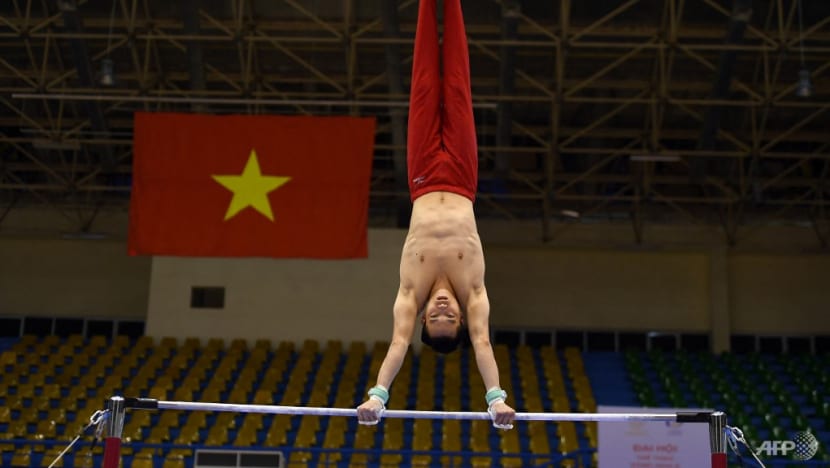
A Vietnamese gymnast takes part in a training session ahead of the 31st Southeast Asian Games (SEA Games) at Quan Ngua gymnasium in Hanoi on May 5, 2022. (Photo: AFP/Nhac Nguyen)A Vietnamese gymnast takes part in a training session ahead of the 31st Southeast Asian Games (SEA Games) at Quan Ngua gymnasium in Hanoi on May 5, 2022. (Photo: AFP/Nhac Nguyen)Malaysia’s Nur Dhabitah Sabri won the first gold at the SEA Games in Hanoi. (Photo: AFP/Nhac Nguyen)The SEA Games will officially begin on May 12, 2022 in Hanoi. (Photo: AFP/Nhac Nguyen)
HANOI: The Southeast Asian Games open in the Vietnamese capital Hanoi on Thursday (May 12) after a six-month COVID-19 delay with Southeast Asian pride at stake in everything from football to bodybuilding and e-sports.
More than 5,000 athletes including Olympic champions are vying for more than 500 gold medals in the event, which is staged every two years, in what should be packed arenas.
The 11-nation Games include traditional Olympic sports such as athletics, swimming and boxing, but also regional ones like sepak takraw, an eye-catching volleyball-style game where teams kick a rattan ball.











 CVD
CVD 