I am an attorney in the Washington DC area, with a Doctor of Law in the US, attended the master program at the National School of Administration of Việt Nam, and graduated from Sài Gòn University Law School. I aso studied philosophy at the School of Letters in Sài Gòn.
.
I have worked as an anti-trust attorney for Federal Trade Commission and a litigator for a fortune-100 telecom company in Washington DC.
I have taught law courses for legal professionals in Việt Nam and still counsel VN government agencies on legal matters.
I have founded and managed businesses for me and my family, both law and non-law.
I have published many articles on national newspapers and radio stations in Việt Nam.
In 1989 I was one of the founding members of US-VN Trade Council, working to re-establish US-VN relationship.
Since the early 90's, I have established and managed VNFORUM and VNBIZ forum on VN-related matters; these forums are the subject of a PhD thesis by Dr. Caroline Valverde at UC-Berkeley and her book Transnationalizing Viet Nam.
I translate poetry and my translation of "A Request at Đồng Lộc Cemetery" is now engraved on a stone memorial at Đồng Lộc National Shrine in VN.
I study and teach the Bible and Buddhism. In 2009 I founded and still manage dotchuoinon.com on positive thinking and two other blogs on Buddhism.
In 2015 a group of friends and I founded website CVD - Conversations on Vietnam Development (cvdvn.net).
I study the art of leadership with many friends who are religious, business and government leaders from many countries.
I have written these books, published by Phu Nu Publishing House in Hanoi:
"Positive Thinking to Change Your Life", in Vietnamese (TƯ DUY TÍCH CỰC Thay Đổi Cuộc Sống) (Oct. 2011)
"10 Core Values for Success" (10 Giá trị cốt lõi của thành công) (Dec. 2013)
"Live a Life Worth Living" (Sống Một Cuộc Đời Đáng Sống) (Oct. 2023)
I practice Jiu Jitsu and Tai Chi for health, and play guitar as a hobby, usually accompanying my wife Trần Lê Túy Phượng, aka singer Linh Phượng.
Biden-Harris Administration is Driving a Multi-Pronged Response to Global Food Security Crisis
President Biden and G7 leaders will announce that they will contribute over $4.5 billion to address global food security, over half of which will come from the United States. President Biden will announce $2.76 billion in additional U.S. Government funding commitments to help protect the world’s most vulnerable populations and mitigate the impacts of Russia’s unprovoked and unjustified war in Ukraine on growing food insecurity and malnutrition. These new investments will support efforts in over 47 countries and regional organizations, to support regional plans to address increasing needs.
Các quận huyện Bình Tân, 12, Tân Phú, Bình Chánh và TP Thủ Đức nguy cơ bùng dịch sốt xuất huyết cũng như Covid-19, theo Giám đốc Sở Y tế Tăng Chí Thượng.
Thông tin được ông Tăng Chí Thượng nói tại cuộc họp về tình hình kinh tế – xã hội giữa năm của UBND TP HCM, sáng 29/6. Cảnh báo được đưa ra trong bối cảnh biến thể Covid-19 mới đã xuất hiện tại Việt Nam, song tỷ lệ tiêm nhắc vaccine còn rất thấp và dịch sốt xuất huyết cũng đang bùng phát ở địa phương này.
Về Covid-19, ông Thượng dẫn Tổ chức Y tế Thế giới (WHO) cho biết các biến thể mới như BA.4 và BA.5 đang có xu hướng thay thế chủng cũ (BA.2) trên toàn cầu. Theo nhận định của Cục Y tế Dự phòng, BA.5 cũng có khả năng trở thành biến thể chủ đạo ở Việt Nam trong thời gian tới.
Được đầu tư vốn lớn cùng làn đường riêng, tuyến BRT đầu tiên của Hà Nội chưa thu hút được người dân, không giảm ùn tắc và thúc đẩy giao thông công cộng.
Tuyến BRT Kim Mã – Yên Nghĩa được phê duyệt từ năm 2007 với tổng vốn đầu tư khoảng 55 triệu USD, tương đương 1.100 tỷ đồng. Ngày 1/1/2017, tuyến bắt đầu hoạt động theo lộ trình Yên Nghĩa – Ba La – Lê Trọng Tấn – Tố Hữu – Lê Văn Lương – Láng Hạ – Giảng Võ – bến xe Kim Mã. Người dân di chuyển toàn tuyến dài 14,77 km sẽ mất khoảng 45 phút.
Dự án được thực hiện bằng vốn vay của Ngân hàng Thế giới (WB). Đây là hợp phần trong lộ trình dài hơi phát triển giao thông công cộng Hà Nội mà WB tham gia. Cơ quan này đưa ra nhiều mục tiêu khi xây dựng tuyến buýt nhanh, như cải thiện tình trạng ùn tắc, ô nhiễm; làm nền tảng phát triển hạ tầng giao thông công cộng; thúc đẩy người dân chuyển từ xe cá nhân sang phương tiện công cộng.
Over the past year, the Asia Maritime Transparency Initiative and the Center for Advanced Defense Studies conducted a study of China’s maritime militia using remote sensing data and open-source Chinese language research. The resulting report, Pulling Back the Curtain on China’s Maritime Militia, features the most comprehensive study to-date of the structure, subsidies, and ownership networks of China’s maritime militia in the South China Sea, as well as a methodology for identifying Chinese maritime militia vessels and a list of over 120 militia vessels thus identified.
Since completing the construction of its artificial island outposts in the Spratly Islands in 2016, China has shifted its focus toward asserting control over peacetime activity across the South China Sea. A key component of this shift has been the expansion of China’s maritime militia—a force of vessels ostensibly engaged in commercial fishing but which in fact operate alongside Chinese law enforcement and military to achieve Chinese political objectives in disputed waters.
The Partnership for Global Infrastructure and Investmentwill deliver game-changing projects to close the infrastructure gap in developing countries, strengthen the global economy and supply chains, and advance U.S. national security
President Biden will announce new flagship projects and lay out the Administration’s comprehensive effort to execute the Partnership for Global Infrastructure and Investment.
At the 2021 G7 Summit, President Biden and G7 leaders announced their intent to develop a values-driven, high-impact, and transparent infrastructure partnership to meet the enormous infrastructure needs of low- and middle-income countries and support the United States’ and its allies’ economic and national security interests. Over the past year, members of the Administration have traveled to hear directly from countries on how we can meet their infrastructure needs, deepened our coordination across the U.S Government and with the G7, honed our infrastructure investment tools, and closed game-changing deals.
‘Years of economic mismanagement’: Why Sri Lanka has a fuel crisis 05:11
(CNN Business)In Sri Lanka, people queue for miles to fill a tank of fuel. In Bangladesh, shops shut at 8 p.m. to conserve energy. In India and Pakistan, power outages force schools to shut, businesses to close and residents to swelter without air conditioning through deadly heat waves in which temperatures top 100 degrees Fahrenheit (37 degrees Celsius).
These are just some of the more eye-catching scenes playing out in the Asia Pacific region, where various countries are facing their worst energy crisis in years — and grappling with the growing discontent and instability caused by knock-on increases in the cost of living.
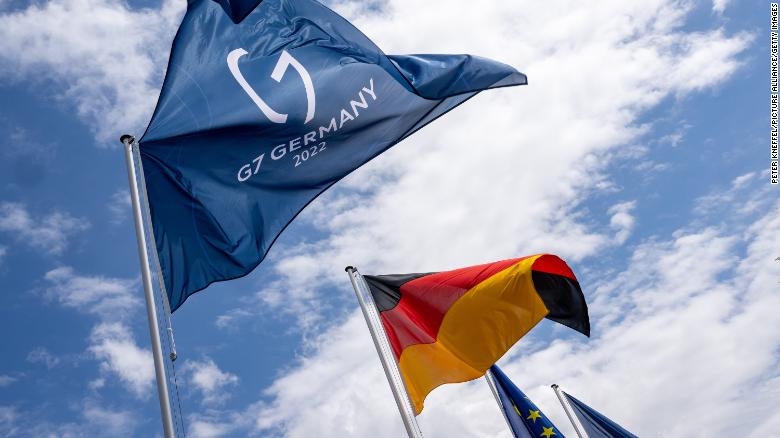
Flags representing the G7 Summit, Germany and the European Union fly ahead of the summit, scheduled to take place at Schloss Elmau in Germany’s Bavaria region from June 26 to 28.
(CNN)What a difference a year makes. Enormous challenges, some of them barely imaginable when the G7 leaders last met 12 months ago, are bearing down on the world’s most prosperous democratic nations as they prepare to meet in Germany.
Optimism was in the air at the Cornish beach resort of Carbis Bay in 2021 as the G7‘s presidents, prime ministers and chancellor met face-to-face for the first time since the Covid-19 pandemic began.
Together they vowed to “beat Covid-19 and build back better,” to “reinvigorate economies,” to “protect our planet” and to “strengthen partnerships.”
But global events have since overtaken their best efforts, and it is far from clear if they will be able to build on those goals this year. Russia’s unprompted invasion of Ukraine is a large and singular cloud, but other thunderheads are gathering too.
Over the next few days, the leaders of Japan, Canada, the United States, the United Kingdom, France, Italy, the European Union and host Germany will meet amid the seclusion of Bavaria’s luxurious Schloss Elmau retreat.
Andrew MullenDeputy Editor, Political Economy 25 June 2022
Dear Global Impact Readers,
Space, they say, is the final frontier. But how far does that frontier go and what’s out there?
China, has in recent years, accelerated all things space as part of its busy science programme we recapped a few weeks ago, from landing a rover on Mars to nearing completion of its Tiangong space station.
This weekend marks the end of Pride month, as cities across the country host events to celebrate the L.G.B.T.Q. community.
It is also a fraught moment in public health: A global outbreak of monkeypox is causing concern, with many of the cases clustered around men who have sex with men.
Experts are now trying to strike a delicate balance, warning people who may be at higher risk, without stigmatizing a community that has often been scapegoated for health scares in the past.
The Supreme Court in a 5-4 decision overturned Roe v. Wade, the landmark ruling that established the constitutional right to abortion.
Roe since 1973 had permitted abortions during the first two trimesters of pregnancy in the United States.
Almost half the states are expected to outlaw or severely restrict abortion as a result of the Supreme Court’s decision on a Mississippi case known as Dobbs v. Jackson Women’s Health Organization.
Justice Samuel Alito wrote the majority opinion. The court’s other five conservatives, including Chief Justice John Roberts, joined in the judgment, which was opposed by the three liberal justices.
Supreme Court overturns Roe v. Wade, ending decades of federal abortion rights
The Supreme Court in a 5-4 decision on Friday overturned Roe v. Wade, the landmark ruling that established the constitutional right to abortion in the U.S. in 1973.
The court’s controversial but expected ruling gives individual states the power to set their own abortion laws without concern of running afoul of Roe, which had permitted abortions during the first two trimesters of pregnancy.
The International Centre for Settlement of Investment Disputes (ICSID) has published the2022 ICSID Rules and Regulationsfor resolving international investment disputes, which come into effect on July 1, 2022.
The updated rules for arbitration, mediation, conciliation, and fact-finding are the outcome of over 5 years of collaboration with State officials, legal counsel, adjudicators, businesses representatives, and civil society. They incorporate innovations designed to make ICSID cases more efficient for parties, to broaden access to ICSID’s facilities and services, and to ensure greater public transparency in the conduct and outcome of proceedings.
This is the first amendment to the ICSID rules since 2006, and the most extensive modernization of ICSID procedures in the Centre’s history.
Innovations introduced in the 2022 Rules and Regulations include:
Tom DannenbaumAssociate Professor of International Law, Tufts University
Alex De WaalResearch Professor and Executive Director of the World Peace Foundation at The Fletcher School, Tufts University
Daniel MaxwellHenry J. Leir Professor in Food Security, Friedman School of Nutrition Science and Policy, Tufts University
Disclosure statement
Alex de Waal is affiliated with the World Peace Foundation.
Daniel Maxwell receives funding from the US Agency for International Development (USAID) and the British Foreign, Commonwealth and Development Office (FCDO). He is a member of the Famine Review Committee for IPC analysis.
Tom Dannenbaum does not work for, consult, own shares in or receive funding from any company or organisation that would benefit from this article, and has disclosed no relevant affiliations beyond their academic appointment.
Partners
Tufts University provides funding as a founding partner of The Conversation US.
Republish our articles for free, online or in print, under Creative Commons licence.
______
A hideous contradiction is playing out in war-torn Ukraine. Thousands of Ukrainians are starving in cities besieged by Russian forces. Meanwhile, the country’s grain stores are bursting with food, and the government is begging for international assistance to export Ukrainian grain to world markets.
Cooking, cleaning, laundry, childcare—domestic labor is essential labor in any society. In Vietnam, a rapidly growing middle class has produced skyrocketing demand for paid domestic workers—both live-in and hourly—particularly in large metropolises like Hanoi and Ho Chi Minh City, and domestic workers have become an important part of the gig economy.
By Tran Đinh Hoanh Tran Đinh Hoanh is an international litigator and writer in Washington DC.
[TĐH: I’ve tried to make this piece ultra-short, simple, and easy
to remember, with sufficient citations for those who’d like to dig
deeper into UNCLOS]
During China Foreign Ministry Spokesperson Wang Wenbin’s Regular Press Conference on June 13, he responded to a Bloomberg question concerning the legal status of the Taiwan Strait. Asked about Chinese military officials’ contention that the Taiwan Strait does not constitute “international waters,” he said that Taiwan is “an inalienable part of China’s territory. …According to UNCLOS and Chinese laws, the waters of the Taiwan Strait, extending from both shores toward the middle of the Strait, are divided into several zones including internal waters, territorial sea, contiguous zone, and the Exclusive Economic Zone. China has sovereignty, sovereign rights and jurisdiction over the Taiwan Strait.”
He went on to say that calling the strait international waters is “a false claim” by “certain countries” searching for a pretext for “threatening China’s sovereignty and security.”
The Quadrilateral grouping of Australia, India, Japan, and the United States (the Quad) has come a long way from its origins, establishing itself as a crucial pillar of the Indo-Pacific regional architecture and significantly shifting in tone and focus from its early iterations. Since its revival in 2017, the Quad has been elevated to a leader-level dialogue, it has begun issuing joint statements, and it has developed a new working-group structure to facilitate cooperation. It has also significantly broadened and deepened its agenda to include vaccines, climate change, critical and emerging technologies, infrastructure, cyber, and space.
These recent changes to the Quad raise several questions about its future trajectory. What are the drivers of engagement, the domestic support, and the bureaucratic capacity in the four countries to continue investing in the Quad? How well does the Quad’s new working-group structure function, and will the working groups be able to deliver tangible results? How has the Quad’s agenda evolved, and will it return to its initial focus on security challenges? Are the Quad countries open to cooperation with additional countries and, if so, what form will this take?
This paper analyzes these questions drawing on recent publications, official statements, and interviews with key experts and policymakers in the four countries. In doing so, it offers five key takeaways into the Quad as an evolving part of the Indo-Pacific architecture, as well as a vehicle for achieving the goals of its four member countries.
Since its revival in 2017, the Quad has been elevated to a leader-level dialogue, it has begun issuing joint statements, and it has developed a new working-group structure to facilitate cooperation
First, in terms of institutionalization and internal goals, there is little interest among the member countries in further institutionalizing the Quad by establishing a secretariat or adopting a charter. All four consider the flexible nature of the grouping to be an asset. At the same time, the Quad partners have increased their alignment on strategic issues and aim to continue doing so in the near future by solidifying ties within the grouping.


 Andrew MullenDeputy Editor, Political Economy 25 June 2022


 We believe in the free flow of information


 CVD
CVD 