I am an attorney in the Washington DC area, with a Doctor of Law in the US, attended the master program at the National School of Administration of Việt Nam, and graduated from Sài Gòn University Law School. I aso studied philosophy at the School of Letters in Sài Gòn.
.
I have worked as an anti-trust attorney for Federal Trade Commission and a litigator for a fortune-100 telecom company in Washington DC.
I have taught law courses for legal professionals in Việt Nam and still counsel VN government agencies on legal matters.
I have founded and managed businesses for me and my family, both law and non-law.
I have published many articles on national newspapers and radio stations in Việt Nam.
In 1989 I was one of the founding members of US-VN Trade Council, working to re-establish US-VN relationship.
Since the early 90's, I have established and managed VNFORUM and VNBIZ forum on VN-related matters; these forums are the subject of a PhD thesis by Dr. Caroline Valverde at UC-Berkeley and her book Transnationalizing Viet Nam.
I translate poetry and my translation of "A Request at Đồng Lộc Cemetery" is now engraved on a stone memorial at Đồng Lộc National Shrine in VN.
I study and teach the Bible and Buddhism. In 2009 I founded and still manage dotchuoinon.com on positive thinking and two other blogs on Buddhism.
In 2015 a group of friends and I founded website CVD - Conversations on Vietnam Development (cvdvn.net).
I study the art of leadership with many friends who are religious, business and government leaders from many countries.
I have written these books, published by Phu Nu Publishing House in Hanoi:
"Positive Thinking to Change Your Life", in Vietnamese (TƯ DUY TÍCH CỰC Thay Đổi Cuộc Sống) (Oct. 2011)
"10 Core Values for Success" (10 Giá trị cốt lõi của thành công) (Dec. 2013)
"Live a Life Worth Living" (Sống Một Cuộc Đời Đáng Sống) (Oct. 2023)
I practice Jiu Jitsu and Tai Chi for health, and play guitar as a hobby, usually accompanying my wife Trần Lê Túy Phượng, aka singer Linh Phượng.
A Cambodian naval officer salutes at the Ream Naval Base in a file photo. Image: Twitter
Rising Sino-American rivalry and fears of an accidental superpower clash are forcing states to step up their diplomatic games.
That’s particularly true for the Association of Southeast Asian Nations (ASEAN), which is now scrambling to forge greater internal unity and nudge the US and China toward greater dialogue to avoid a conflict in its neighborhood.
Image: Australian Strategic Policy Institute / NASA
The Indo-Pacific is increasingly defined by strategic competition between the United States and China. But this dynamic is further complicated by the presence of a class of diverse but consequential second-tier states.
Their middling economic and military capabilities are often combined with valuable geographic positioning around the flashpoints of potential conflict, or elevated social status in elite global clubs such as the G20 or OECD – making them important regional players whose roles and preferences cannot be ignored.
NATO Holds Largest Air Drills in Europe Since End of Cold WarT
wenty-five countries are participating in joint military air exercises (NYT) that began in Germany yesterday, including new North Atlantic Treaty Organization (NATO) member Finland and prospective member Sweden. The drills, planned since 2018, were initially organized following Russia’s 2014 invasion and illegal annexation of Ukraine’s Crimean Peninsula, but have taken on new relevance after Russia invaded Ukraine last year. The drills will occur at six German bases over twelve days.
Japan is an observer to the drills, which come as NATO is preparing documents that will elevate its partnerships with the Indo-Pacific countries of Australia, Japan, New Zealand, and South Korea, Nikkei reported. The leaders of those four countries are expected to attend a NATO summit in Lithuania in July.
The present policy brief is focused on how threats to information integrity are having an impact on
progress on global, national and local issues. In Our Common Agenda, I called for empirically backed consensus around facts, science and knowledge. To that end, the present brief outlines potential principles for a code of conduct that will help to guide Member States, the digital platforms and other stakeholders in their efforts to make the digital space more inclusive and safe for all, while vigorously defending the right to freedom of opinion and expression, and the right to access information. The Code of Conduct for Information Integrity on Digital Platforms is being developed in the context of reparations for the Summit of the Future. My hope is that it will provide a gold standard for guiding action to strengthen information integrity.
Digital platforms are crucial tools that have transformed social, cultural and political interactions
everywhere. Across the world, they connect concerned global citizens on issues that matter. Platforms help the United Nations to inform and engage people directly as we strive for peace, dignity and equality on a healthy planet. They have given people hope in times of crisis and struggle, amplified voices that were previously unheard and breathed life into global movements.
Yet these same platforms have also exposed a darker side of the digital ecosystem. They have enabled the rapid spread of lies and hate, causing real harm on a global scale. Optimism over the potential of social media to connect and engage people has been dampened as mis- and disinformation and hate speech have surged from the margins of digital space into the mainstream. The danger cannot be overstated. Social mediaenabled hate speech and disinformation can lead to violence and death.
The ability to disseminate large-scale disinformation to undermine scientifically established facts poses an existential risk to humanity (A/75/982, para. 26) and endangers democratic institutions and fundamental human rights. These risks have further intensified because of rapid advancements in technology, such as generative artificial intelligence. Across the world, the United Nations is monitoring how mis- and disinformation and hate speech can threaten progress towards the Sustainable Development Goals. It has become clear that business as usual is not an option.
By Carlyle A. Thayer , Emeritus Professor, The University of New South Wales at the Australian Defence Force Academy, Canberra
When Prime Minister Anthony Albanese visited Vietnam last weekend, he took an important symbolic step in a long history of consolidating bilateral relations. Carlyle A. Thayer reviews a remarkable transformation that in five decades turned Vietnam from enemy to valued friend and partner.
In February 1973, the Whitlam Labor Government extended diplomatic recognition to the communist Democratic Republic of Vietnam (DRV, North Vietnam), a recent adversary in the Vietnam War. Fifty years later, Australia and the unified Socialist Republic of Vietnam (SRV) are poised to become comprehensive strategic partners, a status Vietnam has only accorded to four countries – Russia, India, China, and South Korea. Prime Minister Anthony Albanese recently declared that Vietnam will become one of Australia’s top-tier partners.
The governments of Australia, Canada, Japan, New Zealand, the United Kingdom, and the United States of America released the following Joint Declaration on 9 June 2023.
The use of trade-related economic coercion and non-market-oriented policies and practices (“non-market policies and practices”) threatens and undermines the rules-based multilateral trading system and harms relations between countries. The purpose of this Declaration is to express our shared concern and affirm our commitment to enhance international cooperation in order to effectively deter and address trade-related economic coercion and non-market policies and practices.
We express serious concern over trade-related economic coercion and non-market policies and practices that undermine the functioning of and confidence in the rules-based multilateral trading system by distorting trade, investment, and competition and harming relations between countries. Trade-related economic coercion and non-market policies and practices threaten the livelihoods of our citizens, harm our workers and businesses, and could undermine global security and stability.
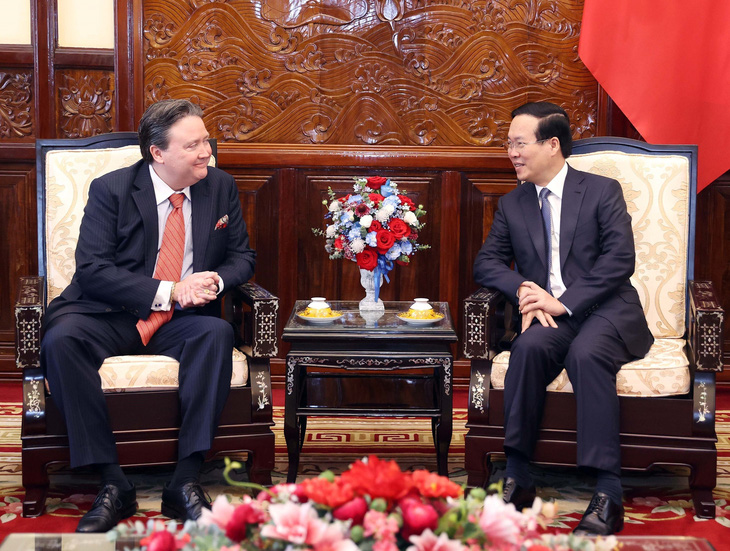
This image shows Vietnamese State President Vo Van Thuong (R) talking with U.S. Ambassador Marc Knapper (L) in Hanoi on June 5, 2023. Photo: Vietnam News Agency
Vietnam always attaches significance to developing its comprehensive cooperation with the U.S., one of its most important partners in the world, State President Vo Van Thuong told Ambassador Marc Knapper.
President Thuong was speaking at his meeting with the ambassador at the Presidential Palace in Hanoi on Monday, during which he also brought forward some suggestions for further promoting the Vietnam – U.S. comprehensive partnership that was set up in 2013, the Vietnam News Agency reported.
It is indeed great to be back here for another Shangri-La Dialogue.
Let me thank John and everyone at IISS for their efforts to deepen our dialogue on the Indo-Pacific. You know, this is my third time speaking in Singapore at an IISS event. And so this is starting to be—it’s becoming a habit there, John.
I also want to thank our national host, Singapore, for your tremendous hospitality.
And it’s great to see Senior Minister Teo, and Minister Ng, and other distinguished guests from our host here today.
And I’m glad that we’re joined by so many defense ministers and leaders from around the Indo-Pacific and around the world.
One minister of defense made a special effort to be here today: my good friend Oleksii Reznikov of Ukraine. Oleksii’s seat is currently empty. I’m sure he’s working the room somewhere around here, but Oleskii, if you can hear me, I’d remind you that, I’d just tell you that your presence here reminds us that we can never take our peace and security for granted.
I’m also delighted to be here with Director Haines and many of our U.S. military leaders.
So thanks to everyone for being here today.
This dialogue is always a great opportunity to exchange views. And the only thing more wide-ranging than the conference agenda is the breakfast buffet.
Humans are taking colossal risks with the future of civilization and everything that lives on Earth, a new study published in the journal Nature shows. Developed by an international science commission engaging more than 40 researchers from across the globe, the scientists deliver the first quantification of safe and just Earth system boundaries on a global and local level for several biophysical processes and systems that regulate the state of the Earth system.
For the first time, safety and justice for humanity on Earth is assessed and quantified for the same control variables regulating life support and Earth stability. Justice, assessed based on avoiding significant harm to people across the world, tightens the Earth system boundaries, providing even less available space for humans on Earth. This is extremely challenging, as the Earth Commission concludes that numerous of the safe boundaries are already crossed today.
“We are in the Anthropocene, putting the stability and resilience of the entire planet at risk. This is why, for the first time, we present quantifiable numbers and a solid scientific foundation to assess the state of our planetary health not only in terms of Earth System stability and resilience but also in terms of human wellbeing and equity / justice.” said Prof. Johan Rockström, Earth Commission Co-Chair, lead author and Director of the Potsdam Institute for Climate Impact Research.
“Justice is a necessity for humanity to live within planetary limits. This is a conclusion seen across the scientific community in multiple heavyweight environmental assessments. It is not a political choice. Overwhelming evidence shows that a just and equitable approach is essential to planetary stability. We cannot have a biophysically safe planet without justice. This includes setting just targets to prevent significant harm and guarantee access to resources to people and for as well as just transformations to achieve those targets” said co-author Prof. Joyeeta Gupta, Co-Chair of the Earth Commission, Professor of Environment and Development in the Global South at the University of Amsterdam and Professor of Law and Policy in Water Resources and Environment at IHE Delft Institute for Water Education.
The stability and resilience of the Earth system and human well-being are inseparably linked1,2,3, yet their interdependencies are generally under-recognized; consequently, they are often treated independently4,5. Here, we use modelling and literature assessment to quantify safe and just Earth system boundaries (ESBs) for climate, the biosphere, water and nutrient cycles, and aerosols at global and subglobal scales. We propose ESBs for maintaining the resilience and stability of the Earth system (safe ESBs) and minimizing exposure to significant harm to humans from Earth system change (a necessary but not sufficient condition for justice)4. The stricter of the safe or just boundaries sets the integrated safe and just ESB. Our findings show that justice considerations constrain the integrated ESBs more than safety considerations for climate and atmospheric aerosol loading. Seven of eight globally quantified safe and just ESBs and at least two regional safe and just ESBs in over half of global land area are already exceeded. We propose that our assessment provides a quantitative foundation for safeguarding the global commons for all people now and into the future.
Negotiators from 14 Indo-Pacific nations concluded negotiations in substance on a new Indo-Pacific Economic Framework for Prosperity (IPEF) Supply Chain Agreement. At a ministerial-level meeting on the margins of an Asia-Pacific Economic Cooperation (APEC) forum gathering in Detroit, Michigan, IPEF parties released a statement outlining major contours of the agreement. The first of four potential agreements that the United States aims to conclude under IPEF, the supply chains agreement represents a positive step toward further economic integration in the Indo-Pacific. However, questions remain about how binding or impactful the supply chains agreement will be and which additional agreements will come to fruition under the framework this year.
Q1: What did IPEF partners agree to under the new Supply Chains Agreement?
Over the past year, the Asia Maritime Transparency Initiative and the Center for Advanced Defense Studies conducted a study of China’s maritime militia using remote sensing data and open-source Chinese language research. The resulting report, Pulling Back the Curtain on China’s Maritime Militia, features the most comprehensive study to-date of the structure, subsidies, and ownership networks of China’s maritime militia in the South China Sea, as well as a methodology for identifying Chinese maritime militia vessels and a list of over 120 militia vessels thus identified.
Since completing the construction of its artificial island outposts in the Spratly Islands in 2016, China has shifted its focus toward asserting control over peacetime activity across the South China Sea. A key component of this shift has been the expansion of China’s maritime militia—a force of vessels ostensibly engaged in commercial fishing but which in fact operate alongside Chinese law enforcement and military to achieve Chinese political objectives in disputed waters.
In response to reporters’ questions on the afternoon of May 25, 2023, Deputy Spokeswoman of the Vietnamese Ministry of Foreign Affairs (MOFA), Pham Thu Hang said that Chinese survey vessel Xiang Yang Hong 10 (XYH-10), Coast Guard vessels, and fishing ships had violated Vietnam’s exclusive economic zone (EEZ) established in accordance with the provisions of the United Nations Convention on the Law of the Sea 1982 (UNCLOS 1982).[1] According to Reuters, the ship XYH-10 and its escorts have appeared in Vietnam’s EEZ since May 8.[2] Data from open vessel-tracking sources such as Marine Traffic or Sea Vision also show this occurrence. Looking back from the beginning of 2023 until now, China has deployed many so-called “survey and research vessels” to operate in Vietnam’s EEZ, such as the case of the Haiyang Dizhi 4 in early March 2023, but it is noteworthy that the XYH-10 this time is approaching the coast of Vietnam and blatantly conducting activities that China calls “normal”. Against the backdrop of China’s efforts to build the image of a “responsible major power”, this move of China has obviously infringed on the UNCLOS and seriously violated Vietnam’s sovereign rights and jurisdiction in its EEZ and continental shelf established in accordance with UNCLOS.
Phương án phát triển lưới điện quốc gia thời kỳ 2021 – 2030 (Hình từ internet)
Ngày 15/5/2023, Thủ tướng Chính phủ ban hành Quyết định 500/QĐ-TTg phê duyệt Quy hoạch phát triển điện lực quốc gia thời kỳ 2021 – 2030, tầm nhìn đến năm 2050 (Quy hoạch điện VIII).
1. Phương án phát triển lưới điện quốc gia thời kỳ 2021 – 2030
Về định hướng phát triển
– Phát triển hệ thống truyền tải điện đồng bộ với tiến độ các nguồn điện, nhu cầu phát triển phụ tải của các địa phương, sử dụng công nghệ hiện đại, đảm bảo tiêu chuẩn quốc tế, sẵn sàng kết nối khu vực. Phát triển lưới điện thông minh để tích hợp các nguồn năng lượng tái tạo ở quy mô lớn, đáp ứng yêu cầu vận hành hệ thống điện an toàn, ổn định và kinh tế.
– Phát triển lưới điện truyền tải 500 kV và 220 kV bảo đảm khả năng giải tỏa công suất các nhà máy điện, nâng cao độ tin cậy cung cấp điện, giảm tổn thất điện năng, đáp ứng tiêu chí N-1 đối với vùng phụ tải quan trọng và N-2 đối với vùng phụ tải đặc biệt quan trọng.
Phát triển lưới điện truyền tải điện có dự phòng lâu dài, tăng cường sử dụng cột nhiều mạch, nhiều cấp điện áp đi chung để giảm diện tích chiếm đất. Khuyến khích xây dựng các trạm biến áp truyền tải kết hợp cung cấp điện cho phụ tải lân cận.
– Lưới điện truyền tải 500 kV giữ vai trò xương sống trong liên kết các hệ thống điện vùng miền và trao đổi điện năng với các nước trong khu vực. Giới hạn truyền tải liên miền ở mức hợp lý, giảm truyền tải điện đi xa, hạn chế tối đa xây dựng mới các đường dây truyền tải liên miền trước năm 2030.
– Xây dựng lưới điện 220 kV bảo đảm độ tin cậy, các trạm biến áp trong khu vực có mật độ phụ tải cao thiết kế theo sơ đồ đảm bảo vận hành linh hoạt. Xây dựng các trạm biến áp 220 kV đủ điều kiện vận hành tự động không người trực. Đẩy mạnh xây dựng các trạm biến áp GIS, trạm biến áp 220/22 kV, trạm ngầm tại các trung tâm phụ tải.
– Nghiên cứu ứng dụng hệ thống Back-to-Back, thiết bị truyền tải điện linh hoạt để nâng cao khả năng truyền tải, giảm thiểu diện tích chiếm đất. Tổ chức nghiên cứu công nghệ truyền tải điện xoay chiều và một chiều điện áp trên 500 kV.
– Định hướng sau năm 2030 sẽ phát triển các đường dây truyền tải siêu cao áp một chiều kết nối khu vực Trung Trung Bộ, Nam Trung Bộ và Bắc Bộ để khai thác mạnh tiềm năng điện gió ngoài khơi. Nghiên cứu các kết nối xuyên châu Á – Thái Bình Dương.
Các dự án lưới điện truyền tải trong Quy hoạch điện VII điều chỉnh chưa đưa vào vận hành được điều chỉnh trong Quy hoạch này.
Về khối lượng xây dựng lưới truyền tải
– Giai đoạn 2021 – 2030: Xây dựng mới 49.350 MVA và cải tạo 38.168 MVA trạm biến áp 500 kV; xây dựng mới 12.300 km và cải tạo 1.324 km đường dây 500 kV; xây dựng mới 78.525 MVA và cải tạo 34.997 MVA trạm biến áp 220 kV; xây dựng mới 16.285 km và cải tạo 6.484 km đường dây 220 kV.
– Định hướng giai đoạn 2031 – 2050: Xây dựng mới 40.000 – 60.000 MW dung lượng trạm HVDC và 5.200 – 8.300 km đường dây HVDC; xây dựng mới 90.900 – 105.400 MVA và cải tạo 117.900 -120.150 MVA trạm biến áp 500 kV; xây dựng mới 9.400 – 11.152 km và cải tạo 801 km đường dây 500 kV; xây dựng mới 124.875 – 134.125 MVA và cải tạo 105.375 – 106.750 MVA trạm biến áp 220 kV; xây dựng mới 11.395 – 11.703 km, cải tạo 504 – 654 km đường dây 220 kV. Khối lượng lưới điện giai đoạn 2031 – 2050 sẽ chuẩn xác trong các quy hoạch điện thời kỳ tiếp theo.
2. Liên kết lưới điện với các nước trong khu vực
– Tiếp tục nghiên cứu hợp tác, liên kết lưới điện với các nước tiểu vùng sông Mê Kông và các nước ASEAN ở các cấp điện áp 500 kV và 220 kV để tăng cường khả năng liên kết hệ thống, trao đổi điện năng, tận dụng thế mạnh tài nguyên của các quốc gia.
– Thực hiện liên kết lưới điện với Lào bằng các tuyến đường dây 500 kV, 220 kV để nhập khẩu điện từ các nhà máy điện tại Lào theo biên bản ghi nhớ hợp tác đã ký kết giữa hai Chính phủ.
– Duy trì liên kết lưới điện với các nước láng giềng qua các cấp điện áp 220 kV, 110 kV, trung thế hiện có; nghiên cứu thực hiện giải pháp hòa không đồng bộ giữa các hệ thống điện bằng trạm chuyển đổi một chiều – xoay chiều ở cấp điện áp 220-500 kV.
– Xây dựng các công trình đấu nối các dự án xuất khẩu điện có hiệu quả kinh tế cao trên cơ sở đảm bảo an ninh năng lượng và an ninh quốc phòng.




 Mục lục bài viết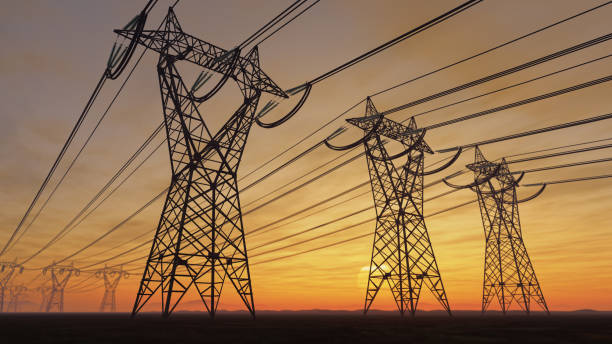
 CVD
CVD 