I am an attorney in the Washington DC area, with a Doctor of Law in the US, attended the master program at the National School of Administration of Việt Nam, and graduated from Sài Gòn University Law School. I aso studied philosophy at the School of Letters in Sài Gòn.
.
I have worked as an anti-trust attorney for Federal Trade Commission and a litigator for a fortune-100 telecom company in Washington DC.
I have taught law courses for legal professionals in Việt Nam and still counsel VN government agencies on legal matters.
I have founded and managed businesses for me and my family, both law and non-law.
I have published many articles on national newspapers and radio stations in Việt Nam.
In 1989 I was one of the founding members of US-VN Trade Council, working to re-establish US-VN relationship.
Since the early 90's, I have established and managed VNFORUM and VNBIZ forum on VN-related matters; these forums are the subject of a PhD thesis by Dr. Caroline Valverde at UC-Berkeley and her book Transnationalizing Viet Nam.
I translate poetry and my translation of "A Request at Đồng Lộc Cemetery" is now engraved on a stone memorial at Đồng Lộc National Shrine in VN.
I study and teach the Bible and Buddhism. In 2009 I founded and still manage dotchuoinon.com on positive thinking and two other blogs on Buddhism.
In 2015 a group of friends and I founded website CVD - Conversations on Vietnam Development (cvdvn.net).
I study the art of leadership with many friends who are religious, business and government leaders from many countries.
I have written these books, published by Phu Nu Publishing House in Hanoi:
"Positive Thinking to Change Your Life", in Vietnamese (TƯ DUY TÍCH CỰC Thay Đổi Cuộc Sống) (Oct. 2011)
"10 Core Values for Success" (10 Giá trị cốt lõi của thành công) (Dec. 2013)
"Live a Life Worth Living" (Sống Một Cuộc Đời Đáng Sống) (Oct. 2023)
I practice Jiu Jitsu and Tai Chi for health, and play guitar as a hobby, usually accompanying my wife Trần Lê Túy Phượng, aka singer Linh Phượng.
While China’s use of maritime gray zone tactics is well known, few resources describe the actual tactics in detail. We’ve developed a publicly available systematic examination of these concrete tactics, which we will roll out for you in the coming weeks.
Spoofing is the act of deceptively and deliberately falsifying a vessel’s AIS identifying information or location.
Gaute Friis | SEPTEMBER 3, 2023
A China Coast Guard (CCG) cutter transmits fraudulent AIS signals to nearby vessels, appearing as a fishing boat on their monitoring equipment (Credit: Gaille Powell).
Gaute Friis
Analyst
Spoofing is a deception tactic meant to disrupt monitoring of maritime activities. It is frequently employed by Chinese gray zone actors in the South China Sea. In contrast to the “going dark” tactic of simply disabling a vessel’s Automatic Information System (AIS) broadcast, the spoofing tactic involves manipulating transmitting signals in order to falsify a vessel’s identity and/or location.
Cable-cutting is a sabotage and harassment tactic in which a ship will attempt to sever the cable to another ship’s trailing equipment, such as trawler lines or towed array sonars.
Gaute Friis | JULY 26, 2023
Chinese fisherman using a boat hook pole in an attempt to snag the cable connecting U.S ocean surveillance ship USNS Impeccable’s towed sonar array, March 8, 2009. (Source: USN)
Gaute Friis, analyst
This tactic is an act of sabotage which aim to cut the cables to a ship’s trailing equipment, such as trawler lines or towed array sonars.
Cable-cutting is most frequently used against commercial research vessels conducting survey operations in disputed maritime zones, such as within China’s huge “nine-dash line” claim in the South China Sea.
Dazzlers are non-lethal laser weapons meant to cause temporary blindness in humans or confound sensors. Recently employed against the Philippine Coast Guard, laser dazzlers have also been employed against U.S. and Australian military helicopters and surveillance planes operating in the region.
Gaute Friis | SEPTEMBER 12, 2023
CCG 5205 firing laser at Philippine Coast Guard cutter BRP Malapascua, February 6, 2023 (Source: Philippine Coast Guard)
Gaute Friis Analyst
Dazzlers are an emerging category of non-lethal but potentially dangerous weapons and a relatively recent addition to China’s gray zone arsenal. They can be used as a harassment tool; for destroying sensitive electro-optical sensors as an electronic warfare component; or as a weapon of psychological warfare.
Dazzlers are not themselves considered illegal. The U.S. military — which refers to them as “non-lethal optical distractors” — considers them an essential capability to “minimize fatalities, protect the innocent and limit collateral damage” when the alternative is lethal force, with the caveat that:
“Prior to fielding, all previously and currently fielded lasers or distracter devices have undergone legal reviews to ensure compliance with obligations assumed by the U.S. under applicable treaties, customary international law, and the law of armed conflict.”
China has used dazzlers to temporarily blind the crew of other countries’ ships. Because dazzlers have both physical and psychological effects their use against vessels at sea is hazardous, eroding their crews’ ability to navigate and react to maritime contingencies.
As detailed in our “going dark” playbook entry, a Chinese Coast Guard cutter used a dazzler to harass a Philippine resupply escort mission on February 6th, 2023.
The Philippine Coast Guard later clarified that was the second time this had occurred during a resupply mission.
Note: Any use of lasers to permanently blind personnel is illegal under Protocol IV (Blinding Laser Weapons) under the Convention on Certain Conventional Weapons, which China joined in 1998.
Central Office of Communist Party of Vietnam Hanoi, Vietnam
6:33 P.M. ICT
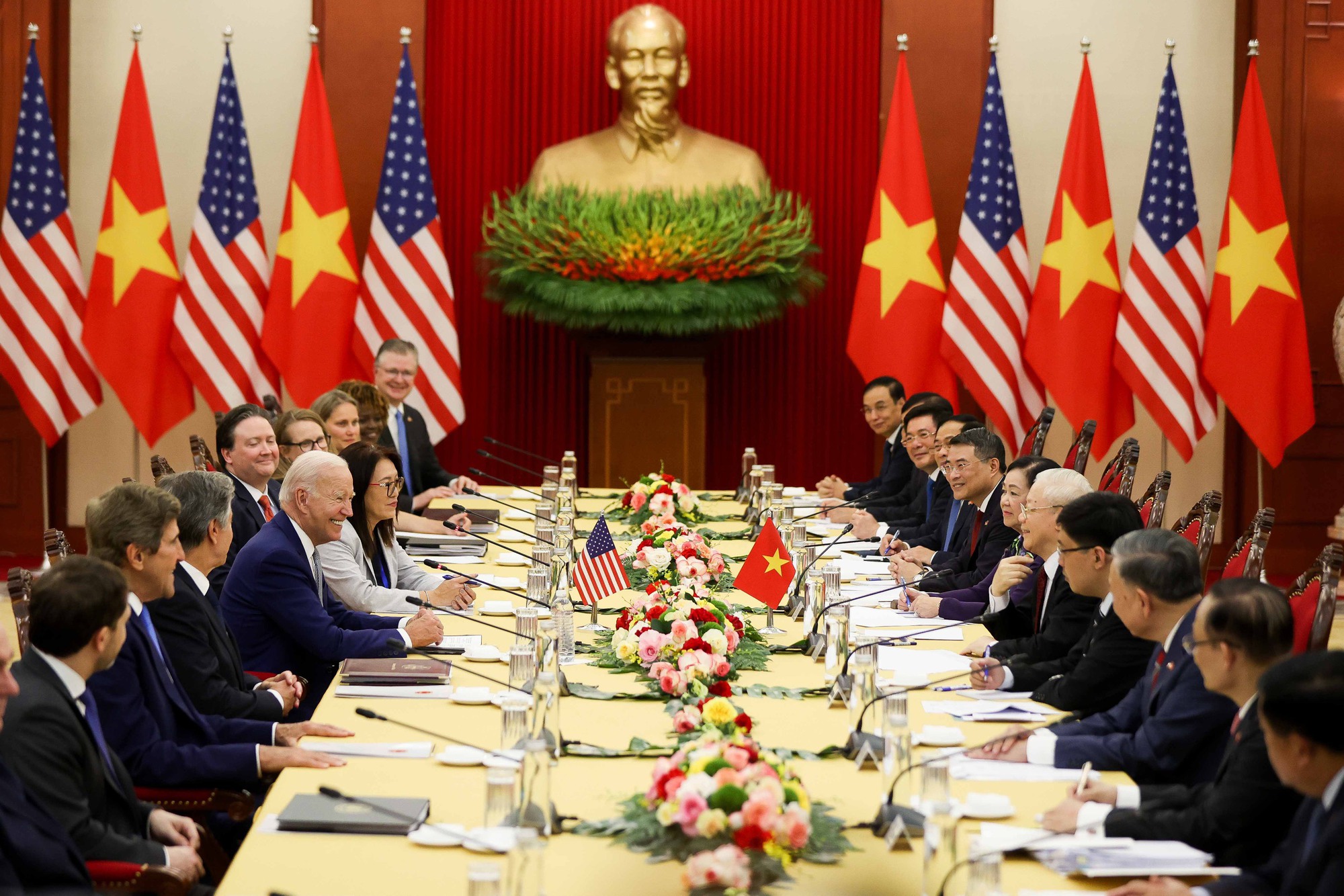
GENERAL SECRETARY TRỌNG: (As interpreted.) Your Honorable Joe Biden, President of the United States of America, distinguished delegates, on behalf of the leaders of the party, state, and people of Vietnam, I’d like to extend my warmest welcome to his Honorable President Joe Biden, who has great affection for the country and people of Vietnam, and for his various contributions to the strengthening of the friendship and cooperation between Vietnam and the U.S. in different capacities.
His visit to Vietnam on this occasion is of great significance, for it coincides with the celebration of the 10th anniversary of the Comprehensive Partnership between the two countries.
Tổng Bí thư Nguyễn Phú Trọng và Tổng thống Mỹ Joe Biden thông báo Việt Nam – Mỹ thống nhất nâng cấp quan hệ lên đối tác chiến lược toàn diện.
Chiều 10.9, tại trụ sở Văn phòng T.Ư Đảng, ngay sau khi kết thúc hội đàm, Tổng Bí thư Nguyễn Phú Trọng và Tổng thống Mỹ Joe Biden thông báo Việt Nam – Mỹ thống nhất nâng cấp quan hệ từ đối tác toàn diện lên đối tác chiến lược toàn diện – cấp cao nhất trong quan hệ ngoại giao nhà nước.
A vital regional river can be a route for U.S. diplomacy.
By Brian Eyler, the director of the Stimson Center’s Southeast Asia Program.
My FP: Follow topics and authors to get straight to what you like. Exclusively for FP subscribers. Subscribe Now | Log In
SEPTEMBER 8, 2023, 4:38 PM
On Sept. 10, Joe Biden pays his first visit to Vietnam as U.S. president, where he is expected to ink a deal to elevate the U.S.-Vietnam relationship from “comprehensive” to “comprehensive strategic”—the highest level of Vietnam’s diplomatic hierarchy. Biden is forgoing this week’s twin summits in Indonesia—the Association of Southeast Asian Nations summit and the East Asia Summit—to show the value Washington places on key bilateral partners, such as Vietnam, in the Indo-Pacific.
Some critics worry that China and Russia, two of Vietnam’s other comprehensive strategic partners, could punish Vietnam for its choice to upgrade relations with the United States. But Vietnam can come out of this complicated diplomatic competition a clear winner by centering the U.S.-Vietnam collaboration on the Mekong—the mighty river that keeps both Vietnam and much of the rest of the world fed.
1. Prime Minister Narendra Modi welcomed United States President Joseph R. Biden, Jr., to India today, reaffirming the close and enduring partnership between India and the United States. The leaders expressed their appreciation for the substantial progress underway to implement the ground breaking achievements of Prime Minister Modi’s historic, June 2023, visit to Washington.
2. The leaders called on their governments to continue the work of transforming the India-U.S. Strategic Partnership across all dimensions of our multifaceted global agenda, based on trust and mutual understanding. The leaders re-emphasized that the shared values of freedom, democracy, human rights, inclusion, pluralism, and equal opportunities for all citizens are critical to the success our countries enjoy and that these values strengthen our relationship. Tiếp tục đọc “Joint Statement from India and the United States”→
Let me save you some reading. ASEAN Summit Chair’s Statement says almost nothing about Ukraine & nothing new about SCS or Myanmar. EAS Chair’s Statement is more critical of Russia, but also says nothing new on SCS or Myanmar.
And this is why it’s fine for the US and other dialogue partners to send the #2 most of the time (as China and Russia have always done).
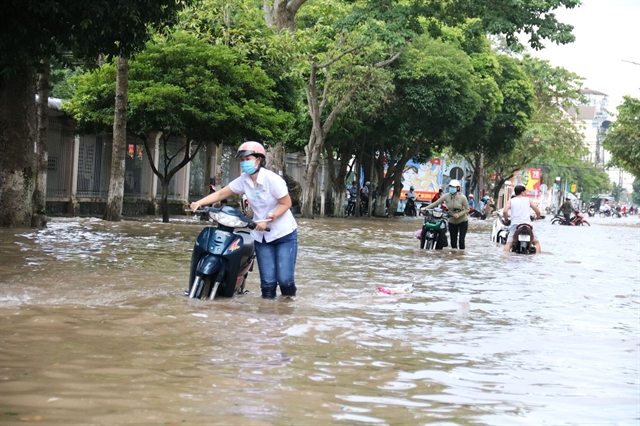
The region is also witnessing faster sea level rise than forecast, with all 13 cities and provinces of the delta are at high risk of flooding due to climate change.
People in Vĩnh Long Province struggled to get through a flooded street due to high tides. — VNA/VNS Photo Lê Thúy Hằng
HCM CITY — The Mekong (Cửu Long) Delta has seen significant strides in urban development, yet the increasing climate change risks mean long-term and practical strategies must be put in place for sustainable growth.
The delta currently has 211 urban areas, with an urbanisation rate of 32 per cent against that of the country at 40.5 per cent. These figures are predicted to rise in the near future.
The region is also witnessing faster sea level rise than forecast, with extreme weather phenomena that affect people’s livelihoods.
Author: Chih-Ling Liu Senior Lecturer in Marketing, Lancaster University
Disclosure statement: Chih-Ling Liu does not work for, consult, own shares in or receive funding from any company or organisation that would benefit from this article, and has disclosed no relevant affiliations beyond their academic appointment.
Partners:
Lancaster University provides funding as a founding partner of The Conversation UK.
China has a gender crisis. The country has a huge surplus of men – around 722 million compared to 690 million women in 2022. This is largely because of sex-selective abortions linked to China’s one-child policy, which ended in 2015.
Though popular belief is that the policy was strictly enforced, many Chinese couples managed to have more than one child by paying fines, accepting benefit deprivations, or proclaiming their membership of a minority ethnic group. Often, they chose to do so because their first child was a girl. The one-child policy lasted three and a half decades, replaced by the two-child policy in 2016 and the three-child policy in 2021. But even today, the belief that boys have more value than girls persists.









 CVD
CVD 