
Inside Vietnam’s plans to dent China’s rare earths dominance
Conversations on Vietnam Development


Sept. 25, 2023 6:06 pm ETS, WSJ
The most important fact in world politics is that 19 months after Vladimir Putin challenged the so-called rules-based international order head-on by invading Ukraine, the defense of that order is not going well. The world is less stable today than in February 2022, the enemies of the order hammer away, the institutional foundations of the order look increasingly shaky, and Western leaders don’t yet seem to grasp the immensity of the task before them.
Tiếp tục đọc “The Rules-Based International Order Is Quietly Disintegrating”

READOUT
SEPTEMBER 22, 2023
The below is attributable to Spokesperson Matthew Miller:
Secretary of State Antony J. Blinken, Japanese Foreign Minister Kamikawa Yoko, and Philippine Secretary of Foreign Affairs Enrique Manalo held a trilateral meeting today in New York during the UN General Assembly High-Level Week.
Tiếp tục đọc “Secretary Blinken’s Meeting with Japanese Foreign Minister Kamikawa And Philippine Secretary of Foreign Affairs Manalo”
International Naval & Maritime News, @NavalNews
Anatomy of China’s Maritime Strategy: Threatening the Maritime Order Through Its National Legislation and Self-Centered Interpretation of UNCLOS
U.S. Naval War College, 2023
DOWNLOAD FULL REPORT HERE:
https://digital-commons.usnwc.edu/cgi/viewcontent.cgi?article=3048&context=ils…
September 21, 2023 Topic: Authoritarianism Region: Eurasia Tags: AuthoritarianismDemocracyRussiaChinaCold WarGreat Power Competition
Across much of the world, the ideas of a democratic liberal political order, of multilateral international collaboration, and of liberal free-market capitalism are now in retreat.
by Azeem Ibrahim Follow Azeem Ibrahim on TwitterL , nationalinterest.org
The world is in turmoil. Only thirty years after the fall of the USSR and the collapse of its proxy network in Eastern Europe, a land war is being fought in Europe between a democracy and a dictatorship.
When the Cold War ended, we could have scarcely imagined that in just three decades we would be where we are now. We know now that the collapse of the USSR in 1991 did not bring about “the end of history” as prophesied. Instead, it bred complacency among the leaders of the Western democracies, great complacency which has sowed the seeds for the current global anti-democratic reckoning.
Tiếp tục đọc “The Threat of an Authoritarian Century”
Saturday, September 23, 2023, 09:36 GMT+7

Vietnam and the U.S. have announced their intention to bolster cooperation in the fields of science, technology, digital innovation, semiconductor manufacturing, and chip production, creating ample opportunities for Vietnamese tech firms to establish a strong presence in global supply chains.
This cooperation is poised to present significant opportunities for the development of Vietnam’s domestic semiconductor sector, Vo Xuan Hoai, deputy director of the Vietnam National Innovation Center (NIC), said in an interview with Tuoi Tre (Youth) newspaper.
Tiếp tục đọc “Cooperation with US to propel development of Vietnam’s semiconductor industry: expert”May — Aug 2023
By Ralph A. Cossa and Brad Glosserman
Published September 2023 in Comparative Connections · Volume 25, Issue 2 (This article is extracted from Comparative Connections: A Triannual E-Journal of Bilateral Relations in the Indo-Pacific, Vol. 25, No. 2, September 2023. Preferred citation: Ralph A. Cossa and Brad Glosserman, “Regional Overview: Building Partnerships Amidst Major Power Competition,” Comparative Connections, Vol. 25, No. 2, pp 1-24.)
Tama University CRS/Pacific Forum
Major power competition was the primary topic du jure at virtually all of this trimester’s major multilateral gatherings, with Russia’s invasion of Ukraine continuing to serve as a litmus test—a test many participants struggled to avoid taking. It was clear which side of the fence the G7 leaders stood on; Putin’s invasion was soundly condemned and Sino-centric warning bells were again gently sounded. At the BRICS Summit and Shanghai Cooperation Organization (sans the US), those alarms were clearly muted, as they were at the ASEAN Regional Forum, at which foreign ministers from all three were present. Headlines from the IISS Shangri-la Dialogue focused on the meeting that did not occur, as China’s defense minister pointedly refused to meet with his US counterpart. At the ASEAN-ISIS’ Asia-Pacific Roundtable, participants lamented the impact of major power tensions on ASEAN unity, even though ASEAN’s main challenges are internal ones that predate the downturn in China-US relations. Meanwhile, Beijing and Washington both expended considerable effort at these and other events throughout the reporting period fortifying and expanding their partnerships, even as many neighbors struggled not to choose sides or to keep a foot in both camps.
Tiếp tục đọc “Regional Overview: Building Partnerships Amidst Major Power Competition”
Shanna Khayat
Communications and Outreach Manager
(808) 852-2595
August 22, 2023
This PacNet was developed as a part of the United States-Japan-Republic of Korea Trilateral Next-Generation Leaders Dialogue to encourage creative thinking about how this vital partnership can be fostered. For the previous entries please click here, here, and here.
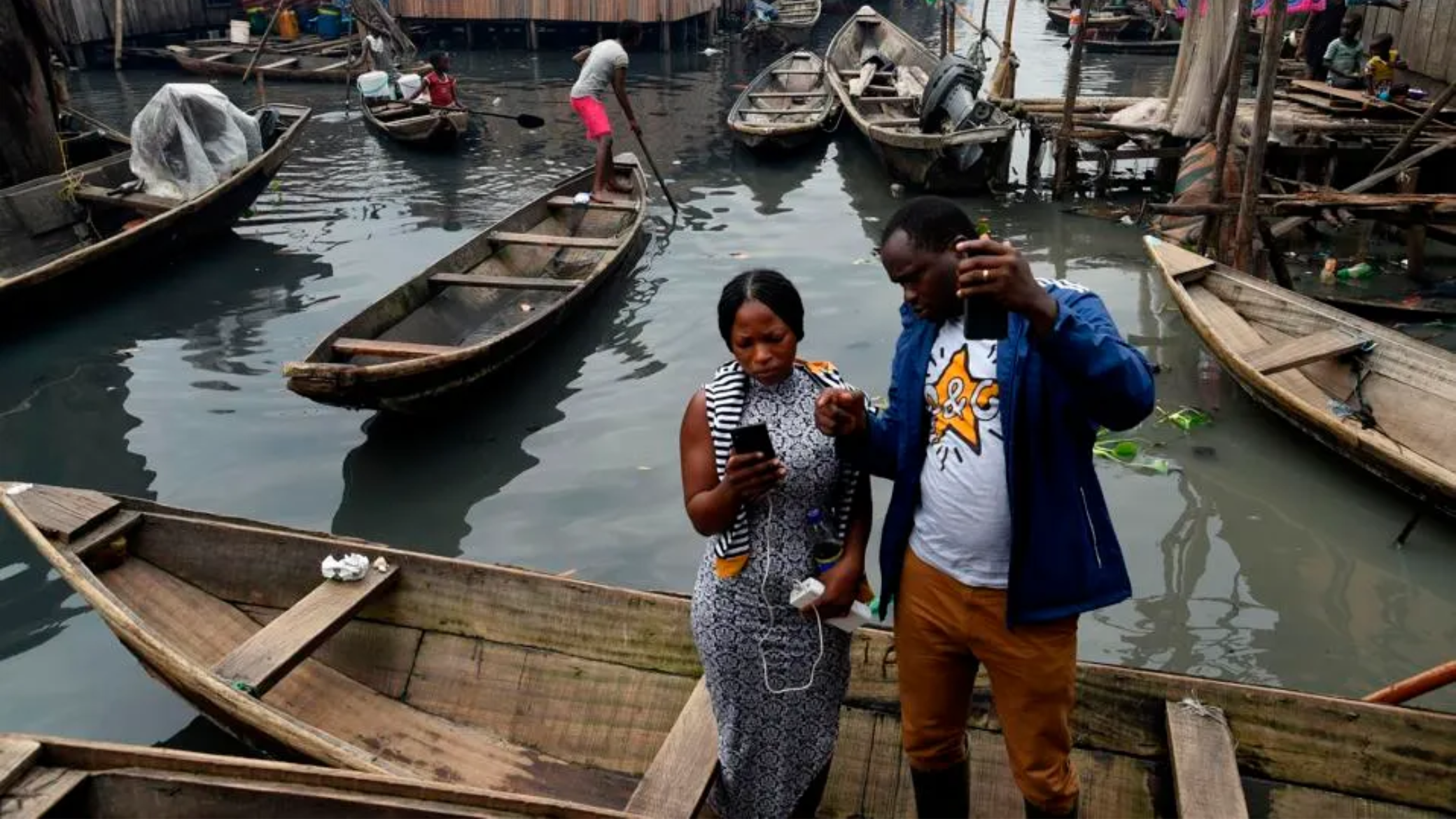
In April 2022, the United States launched its “Declaration for the Future of the Internet.” It asserts that human rights and democratic values must remain central to future technological development, innovation, and investment. Along with Japan, South Korea, and 58 other signatories, the United States argued that universal values should be embedded and enhanced at every stage of technological design, implementation, and diffusion. It’s time for the United States and its allies to match words with actions and ensure that developing countries have access to the resources they need to make that future a global reality.
Tiếp tục đọc “The developing world needs an alternative to Chinese tech”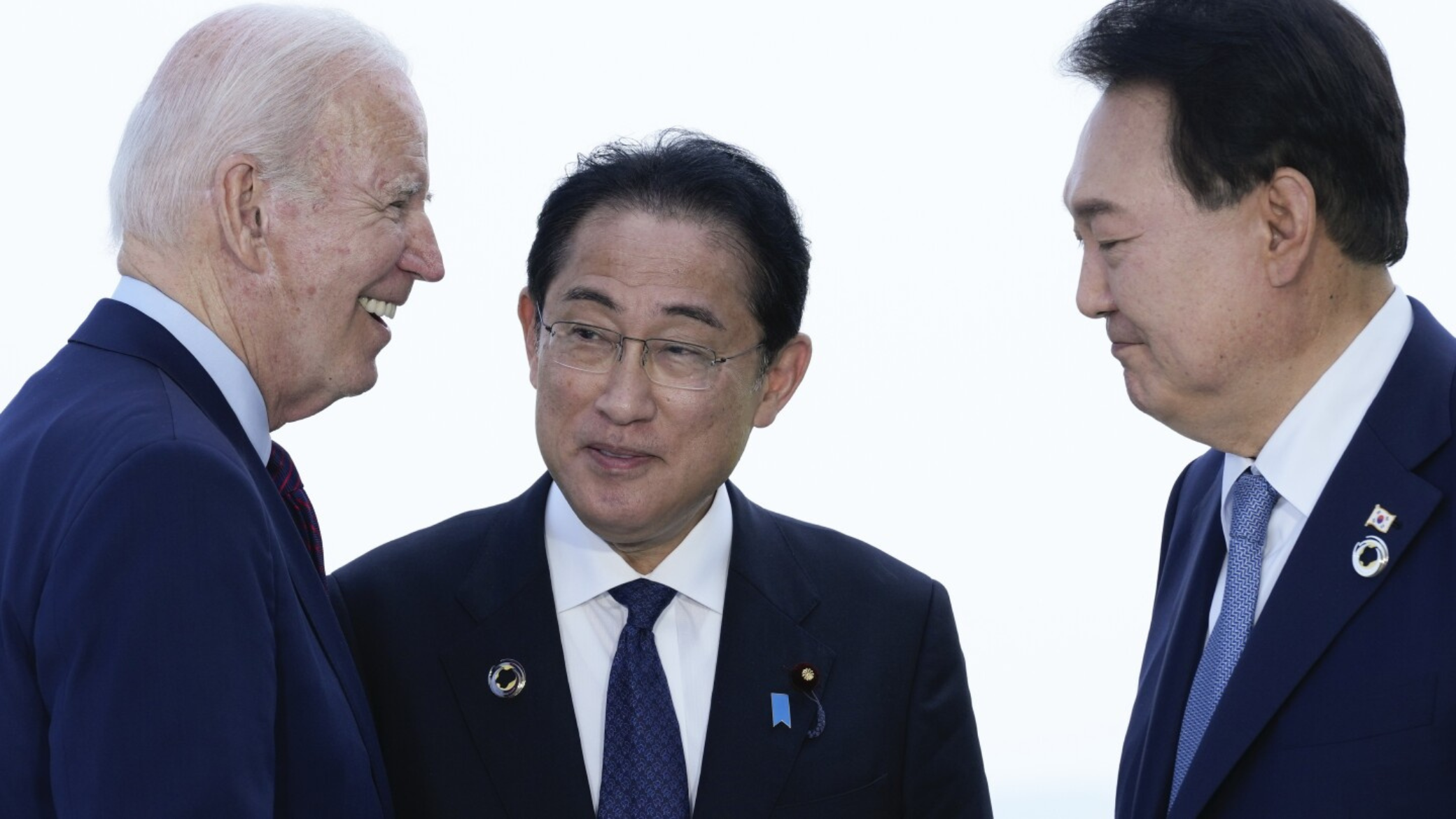
Shanna Khayat
Communications and Outreach Manager
(808) 852-2595
August 17, 2023
This PacNet was developed as a part of the United States-Japan-Republic of Korea Trilateral Next-Generation Leaders Dialogue to encourage creative thinking about how this vital partnership can be fostered. For previous entries please click here and here.
The AUKUS security agreement, cemented between Australia, the United States, and the United Kingdom in September 2021, enhances regional partnership in the Indo-Pacific by facilitating technology sharing, strengthened supply chains, and the acquisition of nuclear powered, conventionally armed submarines for Australia. The pact also creates a pathway to establish engagements focused on renewing, strengthening, and expanding military cooperation between AUKUS, South Korea, and Japan.
Tiếp tục đọc “An AUKUS-Japan-ROK framework for the Indo-Pacific”Read & download full report >>
MARITIME AFFAIRS SERIES AUTHORS
| Hunter Marston is an Adjunct Research Fellow at La Trobe Asia with La Trobe University, Melbourne, a PhD candidate in International Relations at Australian National University in the Coral Bell School of Asia-Pacific Affairs, and an Associate with 9DashLine. He was previously a 2021 nonresident WSD-Handa Fellow at the Pacific Forum in Honolulu and the recipient of a Robert J. Myers Fellows Fund from the Carnegie Council for Ethics in International Affairs. From 2015-2019, he was a Senior Research Assistant for the Center for East Asia Policy Studies and The India Project at the Brookings Institution. He also worked in the Center for Strategic & International Studies’ (CSIS) Southeast Asia program. He completed his Masters in Southeast Asia Studies and Masters in Public Administration at the University of Washington in 2013. In 2012 Hunter was a Harold Rosenthal Fellow in International Relations in the U.S. Embassy in Myanmar. He is the co-host of the Undiplomatic Podcast on international affairs and writes regularly on Southeast Asian politics and U.S. foreign policy. His work has appeared in Contemporary Southeast Asia, the New York Times, Foreign Affairs, Foreign Policy, and the Washington Post. | Dr. Bich Tran is a postdoctoral fellow at the Lee Kuan Yew School of Public Policy, National University of Singapore. In addition to being an adjunct fellow at the Center for Strategic and International Studies (CSIS) in Washington DC, she has been a visiting fellow at the East West Center, International Institute for Strategic Studies (IISS-Asia), and ISEAS-Yusof Ishak Institute among others. Dr. Tran obtained her PhD in Political Science from the University of Antwerp in Belgium. Her research interests include Vietnam’s grand strategy, Southeast Asian states’ relations with major powers, and political leadership. She has published on various platforms, including Asia Pacific Issues, Asian Perspective, Asian Politics & Policy, The Diplomat, East Asia Forum, and Fulcrum. Dr. Tran is the author of “Vietnam’s Strategic Adjustments and US Policy” (Survival 64, no. 6, 77–90) |
| Elina Noor is a senior fellow in the Asia Program at Carnegie where she focuses on developments in Southeast Asia, particularly the impact and implications of technology in reshaping power dynamics, governance, and nation-building in the region. Previously, Elina was director of political-security affairs and deputy director of the Washington, D.C. office at the Asia Society Policy Institute. Prior to that, Elina was an associate professor at the Daniel K. Inouye Asia-Pacific Center for Security Studies in Honolulu. She spent most of her career at the Institute of Strategic and International Studies Malaysia, where she last held the position of director, foreign policy and security studies. Elina was also formerly with the Brookings Institution’s Project on U.S. Relations with the Islamic World. Between 2017 and 2019, Elina was a member of the Global Commission on the Stability of Cyberspace. She currently serves on the ICRC’s Global Advisory Board on digital threats during conflict. | Javad Heydarian is a Senior Lecturer at the University of the Philippines, Asian Center, a columnist at the Philippine Daily Inquirer, and a Television Host at TV5 Network. He has written for the world’s leading publications, including The New York Times, Washington Post, The Guardian, and Foreign Affairs. He is the author of, among others, “Asia’s New Battlefield” (Zed, 2015), The Rise of Duterte: A Populist Revolt against Elite Democracy” (Palgrave Macmillan, 2017) and “The Indo-Pacific: Trump, China, and the New Global Struggle for Mastery” (Palgrave Macmillan, 2019). He is also a regular contributor to leading global think tanks such as Center for Strategic and International Studies (CSIS), Brooking Institution, and Council on Foreign Relations (CFR). His forthcoming book is “China’s New Empire” (Melbourne University Press) |
INTRODUCTION
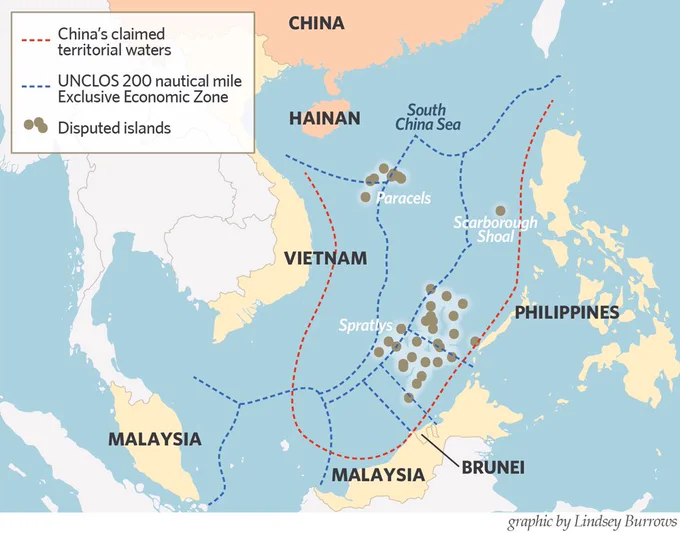
Sailors have an expression, “fair winds and following seas,” to describe the favourable conditions which they desire when setting out to sea. Much like these seafarers, Southeast Asian maritime nations seek stable and peaceful waters for their security and prosperity. The South China Sea has long vexed regional policymakers and security strategists due to both the number and complexity of overlapping maritime territorial claims among regional actors, including Brunei, China, Malaysia, the Philippines, Taiwan and Vietnam.
In the past two decades, China’s increasingly expansionist tendencies and willingness to use force to coerce or intimidate smaller claimants has reinforced growing threat perceptions vis-à-vis Beijing and fuelled hedging strategies. In February 2023, a Chinese Coast Guard (CCG) vessel targeted Filipino counterparts with a military-grade laser in the Spratly Islands.1 The following month, a CCG vessel caused a dangerous encounter with Vietnamese patrol boats during a patrol of Vietnamese oil and gas fields around Vanguard Bank. Around this time, a CCG vessel was also seen operating in close proximity to Malaysia’s Kasawari gas project near Luconia Shoals, prompting the Malaysian Navy to dispatch a Keris-class littoral ship to the area.
As a result of Chinese intimidation, Southeast Asian states have begun to prioritise maritime security as a central component of national defence and security strategies. While power asymmetry between regional states and China makes a concerted pushback against Chinese coercion unpalatable, arguably no state has mounted a consistent or coherent response to deal with this security challenge. Rather, Southeast Asian countries have adopted an array of hedging tactics to deepen engagement with China while bolstering their own domestic defence capabilities and simultaneously expanding security cooperation with a variety of external partners, including Australia, Japan, and Korea.
Hedging refers to insurance-seeking behaviour meant to signal ambiguity in a state’s alignment while cultivating fall-back options to preserve maximum autonomy. Few existing studies of hedging have considered the central role that maritime security plays in regional countries’ foreign policies. This paper therefore clarifies the maritime security strategies of three Southeast Asian claimant states (Malaysia, the Philippines, and Vietnam) to assess how such strategies map onto or deviate from existing notions of hedging. In each of the case studies below, maritime security strategy is reflective of a state’s broader hedging strategy and mirrors the same fundamental tensions: power asymmetry, geographic proximity to a security threat, lack of political consensus, and profound strategic uncertainty, namely fears of abandonment or entrapment in a great power conflict. Seen in this light, maritime security strategy is a manifestation of states’ deeply ingrained preferences for ambiguity and unwillingness to choose sides in brewing superpower competition.
The paper concludes with a brief summary assessing the parallels between the three case studies and what they tell us about hedging and maritime security strategy
This post explains how the AIS vessel tracking system works and how bad actors abuse the system.
Miao Shou, Gaute Friis | AUGUST 21, 2023


Analyst

Analyst
Tracking vessels’ Automatic Information System (AIS) signals is a core means SeaLight and other open-source intelligence collectors use to monitor maritime activity. AIS is a broadcast system that maritime authorities use to identify a vessel’s unique identification number, type, position, course, speed and navigation status.
The International Maritime Organization (IMO) mandates the use of AIS to ensure maritime safety and direct marine traffic more efficiently. According to the International Maritime Organization’s International Convention for the Safety of Life at Sea (SOLAS) Regulation V/19.2.4, all vessels over 300 gross tons (or 500 tons for those not on international voyages) and passenger ships of any size are required to “carry automatic identification systems capable of providing information about the ship to other ships and to coastal authorities.”
“Going dark” refers to the gray zone tactic of strategically turning off a vessel’s Automatic Information System (AIS) transponder to avoid detection.
Miao Shou | AUGUST 17, 2023

Analyst
“Going dark” refers to the gray zone tactic of turning off a vessel’s Automatic Information System (AIS) transponder to avoid detection. AIS is a signaling system used to identify a vessel’s type, position, course, speed and other navigation safety information, and is required by the International Maritime Organization for larger non-military ships operating in international waters. Read our primer on the AIS system here.
Going Dark in the Recent Water Cannon Incident
In a recent incident that involved the blockade and water-cannoning of a small Philippine resupply vessel and its escorts, six of the blockading ships were from the China Coast Guard. Of these, only one ship (CCG 5402) remained AIS-visible during the entire engagement, while two other ships (CCG 4203 and CCG 3302) broadcast AIS only intermittently.
Tiếp tục đọc “Gray Zone Tactics Playbook: Going Dark”This tactic consists of blasting another ship with a powerful stream of water using a high-pressure water cannon.
Gaute Friis | AUGUST 7, 2023

Analyst
As of this writing, the Philippines has just produced evidence that its coast guard and resupply vessels were subjected to assault by water cannons from China Coast Guard ships on 5 August 2023. This occurred during the regular rotation and resupply mission to the Philippine Navy’s outpost aboard the grounded BRP Sierra Madre at Second Thomas (Ayungin) Shoal, and is reminiscent of a similar incident in November 2021.
Tiếp tục đọc “Gray Zone Tactics Playbook: Water Cannoning”
 CVD
CVD 