$10bn of precious metals dumped each year in electronic waste, says UN

A fast growing mountain of toxic e-waste is polluting the planet and damaging health, says new report
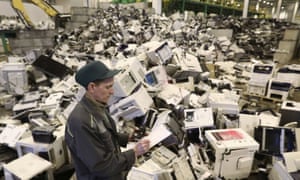
Ecotechprom electronic and electric equipment recycling plant in Moscow<br>MOSCOW, RUSSIA - FEBRUARY 21, 2020: An employee at the Ecotechprom electronic and electric equipment recycling plant of the Ecopolis Corporation, Russia’s leading enterprise investing in recycling and utilization of electronic and electric equipment; its recycling efficiency reaches 95% of the incoming volume. Sergei Karpukhin/TASS (Photo by Sergei Karpukhin\TASS via Getty Images)

A worker at an electronic and electric equipment recycling and reuse plant, belonging to Ecopolis Corporation, in Moscow. Photograph: Sergei Karpukhin/Tass

At least $10bn (£7.9bn) worth of gold, platinum and other precious metals are dumped every year in the growing mountain of electronic waste that is polluting the planet, according to a new UN report.

A record 54m tonnes of “e-waste” was generated worldwide in 2019, up 21% in five years, the UN’s Global E-waste Monitor report found. The 2019 figure is equivalent to 7.3kg for every man, woman and child on Earth, though use is concentrated in richer nations. The amount of e-waste is rising three times faster than the world’s population, and only 17% of it was recycled in 2019.

Electronic and electrical goods, from phones and computers to refrigerators and kettles, have become indispensable in modern societies and enhance lives. But they often contain toxic chemicals, and soaring production and waste damages human health and the environment, and fuels the climate crisis.

The report blames lack of regulation and the short lifespan of products that are hard or impossible to repair. Experts called the situation a “wholly preventable global scandal”.

People in northern Europe produced the most e-waste – 22.4kg per person in 2019. The amount was half as much in eastern Europe. Australians and New Zealanders disposed of 21.3kg per person, while in the US and Canada the figure was 20.9kg. Averages across Asia and Africa were much lower, at 5.6kg and 2.5kg per person respectively.E-waste contains materials including copper, iron, gold, silver and platinum, which the report gives a conservative value of $57bn. But most are dumped or burned rather than being collected for recycling. Precious metals in waste are estimated to be worth $14bn, but only $4bn-worth is recovered at the moment.
Tiếp tục đọc “$10bn of precious metals dumped each year in electronic waste, says UN”
Wildlife trade amplifies spread of coronaviruses

telegraph.co.uk

The proportion of rats testing positive for viruses jumped substantially between the start and end of Vietnam’s supply chain

Asia’s booming wildlife trade is fuelling the spread of coronaviruses by providing the ideal opportunity for animals to infect each other and potentially humans, two studies have found.

Across Asia, wild animals including rodents, pangolins and bats are transported, often illegally, thousands of miles in crowded and chaotic conditions for use in restaurants and traditional medicines.

Experts have long thought this amplifies the transmission of coronaviruses, making the possibility of a jump to humans more likely.

In one new study, published as a preprint without peer review, researchers analysed oral swabs from more than 2,000 field rats in three provinces in southern Vietnam. They found that the animals smuggled across the Mekong River Delta, from traders to restaurants, tested positive for six different coronaviruses. More significantly, the incidence of infection increased significantly along their journey.

Roughly 20 per cent of wild rats caught by traders tested positive for at least one coronavirus, rising to 32 per cent of rodents in large markets. In restaurants, the final step in the chain, 55 per cent of rats were infected.

“The observed viral amplification along the wildlife trade supply chain for human consumption likely resulted from the mixing and close confinement of stressed live animals,” the researchers wrote.
Tiếp tục đọc “Wildlife trade amplifies spread of coronaviruses”

Beyond Power, Wind Plants Can Provide a Full Suite of Essential Reliability Services to the Grid

Emerging from the pandemic, Vietnam must position itself for recovery

It’s been two months since the last known case of community transmission of the coronavirus in Vietnam, enabling the country, hailed recently as one of the 11 outperformers among emerging economies, to be among the first to fully reopen its domestic economy.While recurrence remains an ever-present threat, Vietnam’s government is now turning its attention to repairing a damaged economy. Vietnam has fared better economically than many countries, but it has not been completely spared. GDP growth in the first quarter was at its lowest level since 2010, although it was still in positive territory at 3.8 percent. With exports and tourism severely affected, domestic consumption has been (and is expected to continue to be) critical to hold the economy together.

Staying afloat in 2020, largely thanks to spending on essentials

Tiếp tục đọc “Emerging from the pandemic, Vietnam must position itself for recovery”

XEM XÉT LẠI VÀ ĐÁNH GIÁ ĐỘC LẬP DỰ ÁN KHU ĐÔ THỊ DU LỊCH LẤN BIỂN CẦN GIỜ

Ký tên vào kiến nghị tại đây 

PETITION FOR THE REVIEW AND INDEPENDENT ASSESSMENT OF THE CAN GIO TOURIST CITY PROJECT IN HO CHI MINH CITY, VIETNAM

KIẾN NGHỊ XEM XÉT LẠI VÀ ĐÁNH GIÁ ĐỘC LẬP TOÀN BỘ DỰ ÁN KHU ĐÔ THỊ DU LỊCH LẤN BIỂN CẦN GIỜ – TPHCM

Kính gửi:  Thủ tướng Chính Phủ nước CHXHCN Việt Nam
Ủy ban Thường vụ Quốc Hội nước CHXHCN Việt Nam
UBND Thành phố Hồ Chí Minh

Chúng tôi kí tên dưới đây, là các cá nhân và tổ chức xã hội yêu môi trường, hoạt động trong các lĩnh vực liên quan, đồng kiến nghị Thủ tướng Chính phủ, Ủy ban Thường vụ Quốc Hội, UBND TPHCM xem xét lại và đánh giá độc lập toàn bộ dự án Khu Đô thị du lịch lấn biển Cần Giờ 2.870 ha, vì những lí do sau đây:

1. Quyết định phê duyệt Báo cáo Đánh giá tác động môi trường dự án Khu Đô thị du lịch lấn biển Cần Giờ của Bộ Tài nguyên Môi trường cho thấy các tác động của dự án lên môi trường chưa được đánh giá khách quan, toàn diện. Đặc biệt, những vấn đề quan trọng nhất đã chưa được đánh giá đầy đủ trước khi phê duyệt, như: tác động của việc thực hiện dự án đến Khu Dự trữ sinh quyển rừng ngập mặn Cần Giờ, vấn đề xói lở, bồi tụ và dòng chảy các khu vực xung quanh dự án, các biện pháp giảm thiểu thích đáng các tác động tiêu cực của dự án.

Nguy cơ Khu Đô thị lấn biển Cần Giờ tác động xấu lên rừng ngập mặn Cần Giờ sẽ kéo theo hàng loạt ảnh hưởng tiêu cực khác lên khu vực đô thị TPHCM, nơi hiện tại người dân và chính quyền vốn đang phải đối mặt với nhiều gánh nặng về ô nhiễm môi trường, ngập lụt, sụt lún, v.v. Tiếp tục đọc “XEM XÉT LẠI VÀ ĐÁNH GIÁ ĐỘC LẬP DỰ ÁN KHU ĐÔ THỊ DU LỊCH LẤN BIỂN CẦN GIỜ”

What makes Asia−Pacific’s Generation Z different?

Gen Zers in the Asia–Pacific region aren’t like their older siblings. Here is what you need to know.

Gen Zers (born 1996–2012) are coming of age. By 2025, the group will make up a quarter of the Asia–Pacific (APAC) region’s population—the same as millennials (born 1980–1995). And as Gen Zers mature, they will make and spend more money. Although Gen Zers share many qualities with millennials, it’s wrong to think of them simply as a younger version. Generation Z has its own unique characteristics. For one thing, unlike millennials, Gen Zers are entering into adulthood during a global pandemic. Still, the demographics are clear: by 2025, the two cohorts will compose half of APAC consumers.

In an effort to understand the distinctive ways that Gen Zers research, consider, purchase, and use products, in the second half of 2019 McKinsey surveyed more than 16,000 consumers in six countries—Australia, China, Indonesia, Japan, South Korea, and Thailand.1 Then we compared results across three generations—Gen Zers, millennials, and Gen Xers (born 1965–1979). The survey asked respondents about their general attitudes toward brands, shopping, digital, and media, as well as their outlook on the world. It also asked specific questions about shopping habits and brands for selected categories (Exhibit 1).
Tiếp tục đọc “What makes Asia−Pacific’s Generation Z different?”

Khởi tố người mẹ bỏ rơi con mới đẻ giữa trời nắng nóng

ĐTH: Bố đứa trẻ đâu? Người làm cho chị này mang bầu đâu?  Tại sao chỉ khởi tố người mẹ? Tại sao đang ở bước khởi tố mà cơ quan chức năng và phóng viên có quyền công khai thông tin cá nhân, hình ảnh của người bị khởi tố. Điều này có vi phạm cơ bản quyền riêng tư và bảo vệ nhân phẩm của người bị khởi tố? Đây không phải là tội phạm. Kể cả tội phạm, đều có quyền được bảo vệ danh tính và quyền riêng tư.

dantri.com.vn
Bỏ rơi con vừa sinh giữa trời nắng nóng khiến cháu bé tử vong, đối tượng Phạm Thị Thành bị khởi tố về hành vi vứt bỏ con mới đẻ.

>>Vứt con mới đẻ giữa trời nắng nóng, người mẹ bị xử lý ra sao?
>>Hà Nội: Xác định người phụ nữ bỏ rơi con mới đẻ giữa trời nắng nóng
>>Bé sơ sinh bị bỏ rơi không qua khỏi vì sốc nhiễm khuẩn sau 21 ngày điều trị

Immediate switch to renewable energy required across sectors, says report

energy.economictimes.indiatimes.com

According to the report by Paris-based think-tank REN21, though growth in renewable power has been impressive over the past five years, too little is happening in heating, cooling and transport

Immediate switch to renewable energy required across sectors, says report

New Delhi: The journey towards climate disaster would continue, unless an immediate switch to efficient and renewable energy is made across sectors in the wake of the COVID-19 pandemic, according to a latest report. Tiếp tục đọc “Immediate switch to renewable energy required across sectors, says report”

HCMC bus service fails to attract more passengers despite increased subsidy

e.vnexpress.net

By Dat Nguyen   June 29, 2020 | 08:28 am GMT+7

HCMC bus service fails to attract more passengers despite increased subsidy

A passenger waits at a bus station in District 1, Ho Chi Minh City. Photo by VnExpress/Quynh Tran.

Losing out to ride hailing operators and social distancing, amongst others, HCMC bus services are struggling to reroute impacts of low demand.

Ho Chi Minh City’s Transport Department recently asked the city for a public bus subsidy of VND1.31 trillion ($56.8 million) this year, up 14 percent from an earlier estimate.

The reason cited for the increase is low demand during and after the social distancing period. Resumption of services has only reached 80 percent of the target and companies say they need to pay staff and service their debts during the social distancing period despite revenues plummeting.

Without the increase in subsidies, the department said it might have to cut 15 percent of bus trips in the last six months of the year.

Tiếp tục đọc “HCMC bus service fails to attract more passengers despite increased subsidy”

Covid-19 in Vietnam — the fear, the tears, the pride and the debt

medium.com

FollowJun 21 · 5 min read

A friend elsewhere in Asia has an elderly parent in the UK. Chatting online she told me she’d read about this “slow-motion grief” affecting people as a result of the Covid-19 situation.

She told me she went on runs and cried through them. I admitted too I wasn’t sleeping. The smallest thing would make me emotional. I couldn’t think too far into the future because it all seemed too dark.

After Wuhan, things moved pretty quickly in Vietnam. Our little one’s nursery closed. Masks became compulsory. Track and trace was in full swing. An app was launched that offered various features. Most significantly, you could basically press a button and people in hazmat suits would appear.

Infected people were hospitalised. People who had come into contact with infected people were remotely quarantined. People who had come into contact with people who had come into contact with infected people were quarantined. People who had… well you get the picture.

Tiếp tục đọc “Covid-19 in Vietnam — the fear, the tears, the pride and the debt”

Effective conservation science must shift away from doomsday views and toward solutions: Study

Mongabay.com

  • Too much of conservation research focuses on describing the state of nature, in particular declines in biodiversity, and not on developing sustainable solutions to conservation challenges, say the authors of a new study.
  • Studies that “ring the alarm bell” tend to dominate because of the challenges of doing the kind of complex multidisciplinary research needed to develop workable solutions, and the fact that professional and financial incentives are lacking for the latter kind of work.
  • The researchers highlighted three cases in which the accumulated body of research on a particular conservation challenge took a solution-oriented trajectory and met with success: South Asian vultures, whooping cranes, and seabird bycatch.

Conservation science that more effectively serves the goals of protecting and enhancing global biodiversity must shift away from tracking declines and toward devising real-world solutions, a recent study suggests.

Too much of the field’s research focuses on describing the state of nature (such as the fact that a particular population is declining), and too little on what is causing those declines and how to address it, the authors write in their paper in the journal Conservation Letters. Tiếp tục đọc “Effective conservation science must shift away from doomsday views and toward solutions: Study”

Vietnam drug user number rises by 10,000 in a year

vnexpress.net

By Sen    June 13, 2020 | 06:05 pm GMT+7

Vietnam drug user number rises by 10,000 in a year

Drug users work at a rehabilitation center in Hanoi, 2020. Photo by VnExpress/Anh Duy.

Vietnam registers more than 10,000 new drug users last year, with the users getting younger and being concentrated in the southern region.

Revealing this at a conference on Thursday, Deputy Minister of Labor, Invalids and Social Affairs Nguyen Thi Ha said that there are now middle school students in many places using drugs.

Many rehabilitation centers in the country are overcrowded, she noted.

Vietnam had 111 licensed centers with around 35,000 inmates as of April.

As of last November the country had 235,314 drug addicts in its official records, 10,215 more than a year earlier.

“The number and the seriousness of crimes like robberies, disturbing public order, and murders committed by drug users has also gone up,” Ha said.

Ngo Thanh Binh, deputy director of the Ministry of Public Security’s department of drug crime investigation, said the number of addicts aged between 12 and 18 is on the rise, and it is difficult to send them to rehab due to legal complications arising from international charters on child rights Vietnam has signed.

Vietnam treats drug addiction as a “social evil.”

According to the department, the quantity of drugs seized last year was the highest ever at nearly nine tons.