Xem mô tả về 395 di sản văn hoá phi vật thể của Việt Nam tại đây
Tiếp tục đọc “Danh mục Di sản văn hóa phi vật thể quốc gia Việt Nam”
Conversations on Vietnam Development

Tiếp tục đọc “Danh mục Di sản văn hóa phi vật thể quốc gia Việt Nam”
Liên Hợp Quốc (LHQ) vừa công bố Báo cáo Toàn cầu lần thứ 7 về nạn buôn người, trong đó ghi nhận việc liên quan đến biến đổi khí hậu và xung đột tiếp diễn tại Ukraine khiến vấn nạn buôn người thêm trầm trọng.
Theo báo cáo, trong khi chưa có một phân tích toàn cầu có hệ thống về tác động của biến đổi khí hậu đối với nạn buôn người, thì các nghiên cứu cấp độ cộng đồng ở nhiều khu vực khác nhau trên thế giới chỉ ra rằng “các thảm họa do thời tiết gây ra là nguyên nhân gốc rễ của nạn buôn người”. Báo cáo do Văn phòng Liên Hợp Quốc về chống Ma túy và Tội phạm (UNODC) thực hiện dựa trên dữ liệu từ 141 quốc gia, được thu thập từ năm 2017 đến năm 2020, và phân tích 800 vụ xét xử tại tòa án.
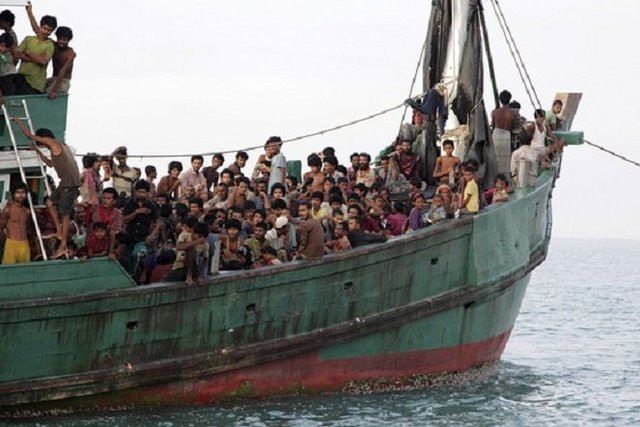
Báo cáo cho biết tác động của biến đổi khí hậu đã dẫn đến ảnh hưởng “ở nhiều cấp độ” đối với hoạt động nông nghiệp, đánh bắt cá và đặc biệt với các cộng đồng nghèo khác chủ yếu dựa vào khai thác tài nguyên thiên nhiên để kiếm sống.
Trong một cuộc họp báo, tác giả chính của nghiên cứu Fabrizio Sarrica giải thích, trong bối cảnh các cuộc khủng hoảng xảy ra chồng chéo, điều kiện sống khó khăn buộc nhiều người phải xa rời cộng đồng của họ, khiến họ dễ dàng trở thành mục tiêu của những kẻ buôn người. Chỉ riêng trong năm 2021, hơn 23,7 triệu người đã phải di dời do các thảm họa liên quan đến khí hậu trong nước, trong khi nhiều người chọn di cư đến các quốc gia khác.
Theo báo cáo của LHQ, khi điều kiện sống tại các khu vực trên thế giới ngày càng sa sút, hàng triệu người sẽ phải đối mặt với nguy cơ bị lạm dụng và bóc lột dọc các tuyến đường di cư.
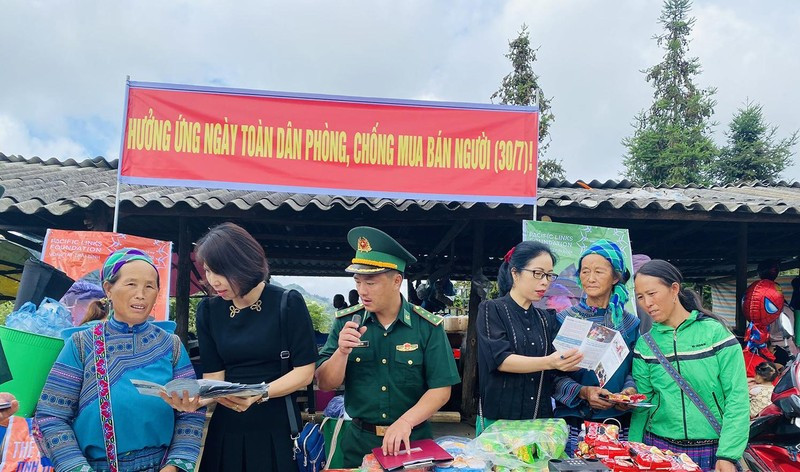
UNODC lưu ý rằng tình trạng gia tăng các trường hợp buôn người đã được ghi nhận ở Bangladesh và Philippines, sau khi các cơn bão và lốc xoáy tàn phá khiến hàng triệu người phải di dời. Hạn hán và lũ lụt ở Ghana và vùng Carribean – nơi hứng chịu bão và mực nước biển dâng cao – cũng buộc nhiều người phải di cư.
Tiếp tục đọc “Báo động nạn buôn người gia tăng trên toàn cầu do biến đổi khí hậu và xung đột”
Climate change and modern slavery are linked closely together in a vicious circle.
Climate-induced disaster, environmental degradation and growing scarcity of resources are affecting many communities, driving millions of people into poverty and forcing many to migrate in search of work, food or safety. In many cases, victims of the climate emergency will be left more vulnerable to forms of modern slavery, including human trafficking, forced labour and child slavery.
Three of the ways that climate change and modern slavery are linked:
- When people are forced to migrate, they face greater risks of human trafficking and forced labour. People who lose their livelihoods, income and ties to their community are often made vulnerable to exploitation, and in the worst cases, modern slavery, as they are forced to migrate. By 2050, the World Bank estimates that more than 143 million people will have been forced from their homes in sub-Saharan Africa, South Asia and Latin America because of climate change
- The same industries that drive climate change leave people vulnerable to forced migration. Extractive industries and agricultural businesses in particular contribute to the emissions that drive climate change, while also profoundly damaging the land and water that ordinary people rely upon. This pushes many more people into poverty and forces them to leave their homes and communities, making them more vulnerable to people traffickers and at risk of slavery
- Many victims of the climate emergency are exploited by businesses that contribute to the problem. Many of the people forced into migration by the climate emergency find themselves trafficked into forced labour, some within the very industries that are degrading the environment – completing a vicious circle in which climate change drives, and is driven by, modern slavery
Tiếp tục đọc “Climate change and modern slavery are linked:”
April 28, 2015 6.27am BST

There is currently no technique that could have helped Nepal predict when the recent earthquake would strike. AP/PA/Niranjan Shrestha
theconversation – Can earthquakes ever be predicted? This question is timely after the magnitude 7.8 earthquake that struck Nepal recently. If authorities had more warning that the earthquake was coming, they may have been able to save more lives.
While Nepal is a documented area of previous seismic activity, at the moment there is no technique that provides predictions of sufficient clarity to allow for evacuations at short notice. So if we cannot predict these events now, are there avenues of research to provide useful predictions in the future?
The key word here is “useful”. It is possible to make long-term forecasts about future earthquake activity, partly by using the past record of earthquakes as a guide. There is no reason to believe that a region of the Earth is going to behave differently in the next few thousands of years from its pattern over the same range back in time. In the short term, seismologists can draw on data from recording stations, with records going back roughly 40 years on a global scale. Tiếp tục đọc “Why it is so hard to predict where and when earthquakes will strike”
Jane Clinton and agencySat 11 Feb 2023 14.14 GMT
The death toll from the earthquake in Turkey and Syria is likely to “more than double”, according to a United Nations emergency relief coordinator.
Martin Griffiths, speaking to Sky News on Saturday, said he expected tens of thousands more deaths.
At least 24,596 people have been confirmed dead after the 7.8 magnitude earthquake struck southern Turkey and north-western Syria on Monday, with multiple aftershocks.
Griffiths said: “I think it is difficult to estimate precisely as we need to get under the rubble, but I’m sure it will double or more,” said Griffiths.
“That’s terrifying. This is nature striking back in a really harsh way.
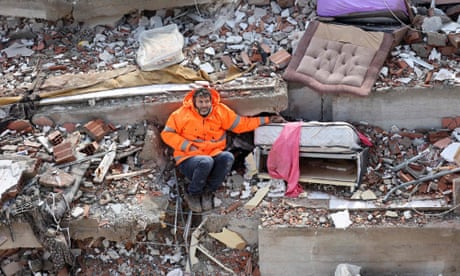
“It’s deeply shocking … the idea that these mountains of rubble still hold people, some of them still alive.
“We haven’t really begun to count the number of dead.”
He said that a 72-hour period after a disaster was usually the “golden period” for rescues, which had now expired, but that survivors were still being pulled out of the rubble.
“It must be incredibly difficult to decide when to stop this rescue phase,” he said.
Griffiths said he was launching a three-month operation for Turkey and Syria to help pay for the costs of operations there.
Griffiths also told Reuters he hoped in Syria aid would go to both government and opposition-held areas, but that things with this regard were “not clear yet”.
Earlier on Saturday, Stéphane Dujarric, the spokesperson for the UN secretary-general, António Guterres, told BBC Radio 4’s Today programme that negotiations were continuing to gain access to more areas in Syria and called for “solidarity” in the relief effort.
He said: “Our message is clear, it’s time to put all politics aside. Just focus on the men, women and children who desperately need help in Syria and in southern Turkey.
“Wherever we work, we have to work with the authorities in charge. That’s just the way that UN humanitarian aid is structured. So in the rebel-held territories, we work with the authorities there; in the government-held areas, we work with the government.”
Responding to criticism of the UN’s response to the urgent need in Syria after the earthquake, he added:
“I think if I was standing in the middle of devastation and my community had been hit, I would be unhappy and I would be critical because aid never comes quickly enough. But I can tell you that the UN stands with the people of Syria, whether they live in rebel territories, whether they live in government-held territories.”
by Hướng Thiện on 13 February 2023
Thuý, who helped run environmental programs at a nonprofit based in Ho Chi Minh City, had for weeks pondered quitting her job to pursue an advanced degree. The 24-year-old, who like all NGO workers interviewed for this story used a pseudonym due to fear of reprisals, was at a loss as to how to communicate her hard decision to her supervisors. While she felt it was time to move on, Thuý was grateful for the open-minded and dynamic working environment that had allowed her to grow tremendously.
Much to Thuý’s surprise, it was her supervisors who initiated a conversation about her career, advising her to be prepared to leave soon, because their organization was being told “from above” to shut down.
Tiếp tục đọc “Vietnam’s environmental NGOs face uncertain status, shrinking civic space”
SHORT SUMMARY
AI and education: Promise and implications
Artificial Intelligence (AI) has the potential to address some of the biggest challenges in education today, innovate teaching and learning practices, and ultimately accelerate the progress towards SDG 4. However, these rapid technological developments inevitably bring multiple risks and challenges, which have so far outpaced policy debates and regulatory frameworks. This publication offers guidance for policy-makers on how best to leverage the opportunities and address the risks, presented by the growing connection between AI and education. It starts with the essentials of AI: definitions, techniques and technologies. It continues with a detailed analysis of the emerging trends and implications of AI for teaching and learning, including how we can ensure the ethical, inclusive and equitable use of AI in education, how education can prepare humans to live and work with AI, and how AI can be applied to enhance education. It finally introduces the challenges of harnessing AI to achieve SDG 4 and offers concrete actionable recommendations for policy-makers to plan policies and programmes for local contexts.
*Nord Stream is a network of natural gas pipelines run under the Baltic Sea from Russia to Germany
‘Colossal amount’ of leaked methane, twice initial estimates, is equivalent to third of Denmark’s annual CO2 emissions or 1.3m cars

Seascape: the state of our oceans is supported by
Scientists fear methane erupting from the burst Nord Stream pipelines into the Baltic Sea could be one of the worst natural gas leaks ever and pose significant climate risks.
Neither of the two breached Nord Stream pipelines, which run between Russia and Germany, was operational, but both contained natural gas. This mostly consists of methane – a greenhouse gas that is the biggest cause of climate heating after carbon dioxide.
As China’s economy moved away from state planning and policymakers introduced market reforms in the 1980s and 1990s, many observers expected that in addition to promoting the growth of the Chinese economy, privatization would also have substantial political implications. Most importantly, it was thought that the rise of the private sector could lead to the establishment of an independent business class that would seek to defend its interests, both in the short term through greater policy lobbying and over the longer term by pushing for institutionalized political change, including democratization. The actual economic and political trajectory of China’s private sector has been more complicated and has been a central area of contestation for economic and political power between firms and the Chinese party-state. Although Chinese companies have pushed to have greater autonomy, they have also faced immense pressure to adapt and cede authority in order to survive and grow.

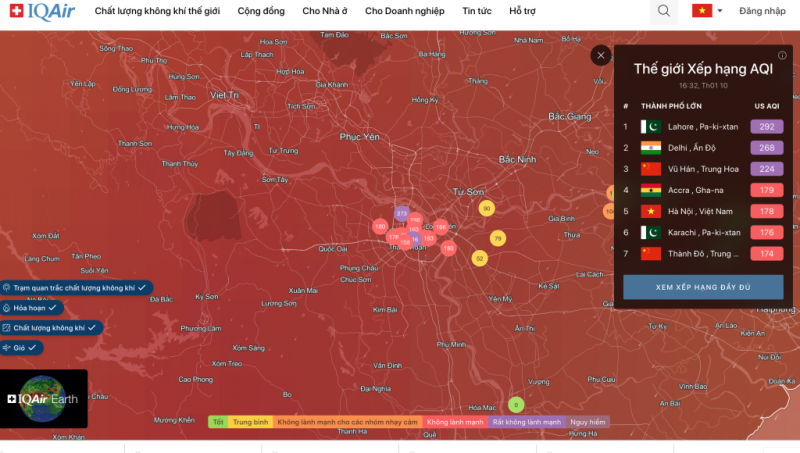
Chiều nay (10/1), trên trang IQAir, với chỉ số AQI trung bình 173 đơn vị, Hà Nội xếp thứ 5 trong 10 TP có chất lượng không khí kém nhất trên thế giới. Sáng nay, Hà Nội còn bị xếp thứ 4 với chất lượng không khí rất kém.
Trong ngày 10/1, chất lượng không khí ở nhiều nơi trên địa bàn Hà Nội rất kém. Toàn TP chìm trong sương mù. Dự báo, trạng thái này còn có thể kéo dài.
Các điểm có chỉ số AQI rất cao như Cầu Giấy 433, phố Phạm Tuấn Tài 305, Trường mầm non thực hành Hoa Sen 451, Thanh Xuân 318, Hoàn Kiếm 376. Cá biệt, Khu đô thị Time City lên tới con số 500.
Tiếp tục đọc “Hà Nội nằm trong 10 thành phố chất lượng không khí kém nhất thế giới”
The quintessential image of a river you might recognise from post cards and paintings – nice and straight with a tidy riverbank – is not actually how it is supposed to look. It’s the result of centuries of industrial and agricultural development. And it’s become a problem, exacerbating the impact of both extreme flooding and extreme drought. Josh Toussaint-Strauss looks into how so many rivers ended up this way, and how river restoration is helping to reestablish biodiversity and combat some of the effects of the climate crisis
‘This is what a river should look like’: Dutch rewilding project turns back the clock 500 years
‘We make nature here’: pioneering Dutch project repairs image after outcry over starving animals
Josh Toussaint-Strauss Ali Assaf Joseph Pierce Nick Hildred Ryan Baxter, Source: The Guardian
By Pamela Constable and Shaiq Hussain January 24, 2023 at 4:39 a.m. EST
ISLAMABAD, Pakistan — Three weeks ago, Pakistani authorities ordered all markets, restaurants and shopping malls to close early, part of an emergency plan to conserve energy as the country of 220 million struggled to make overdue payments on energy imports and stave off a full-fledged economic collapse.
But the measures were too little, too late. On Monday morning, the country’s overburdened electrical system collapsed in a rolling wave of blackouts that began in the desert provinces of Baluchistan and Sindh but quickly spread to nearly the entire country, including the densely crowded cities of Karachi, Lahore and Rawalpindi.
Tiếp tục đọc “Pakistan’s nationwide power cuts highlight escalating economic crisis”
Geopolitical tensions derail Duisburg’s hopes of trade bonanza
DUISBURG, Germany — Suad Durakovic, the owner of a truck driving school on the outskirts of the western German city of Duisburg, made it into Chinese newspapers in 2019 by testifying that Beijing’s Belt and Road Initiative had triggered a local logistics industry boom.
Today, his business benefits from a shortage of qualified truckers, but not because of China’s global infrastructure development strategy.
“The Silk Road has not developed for us,” Durakovic told Nikkei Asia. “First it was COVID, then it was the Ukraine war, so the boom is no longer about Silk Road logistics.”
Duisburg, a city of half a million people, is located in Germany’s industrial heartland at the junction of the Rhine and Ruhr rivers. A downturn in the country’s steel and coal industries in the 1990s and early 2000s battered its economy.
But the city found a savior in Chinese President Xi Jinping, who visited Duisburg in 2014 to officially make its inland port Europe’s main Belt and Road hub. While this fueled anticipation of a new heyday, recent events suggest the prospects are dimming.

Much of this stems from the Ukraine war and Germany’s awkward relationship with China.
Chancellor Olaf Scholz was the first European leader to visit Beijing since Xi secured a third term as party leader at the Communist Party Congress in October. But German attitudes have soured recently over China’s cozy relationship with Russia, Taiwan and human rights, as well as its growing trade deficit with the world’s second-biggest economy.
Tiếp tục đọc “China Belt and Road dreams fade in Germany’s industrial heartland”

For many citizens, the American dream has been downsized. In recent decades, the United States has ceased to be the world’s workshop and become increasingly reliant on importing goods from abroad. Since 1998, the widening U.S. trade deficit has cost the country five million well-paying manufacturing jobs and led to the closure of nearly 70,000 factories. Small towns have been hollowed out and communities destroyed. Society has grown more unequal as wealth has been concentrated in major coastal cities and former industrial regions have been abandoned. As it has become harder for Americans without a college degree to reach the middle class, the withering of social mobility has stoked anger, resentment, and distrust. The loss of manufacturing has hurt not only the economy but also American democracy.
 CVD
CVD 