Vietnamese buddhism: Influence of buddhist culture in vietnam during Ly- Tran dynasty (1009-1400 A.D.)

International Journal Of Current Research.

Author: Le Chi Luc Ph.D. Research Scholar, Mahayana Buddhist Studies, Acharya Nagarjuna University, Guntur-522510, A.P, India

Abstract: Ly-Tran dynasty (1009 – 1400 A.D.) was the peak period of Vietnamese feudalism history. It was also known as the golden age of Vietnamese Buddhism. Therefore, the finding of study aim on the explore influence of Buddhist culture in Vietnam during Ly-Tran Dynasty (1009-1400 A.D.), that finds absorbed and deeply influenced in Vietnamese culture. This article addresses the main influences of Buddhist culture on the decisive ideology of this period, which is the premise to create a great landmark in the history of Vietnamese Buddhism finds the influence several aspects related the Vietnamese Buddhists 4 aspects as followed (1) influence on political – social thought, (2) influence on traditional and customs of Vietnamese, (3) influence on literature, and (4) influence on architecture and sculpture.

Download PDF file:  36536.pdf

Why the Global Stocktake is a Critical Moment for Climate Action

UNFCCC.int

Climate Change

The global stocktake is a critical turning point in our battle against the escalating climate crisis – a moment to take a long, hard look at the state of our planet and chart a better course for the future.

“The global stocktake is an ambition exercise. It’s an accountability exercise. It’s an acceleration exercise,” said UN Climate Change Executive Secretary Simon Stiell. “It’s an exercise that is intended to make sure every Party is holding up their end of the bargain, knows where they need to go next and how rapidly they need to move to fulfill the goals of the Paris Agreement.”

What is the global stocktake?

Tiếp tục đọc “Why the Global Stocktake is a Critical Moment for Climate Action”

Climate Change History – PM of the UK, Margaret Thatcher – Speech to UN (Nov. 8, 1989)

Prime Minister of the UK, Margaret Thatcher studied chemistry at Oxford, and worked briefly as a research chemist before becoming a barrister

Mr President, it gives me great pleasure to return to the Podium of this assembly. When I last spoke here four years ago, on the 40th anniversary of the United Nations, the message that I and others like me gave was one of encouragement to the organisation to play the great role allotted to it.

Of all the challenges faced by the world community in those four years, one has grown clearer than any other in both urgency and importance—I refer to the threat to our global environment. I shall take the opportunity of addressing the general assembly to speak on that subject alone.

INTRODUCTION

Tiếp tục đọc “Climate Change History – PM of the UK, Margaret Thatcher – Speech to UN (Nov. 8, 1989)”

Chasing malware scams: From Singapore to Vietnam, hacker hotspot

CNA

How Do Scammers Take Over Your Phone And Steal Your Money? – Part 1/2

Ever scroll through your social media and come across an advertisement for food or cleaning service? But an innocent ad could turn insidious when the seller asks you to download an app to place an order or booking. Since the start of this year, some 750 people have lost a combined total of over S$10 million to malware app scams. In this episode, host Steven Chia investigates how these scams work and attempts to bait a scammer himself.

00:00 Introduction

01:22 A deal too good to be true?

05:59 Malware: How does it work?

09:12 Could we easily fall for malware scams?

12:19 What a malware app might look like

18:55 Why are Android phones at greater risk than iPhones?

21:06 If I lose my money, will banks give my money back?

Who Are The People Behind Malware Scams? – Part 2/2

After investigating how malware scams affect victims, host Steven Chia heads to Vietnam to find out who is behind these scams and how easy it is to create malware. He meets a notorious ex-hacker who digs further into an app embedded with malware that was making its rounds in Singapore. He also finds out how sophisticated scams are going to get, and what we can do to protect ourselves. WATCH Part 1:    • How Do Scammers Take Over Your Phone …  

Tiếp tục đọc “Chasing malware scams: From Singapore to Vietnam, hacker hotspot”

Fukushima’s Nuclear Wastewaters Have Been Released. Now What?

34,303 views Oct 10, 2023 #Radioactive#CNAInsider#Japan

Japan has completed phase one of wastewater release from the Fukushima-Daiichi nuclear disaster. Despite assurances from the government and IAEA representatives that the water’s radioactive particles, specifically Tritium, are not harmful, many in Japan and the region are not appeased.

Insight’s Genevieve Woo travels across Fukushima to find out what has happened since the release. She finds fishermen off the coast of Japan who are worried about their livelihoods. Meanwhile, China and Hong Kong seafood curbs continue. What repercussions will the wastewater have on Japan and its neighbours? What has happened one month after the water release? And does the data support further release of waters?

00:00 Introduction

01:30 Activists protest discharge of radioactive water

05:34 Treating radioactive wastewater before release

08:07 Fukushima’s fishermen unhappy

13:00 Impact on Fukushima’s tourism industry

17:59 People living near the plant react to the release

23:42 How much radiation is there really?

28:18 Distrust towards TEPCO and the Japanese government

35:08 China’s import ban on Japanese seafood

37:13 Does the rest of Japan have fears about the wastewater release?

42:41 Japan’s future nuclear power plans

=============== ABOUT THE SHOW: Insight investigates and analyses topical issues that impact Asia and the rest of the world.

Fukushima wastewater issue will further divide a nation, split families, and cause ‘atomic divorce’

thebulletin.org By Maxime Polleri | October 17, 2023

 Mothers march in Tokyo against radiation exposure risks five years after the Fukushima nuclear disaster on March 5, 2016. (Photo by Maxime Polleri)Share

In a bid to dispel seafood worries around the release of Fukushima nuclear wastewater into the ocean, Japan’s Prime Minister Fumio Kishida ate an array of sashimi late in August; the raw fish ranged from flounder to sea bass caught in the Fukushima area. It is “safe and delicious,” he joyfully declared during a public relations effort to revitalize the fishing industry, which has been affected by a Chinese seafood ban and consumer anxieties over the wastewater release.

Many applauded Kishida’s comment, which echoes the same government narrative around post-Fukushima food safety, as well as his firm support for the release of tritium-contaminated water—a discharge process that the International Atomic Energy Agency stated complies with operational safety limits for radiation.

But as someone who studied the aftermath of the Fukushima nuclear disaster for more than a decade, I believe that this decision will irreversibly erode public trust and create irreparable long-lasting tensions. During my years of research in Japan as an anthropologist, I witnessed first-hand how state policies around Fukushima’s economic recovery are fragmenting communities, which constitutes an enduring catastrophe of its own.

Tiếp tục đọc “Fukushima wastewater issue will further divide a nation, split families, and cause ‘atomic divorce’”

Why Is Britain Retreating from Global Leadership on Climate Action?

Yale Environment 360

Prime Minister Rishi Sunak announcing last month that the U.K. will delay the phaseout of gasoline and diesel cars.
Prime Minister Rishi Sunak announcing last month that the U.K. will delay the phaseout of gasoline and diesel cars. JUSTIN TALLIS / POOL VIA AP

While Britain has long been a leader in cutting emissions, Prime Minister Rishi Sunak is now implementing a stunning reversal of climate-friendly policies, with new plans to “max out” oil production. Business leaders have joined environmentalists in condemning the moves.

BY FRED PEARCE • OCTOBER 17, 2023

In 1988, British Prime Minister Margaret Thatcher became the first world leader to take a stand on fighting climate change. Last month, exactly a quarter-century later, her successor Rishi Sunak tore up a cross-party consensus on the issue that had survived the intervening eight general elections and replaced it with a populist assault on what had been his own government’s environmental policies.

Thatcher, who trained as a chemist before entering politics, took her stand at a packed meeting of the country’s most prestigious science body, the Royal Society, on September 27, 1988. She told the assembly that “we are creating a global heat trap which could lead to climate instability” and promised action to curb global warming and achieve “stable prosperity”.

Tiếp tục đọc “Why Is Britain Retreating from Global Leadership on Climate Action?”

Amazon River hits lowest level in over a century

reuters.com

The Amazon River fell to its lowest level in over a century on Monday at the heart of the Brazilian rainforest as a record drought upends the lives of hundreds of thousands of people and damages the jungle ecosystem.

Rapidly drying tributaries to the mighty Amazon have left boats stranded, cutting off food and water supplies to remote villages, while high water temperatures are suspected of killing more than 100 endangered river dolphins.

Advertisement · Scroll to continue

Tiếp tục đọc “Amazon River hits lowest level in over a century”

Commission of Inquiry finds further evidence of war crimes in Ukraine

UN.org

A playground lies in ruins near  in the village of Groza in eastern Ukraine.

© Yevhen Nosenko

A playground lies in ruins near in the village of Groza in eastern Ukraine.

Facebook Twitter Print Email

Human Rights

A new UN report has found continued evidence of war crimes and human rights violations committed by Russian authorities in Ukraine, including torture, rape and the deportation of children. 

Tiếp tục đọc “Commission of Inquiry finds further evidence of war crimes in Ukraine”

Explainer: What is international humanitarian law?

UN.org

© UNICEF/Eyad El Baba

Families flee their shattered homes in Tal al-Hawa neighbourhood in Gaza city.

Human Rights

While aid workers serving conflict-affected civilian populations depend on a set of laws to protect them, some warring parties violate these global agreements, from targeting hospitals and schools to blocking aid workers from reaching civilians with lifesaving goods and services.

But, what exactly are the rules of war and what happens when they are broken?

To find out more about international humanitarian law, known by its acronym IHL, UN News spoke with Eric Mongelard at the UN human rights office, OHCHR.

Here’s what you need to know:

Rules of war

International humanitarian law is as old as war. From passages in the Bible and Quran to medieval European codes of chivalry, this ever-growing set of rules of engagement aims to limit a conflict’s effects on civilians or non-combatants.

The laws represent “the very minimum rules to preserve humanity in some of the worst situations known to mankind,” Mr. Mongelard said, noting that the rules of war apply the moment an armed conflict has begun.

A UN interpreter works during a debate on international humanitarian law.
Tiếp tục đọc “Explainer: What is international humanitarian law?”

United Nations Committee on the Exercise of the Inalienable Rights of the Palestinian People – NGO ACTION NEWS19 October 2023

Click here for the PDF version 
Puede encontrar aquí los números de “Noticias de Acción de las ONG” en español. 
Priere de trouver ci-joint les bulletins “NGO Action News” en français. للحصول على الترجمة العربية لأنباء عن أعمال المنظمات غير الحكومية، يرجى زيارة هنا  

Middle East 
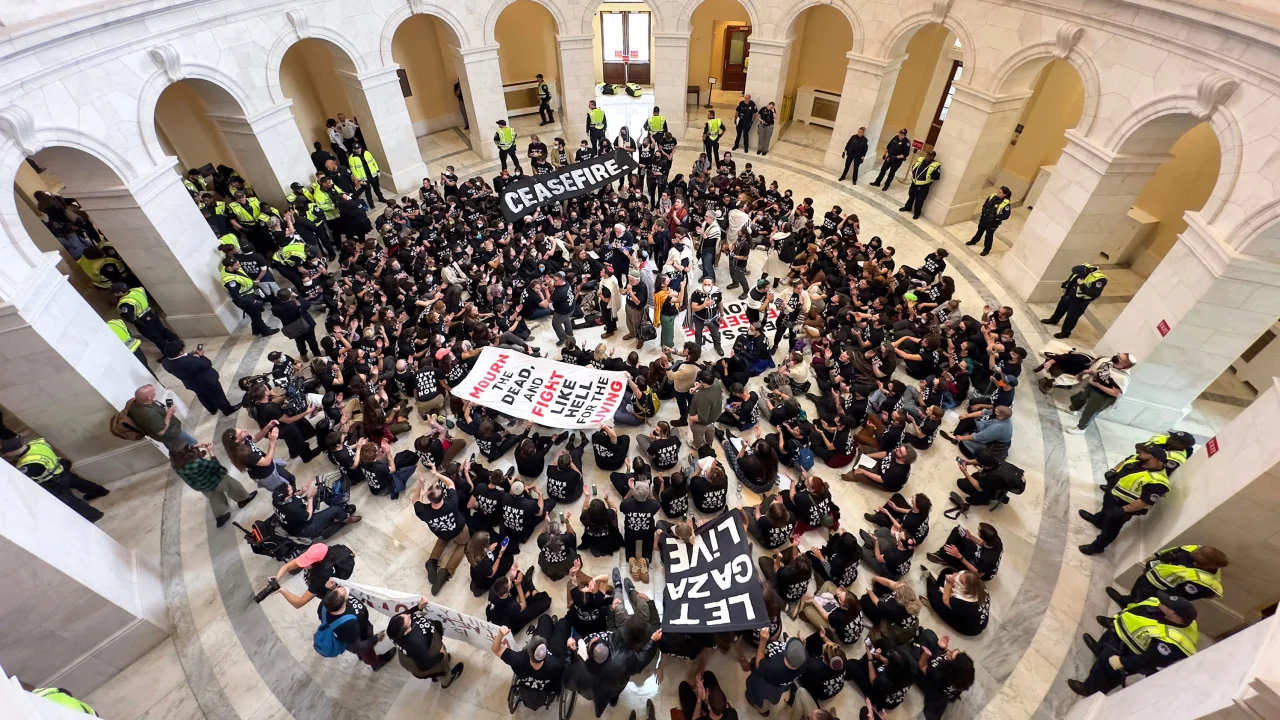
On 18 October, the Cairo Institute for Human Rights Studies published an article expressing dismay over the bombing of Al Ahli Arabi Baptist Hospital in Gaza and calling, among other things, for the ICC to implement an investigation into crimes committed by all parties since 7 October and initiate prosecution of those implicated in crimes.  Tiếp tục đọc “United Nations Committee on the Exercise of the Inalienable Rights of the Palestinian People – NGO ACTION NEWS19 October 2023”

I mourn the loss of Australia’s Indigenous voice vote – and won’t forgive the media’s mendacity

theguardian.com Thomas Keneally

Thomas Keneally

The polls had been favourable until a brutal press campaign kicked in against this kindly, long-overdue change

  • Thomas Keneally is the author of the Booker-winning Schindler’s Ark

Wed 18 Oct 2023 13.26 BST

Last Sunday, many in Australia profoundly mourned the loss of the Indigenous voice to parliament referendum, the greatest kindly amendment ever to be proposed for the Australian constitution, those dreary old articles of association by which our states and territories rub along together in far-flung federation.

When the referendum was announced in March this year, it was as a result of a message to mainstream Australia from Indigenous Australia, a statement made at Uluru near Alice Springs by Aboriginal representatives. They suggested constitutional recognition of the Aboriginal race’s ancient discovery and ownership of Australia, and proposed that their community’s disadvantages in modern Australia could be addressed through a group of Aboriginal delegates who would advise on federal laws affecting Aboriginal Australians.

https://9f16b9aa9979ae753e00d73da3e26298.safeframe.googlesyndication.com/safeframe/1-0-40/html/container.html

The ownership matter is no longer as controversial as it once was. In the 1970s a Torres Strait Islander named Eddie Mabo was shocked to hear that his garden on Murray Island belonged to the crown. He undertook a long, brave journey from regional courts all the way to the high court, to prove that his tropic garden was not the crown’s, but his own. That decision in 1992 declared that Indigenous Australians had never ceded sovereignty over their land. There were cries that every white-owned house and swimming pool would be imperilled, but the truth was that the decision allowed the Aboriginal people to claim in reality traditional and unalienated, as in not yet purchased under title and built-upon, land. With that decision began the custom of the “welcome to country”: a local tribesman, or at least an Aboriginal Australian, briefly, as a small polite gesture, welcoming people to public events and citing the local tribe and its elders, men and women, past and present. This will continue to be the practice; an acknowledgment of the established fact.

Tiếp tục đọc “I mourn the loss of Australia’s Indigenous voice vote – and won’t forgive the media’s mendacity”

24 hours with … climate negotiator Vicente Paolo Yu III

eco-business.com

Brokering for the environment for the G77, the biggest negotiating bloc of low-income countries, comes with both challenges and triumphs, says the Filipino lawyer. He shares what it is like to spend sleepless nights at the climate meetings, ahead of COP28.

Vice Yu COP24
Vicente Paolo Yu III, known by his nickname Vice, at COP24 in Katowice, Poland in 2018. Image: Vice Yu

By Hannah Alcoseba Fernandez

It is 12 midnight on the last Saturday before the conclusion of the world’s biggest climate summit. 

The Conference of the Parties (COP) to the United Nations Framework Convention on Climate Change (UNFCCC) are two-week gatherings that have been held yearly for almost three decades in a bid to make major resolutions to combat worsening impacts of global warming.

The crowd of delegates from nearly 200 countries, dozens of world leaders and hundreds of the biggest companies and nonprofits has dissipated. At the venue, negotiators, however, are huddling in a room to grapple with the final wording of text that could potentially shift the discourse on climate change for the long term. Most of them have not eaten a proper meal, and are surviving on energy bars and the water served for free at the venue.

This is a typical scene into the last hours at  the COPs, said Vicente Paolo Yu III, coordinator for the biggest negotiating bloc of low-income countries at the conference, the Group of 77 (G77) and China. The Asian superpower is not classified a developed country under international standards and has provided consistent support to the G77 on climate issues.

Tiếp tục đọc “24 hours with … climate negotiator Vicente Paolo Yu III”

Nhóm ‘nhặt sạn định kiến giới trong sách giáo khoa Tiếng Việt’ đoạt giải nhất Hội thi Sáng kiến Giới

tamviet.tienphong.vn 30/09/2023 | 20:02

TPO – Chiều 30/9, Khoa Giới và Phát triển tại Học viện Phụ nữ Việt Nam đã tổ chức trao giải mùa thứ 3 cho Hội thi Sáng kiến Giới. 

Cụ thể, chiều 30/9, Khoa Giới và Phát triển tại Học viện Phụ nữ Việt Nam, đơn vị tổ chức Dự án “Thanh niên tham gia thay đổi định kiến giới, thúc đẩy bình đẳng giới tại Việt Nam”, đã trao giải mùa thứ 3 cho Hội thi Sáng kiến Giới.

https://image.tienphong.vn/w1000/Uploaded/2023/tpuokbj/2023_09_30/screen-shot-2023-09-30-at-182854-2973.png
Tiến sĩ Nguyễn Tuấn Minh, đại diện Ban tổ chức trao giải cho sinh viên.

Buổi Lễ được dẫn dắt bởi TS. Dương Kim Anh, Phó Giám đốc Học viện Phụ nữ Việt Nam và Trưởng Khoa Giới và Phát triển, cùng ông Đào Ngọc Ninh, Phó viện trưởng Viện Tư vấn Phát triển Kinh tế Xã hội Nông thôn và Miền núi (CISDOMA). Sự kiện diễn ra trong không khí phấn khích của chuỗi hoạt động chào mừng tân sinh viên khóa K11 và kỷ niệm 8 năm thành lập Khoa Giới & Phát triển.

Tiếp tục đọc “Nhóm ‘nhặt sạn định kiến giới trong sách giáo khoa Tiếng Việt’ đoạt giải nhất Hội thi Sáng kiến Giới”