
Bethlehem, the birthplace of Jesus, observed a muted Christmas celebration on Sunday amid the ongoing Israel-Hamas war. Gaza’s Health Ministry said that more than 160 people were killed over the past 24 hours
Tác giả: Đào Thu Hằng
I'm from Hanoi, Viet Nam.
I'm an author of Dot Chuoi Non (dotchuoinon.com/author/hangbelu/), a blog on Positive thinking, founded by Dr. Tran Dinh Hoanh, an attorney in Washington DC.
I'm a co-founder of Conversations on Vietnam Development - cvdvn.net, a virtual think tank. I am a co-founder of two companies in Viet Nam working on children education services. I advise companies on STEAM education, English language education for children and students in Vietnam.
I'm studying the Buddha's teaching and the teaching of Jesus. I practice mindful living including meditation.
I hold a PhD on Sustainable Energy Systems from University of Lisbon and Aalto University.
I graduated from Hanoi University of Technology on Environmental Engineering. I obtained a Master degree of the same major from Stanford University and Nanyang Technological University.
My English-language blog at: hangbelu.wordpress/.
I play table tennis as a hobby.
Số vụ xâm hại trẻ em tăng hơn 41% năm 2023
>> 8.000 TRẺ EM BỊ XÂM HẠI TRONG 5 NĂM, 90% DO NGƯỜI THÂN QUEN – Tổng đài 111
Năm 2023, xảy ra hơn 1.800 vụ xâm hại trẻ em, tăng 41,88% so với cùng kỳ năm 2022. Đây là vấn đề được các đại biểu đề nghị cần có giải pháp khi thảo luận về Báo cáo của Chính phủ về công tác phòng chống tội phạm và vi phạm pháp luật.
Theo đại biểu, đã xảy ra nhiều vụ việc người thân, người có trách nhiệm nuôi dưỡng xâm hại thân thể, tính mạng, xâm hại tình dục trẻ em gây bức xúc dư luận. Mặc dù Quốc hội đã ban hành nghị quyết riêng về phòng chống xâm hại trẻ em từ năm 2020. Về tư pháp người chưa thành niên, Việt Nam hiện nay đang có 7 bộ luật. Song nhìn chung, công tác bảo vệ người chưa thành niên thời gian qua vẫn còn nhiều bất cập.
Theo Báo cáo thẩm tra của Ủy ban Tư pháp, tội phạm xâm hại trẻ em tăng so với cùng kỳ năm 2022, đã xảy ra 1.853 vụ tăng 41,88% .
Tình trạng người chưa thành niên vi phạm pháp luật bị xâm hại vẫn diễn biến phức tạp và có xu hướng gia tăng cũng đặt ra nhiều giải pháp mang tính đồng bộ trong thời gian tới.
In solidarity with Gaza, Bethlehem church in West Bank cancels Christmas celebrations, placing baby Jesus in the rubble
In Solidarity With Gaza, Nazareth Christians Scale Back Christmas Celebrations
In Nazareth, where Christians believe Jesus lived much of his life, Christmas celebrations have been scaled back in solidarity with Palestinians in Gaza. Christian leaders say it is impossible to feel celebratory at this time, while business owners say trade has plummeted.
Volunteers play with children sheltering in Khan Younis | Reuters
Sudan Humanitarian Update (21 December 2023)
SITUATION OVERVIEW
Eight months after fighting between the Sudanese Armed Forces (SAF) and the Rapid Support Forces (RSF) erupted in mid-April, more than 6.9 millionpeople have fled their homes, taking refuge inside and outside the country, with children representing about half of the people displaced. Sudan is now the country with the largest number of displaced people and the largest child displacement crisis in the world.
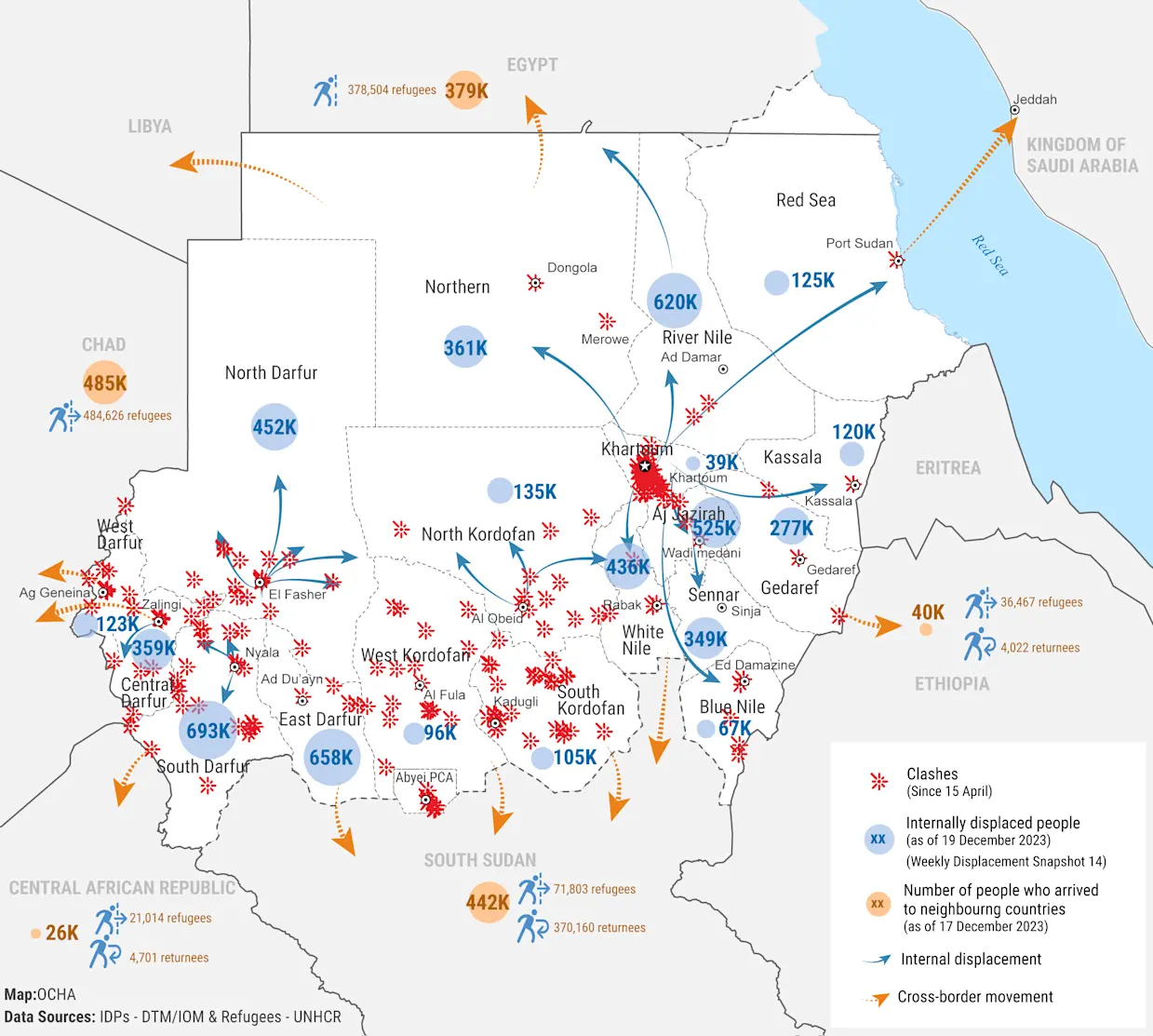
According to the International Organization for Migration Displacement Tracking Matrix (IOM DTM) Sudan Weekly Displacement Snapshot (13), more than 5.5 million people have been displaced within Sudan since April 2023. People have been displaced in 6,089 locations across the country’s 18 states, an increase of 115,000 people and 160 locations in one week. The highest proportions of IDPs have been observed across South Darfur (13 per cent), East Darfur (12 per cent), River Nile (11 per cent), Aj Jazirah (9 per cent), and North Darfur (8 per cent). THE IDPs were initially displaced from 11 states. The majority of IDPs – 3.5 million people or 64 per cent of the total – have been reportedly displaced from Khartoum State; followed by South Darfur (17 per cent), North Darfur (9 per cent), Central Darfur (4 per cent), West Darfur (3 per cent) and other states. In addition, about 1.4 million people crossed into neighbouring countries since 15 April, according to UNHCR.
The total number of people displaced within Sudan is likely to increase further when the estimated 250,000-300,000 people who have been newly displaced from Wad Medani and surrounding areas in Aj Jazirah State over the past few days are registered and verified in the locations where they have sought shelter and assistance.
About 250,000-300,000 people displaced from Wad Medani and surrounding areas, Aj Jazirah State
Tiếp tục đọc “Sudan Humanitarian Update (21 December 2023)”Sudan conflict: At least 4.9 million people at risk of extreme hunger
More than 100 container ships rerouted from Suez canal to avoid Houthi attacks
Cape of Good Hope diversion adds 6,000 nautical miles and three or four weeks to delivery times and has driven up oil prices
Jasper Jolly @jjpjollyWed 20 Dec 2023 14.24 GMT
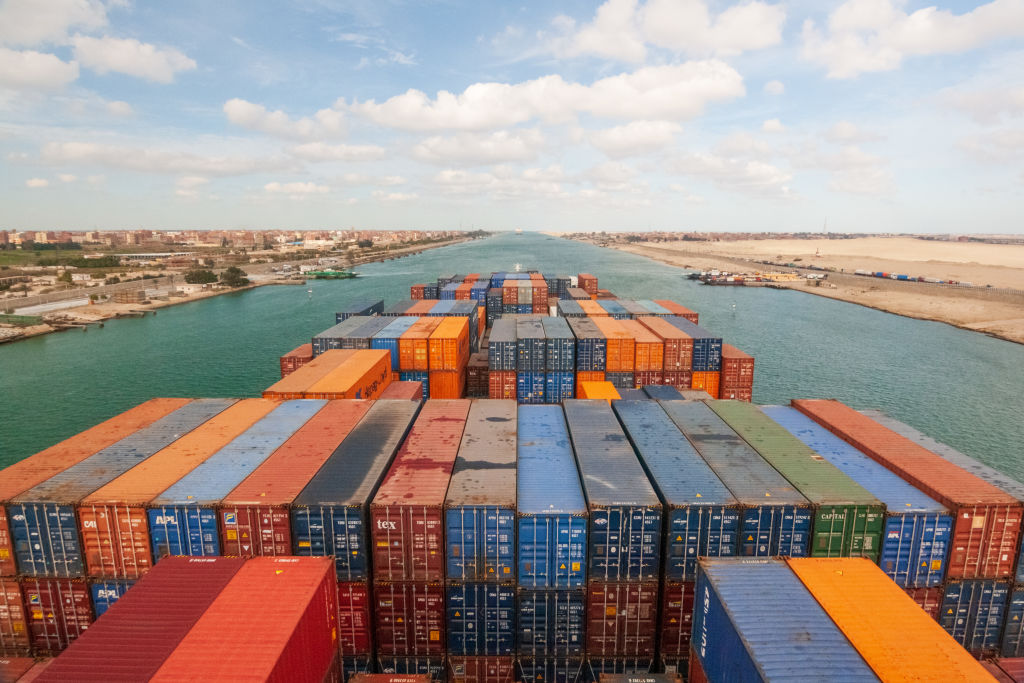
More than 100 container ships have been rerouted around southern Africa to avoid the Suez canal, in a sign of the disruption to global trade caused by Houthi rebels attacking vessels on the western coast of Yemen.
The shipping company Kuehne and Nagel said it had identified 103 ships that had already changed course, with more expected to go around South Africa’s Cape of Good Hope.
Tiếp tục đọc “More than 100 container ships rerouted from Suez canal to avoid Houthi attacks”How—and Why—Yemen’s Houthi Rebels Are Poised to Seriously Disrupt the Global Economy
time.com
BY GREGORY BREW
DECEMBER 19, 2023 12:00 AM EST
Gregory Brew is a historian of international energy, U.S. foreign policy, the Cold War, U.S.-Iranian relations, and modern Iran. He is currently an Analyst at Eurasia Group.
After two months, the crisis in the Middle East is poised to seriously disrupt the global economy as well as regional stability—thanks to the Houthis, a rebel Shi’a group in Yemen, and their successful effort to disrupt shipping through the Red Sea.
While attacks by the Houthis on commercial shipping began on November 19, they escalated last week, with the Yemeni rebels firing anti-ship ballistic missiles at several passing ships and hitting one (the first time such a weapon has ever been used successfully). As none of the ships were bound for Israel or owned by Israeli companies, the attacks signaled the Houthis were stepping up their efforts to pressure local commerce as a way to force Israel to suspend its campaign in Gaza.
https://imasdk.googleapis.com/js/core/bridge3.609.1_en.html#goog_2071400301
Shipping companies got the message. Five of the largest shipping firms announced they would redirect their container ships away from the Bab al Mandab strait, the strategic waterway through which ships must pass on their way to the Suez Canal and which handles over 10% of global commerce.
Tiếp tục đọc “How—and Why—Yemen’s Houthi Rebels Are Poised to Seriously Disrupt the Global Economy”“Gaza: Children after children after children who are lying in the hospital corridors, with horrific injuries”
Journalist casualties in the Israel-Gaza war
CPJ.org December 21, 2023 4:07 PM EST
The Israel-Gaza war has taken a severe toll on journalists since Hamas launched its unprecedented attack against Israel on October 7 and Israel declared war on the militant Palestinian group, launching strikes on the blockaded Gaza Strip.
CPJ is investigating all reports of journalists and media workers killed, injured, or missing in the war, which has led to the deadliest period for journalists since CPJ began gathering data in 1992.
As of December 21, 2023, CPJ’s preliminary investigations showed at least 68 journalists and media workers were among the more than 20,000 killed since the war began on October 7—with more than 19,000 Palestinian deaths in Gaza and the West Bank and 1,200 deaths in Israel.
The Israel Defense Forces (IDF) told Reuters and Agence France Press news agencies that it could not guarantee the safety of their journalists operating in the Gaza Strip, after they had sought assurances that their journalists would not be targeted by Israeli strikes, Reuters reported on October 27.
Journalists in Gaza face particularly high risks as they try to cover the conflict during the Israeli ground assault, including devastating Israeli airstrikes, disrupted communications, supply shortages and extensive power outages.
As of December 21:
- 68 journalists and media workers were confirmed dead: 61 Palestinian, 4 Israeli, and 3 Lebanese.
- 15 journalists were reported injured.
- 3 journalists were reported missing.
- 20 journalists were reported arrested.
- Multiple assaults, threats, cyberattacks, censorship, and killings of family members.
CPJ is also investigating numerous unconfirmed reports of other journalists being killed, missing, detained, hurt, or threatened, and of damage to media offices and journalists’ homes.
Australian City Uses Drainage Nets to Stop Waste from Polluting Waterways
/img/iea/3oOpZZzb6W/drainage-picture-2.jpg)
Pollution in our waterways is not only dangerous and unsanitary for humans but it also affects wildlife. That’s why it is so exciting to see an initiative aimed at preventing such waste.
RELATED: THIS MODULAR ROBOTIC EEL CAN DETECT SOURCES OF WATER POLLUTION
The Australian city of Kwinana has designed a simple and cost-effective solution to deal with the discharge of waste from drainage systems. The town has put nets on the outlet of drainage pipes.

These nets stop waste and pollutants from leaving the sewers, preventing garbage transported by rain waters from contaminating the town’s local water reserve. It is a simple filtering system and it works like a charm.

World Demands Ceasefire as Gaza Death Toll Tops 20,000
In memoriam: Saleemul Huq (1952-2023) – “For three decades, Huq was arguably the foremost champion of poorest countries in UN climate negotiations”
This short film pays tribute to professor Saleemul Huq, an environmental and climate change giant who died on 28 October 2023.
Professor Saleemul Huq OBE (1952-2023)
Following the passing of Professor Saleemul Huq, senior fellow of IIED. This book of remembrance is open to all who wish to share their memories of Saleem.

Professor Saleemul Huq was an environmental and climate change giant and senior fellow and dear friend of IIED and many IIED colleagues past and present.
Director of the International Centre for Climate Change and Development (ICCCAD) and a senior associate of IIED, he was awarded an OBE by the Queen in the 2022 New Year’s Honours List for his services to combating international climate change.
The honour was awarded in recognition of his work to build climate expertise in Bangladesh, the UK and across the world.
Saleem was an expert on the links between climate change and sustainable development, particularly from the perspective of vulnerable developing countries. A constant voice for climate action and justice for the global South, he was the lead author of chapters in the third, fourth and fifth assessment reports of the Intergovernmental Panel on Climate Change. Huq’s work with the IPCC spanned 1997 to 2014 and he contributed to reports that led to the panel being awarded the Nobel Peace Prize in 2007.
A professor at the Independent University, Bangladesh, and an advisor to the Least Developed Countries (LDC) Group of the UNFCCC, Huq published hundreds of scientific as well as popular articles and was named by Nature in 2022 as one of its top 10 scientists.
He set up the climate change research group at IIED in 2000 and was its initial director – continuing as a senior fellow until 2021 – and worked across the institute to ensure climate was at the heart of all that IIED did.
IIED executive director Tom Mitchell said: “I would like to offer my deepest sympathy and condolences to Saleem’s family and loved ones on behalf of IIED. There was no one quite like Saleem and I will remember his unique combination of warmth, generosity of spirit, academic prowess and enormous standing in climate science.
Starved by Israel’s blockade – Gaza’s displaced children go hungry
(This was 1 month ago, the situation is now even worse)
 CVD
CVD 