What’s really important about China’s stock market disaster, and what’s not

January 7

Washingtonpost – You can only defy financial gravity for so long. At some point, what went up for no reason must come down for a very good one, no matter what the government does to try to keep it aloft.

Which is to say that it was another disastrous day for Chinese stocks. On the plus side, though, it was a short one. Indeed, China’s market was only open for 14 minutes on Thursday before it fell the maximum 7 percent it’s allowed to in a single session. It’s the second time that’s happened this week, enough to erase almost all its gains since the summer. Tiếp tục đọc “What’s really important about China’s stock market disaster, and what’s not”

5 reasons to be worried about health security in Asia

Published on Thursday, 17 December 2015

Pharmacy at a health clinic in Poipet, Cambodia.

blogs.adb.org – If you live in Asia and the Pacific, do you ever wonder how high your risk is of contracting antimicrobial-resistant bacteria or emerging infectious diseases such as a new strain of avian influenza? Unfortunately, I have to tell you that the risk here is higher that in any other region in the world.

1. South and Southeast Asia are epicenters for antimicrobial resistance.

South and Southeast Asia are home to the highest number of major bacterial pathogens for which there is antimicrobial resistance. Most developing countries in the region do not monitor or reinforce standards in antibiotic use and prescription, and the limited available data paints a picture of widespread non-compliance with antibiotic treatment regimen. Self-medication with antibiotics available over-the-counter is common throughout Asia, and an estimated 50% of patients fail to follow the recommended antibiotics course of treatment, mainly because it’s expensive. Traces of antimicrobials used in the animal husbandry sector find their way into the food chain; so most of the meat that was not grown organically was likely treated with antibiotics. Even fish is often bathed in antibiotic solution in many commercial fisheries. And of course the water you drink might also be contaminated due to lack of adequate water treatment plants. Constant exposure to antibiotics increases the risk of developing antimicrobial resistance.

2. Asia is a hotspot for emerging infectious diseases.

Asia as where new emerging infectious diseases are most likely to originate, particularly zoonosis (diseases transmitted from animals), vector-borne diseases and drug-resistant pathogens. This is evident in the increasing frequency of these events over the last decade and is correlated directly with socio-economic, environmental and ecological factors. Numerous outbreaks of emerging infectious diseases have had a huge impact in Asia. SARS rapidly decimated tourism to the region in 2003, costing the industry $18 billion or approximately $2 million per person infected. The H5N1 virus had a profound effect on the poultry industry: in 2003-2004 Viet Nam culled 45 million birds and lost $118 million, while a Thai ban on poultry reduced the country’s income from poultry exports by 93%, from $598 million in 2003 to $44 million in 2004.

3. Health risks are increasing in Asia.

Asia is one of the most globalized, mobile regions in the world, and trade facilitates the rapid spread of diseases that otherwise may have been contained by geographical boundaries. Climate change and the associated rise in temperature and flooding lead to more vector-borne diseases such as chikungunya, malaria and dengue. Pollution and natural disasters are also significant risk factors for respiratory tract infections and water-borne diseases.

4. Fragmented supply chains impact the efficiency of drugs and vaccines.

Too much medicine that needs cold storage but is exposed to heat and humid environments can lead to an overestimation of actual effective vaccination coverage and decreased efficacy of medicines – both contributing to increasing risk of disease outbreaks. You might have seen this affect in your own children, who have been vaccinated in Asia but still developed certain diseases they were supposed to be protected against because the vaccine probably wasn’t effective anymore.

5. Unregulated health service providers.

Chronic under-investment in public health systems has resulted in private sector provision of health services, which are often unregulated (threatening quality) and not required to report routinely to health management information systems. A consequence of this data gap is that critical information on incidence of infectious diseases or drug resistance identified in the private sector takes much longer to reach public health sector officials.

The above risks can only be addressed with strengthened health systems and increased accountability, both of which arise from collaboration between countries and development partners to invest in public health services. To combat health threats and to avoid significant economic losses, we must step up health financing and redouble their efforts in cross-sector, cross-border and regional coordination on health policies and practices.

Investing in health systems today will yield not only direct health and economic benefits tomorrow, but will also help protect populations from emerging health threats both within and beyond the region. Donors outside of the region must continue to support health system strengthening in Asia, as weak health systems in any country can pose threats to their own public health and economic security.

Health is having the same disease as your neighbor – so make sure your neighbor has no diseases.

Family planning in Vietnam Running deer

A draft population law looks ill-considered and discriminatory

Reinvigorating agricultural productivity in the Lower Mekong

November 27, 2015 1:00 pm JST
Aladdin D. Rillo and Mercedita A. Sombilla

asia.nikkei.com – The green revolution has done wonders for Asia. Yields for most crops, particularly the region’s main staple of rice, have doubled over recent decades. In the Lower Mekong Delta, considered to be Asia’s rice bowl, the new technologies and crop strains that the green revolution brought were a big success.

Cambodian farmers load vegetables onto a cart for transport to market, at a farm in Kandal Province, south of Phnom Penh, on Oct. 16, which was World Food Day. © AP

Rice production in the Lower Mekong countries of Cambodia, Laos, Myanmar and Vietnam soared 68% between 1980 and 1995. During the same period, average yields more than doubled from their levels in the 1960s to about 3.5 tons per hectare. Total land area planted with rice also increased by around 25% to 16.3 million hectares between 1996 and 2005.

      By the end of 2013, however, the gains seemed to have leveled off. Between 2006 and 2013, average yield growth slowed to 22% across all of the Lower Mekong countries except Cambodia, as growth in rice production slid to 36%.

The slower trends in yield and production growth were not unique to the Lower Mekong. They also applied to the rest of Asia for various reasons. Chief among them is that green revolution technologies, particularly new rice seed varieties, had become exhausted. Poor land and water quality were also culprits in the drop-off, along with inadequate farm management practices and the rapid conversion of farmland to non-agricultural use. Eroding profit margins due to a decline in the price of rice on global markets exacted a heavy toll as well.

Low productivity

There is reason for alarm at the change. Agriculture still provides 10% of Asia’s value-added output and is an important source of employment as about 45% of jobs in Asia are in rural areas. With declining yields and production, this means that productivity, the value of output per worker, will decline further. Tiếp tục đọc “Reinvigorating agricultural productivity in the Lower Mekong”

How a Vietnamese Refugee Is Rethinking Food Delivery in America

Munchery CEO Tri Tran opens up about his harrowing journey to Silicon Valley.

January 5, 2016

Brad Stone BradStone

Munchery’s roasted chicken with frisée, walnut, and blue cheese salad.

Bloomberg.com – Tri Tran was always looking for something better to eat than government gruel. He grew up in the desperately lean decade after the end of the Vietnam War, in the small city of Ba Ria, about 50 miles southeast of Ho Chi Minh City. Because his parents were public school teachers, they received discounts on rations of rice, root vegetables, and a paste made from sorghum, which his mother cooked together. The paste was barely enough to subsist on and gave Tran terrible digestive problems. So he, his older brother, Trac, and their father occasionally sneaked into desiccated rice fields to gather wild vegetables and, if they were lucky, paddy crabs.

Tran’s parents knew their sons faced limited prospects. Tran was only 11 years old in 1986, but he remembers failed escape attempts, brokered by shady operators who skirted the communist government’s prohibition on leaving the country. Once, the family stowed away in a canoe and paddled into the middle of Ganh Rai Bay to meet a larger boat that never arrived. Later, walking back from the bay after another failed attempt, they were caught by police and thrown in jail for 24 hours.
Tiếp tục đọc “How a Vietnamese Refugee Is Rethinking Food Delivery in America”

Migration and refugees

ODI – Development is migration: millions leave their countries each year in search of opportunities and better lives. People also leave their homes to escape conflict, repression or environmental disasters. Remittances – the money that people send home from abroad – accounts for nearly 600 billion dollars, dwarfing global aid budgets.

Our research and high-level debates on the crisis in the Mediterranean and, more recently, on the Syrian refugee crisis, examine how we can meet these global challenges – and the role of international development to better manage global migration.

Through research, events, media engagement and partnerships, ODI offers evidence to lay bare the political and economic realities of migration and to inform the public debate.

Specifically, we focus on three areas: refugees and displacement, European migration policy and human mobility.

Opening borders and barriers

Nature 527, S80–S82 (12 November 2015) doi:10.1038/527S80a
Published online
11 November 2015

Collaboration may result in higher impact science, but are government initiatives the best way to promote such international and interdisciplinary connections?

Kavli Institute

Tea time at Kavli Institute allows for an organized and informal exchange of collaborative ideas.

Nature – An American physicist, a Japanese mathematician and a German cosmologist walk into a lab; what do you get? Based on recent outcomes, you’ll get ground-breaking science. And lately, governments have begun paying heed to evidence1 that suggests international, multidisciplinary collaborations such as these will yield high-impact results.

Policymakers from diverse countries, including China, Japan, Australia, Chile and Germany, have sought to foster excellent science and technological innovation — and reap the associated economic benefits — by promoting collaboration across borders and disciplines, and setting up specialist centres with the necessary resources (see ‘Conduits to collaboration’).

Study Looks at Renewable Energy in Germany and Texas

Dec 29, 2015

renewablenergyworld – A report published by Stanford’s Steyer-Taylor Center for Energy Policy and Finance looks at three of the world’s largest economies and largest energy jurisdictions in an attempt to compare their approaches to ramping up renewable energy.  Included in the report is a comparison of electricity rates in Germany to those in Texas and California as well a discussion of how renewables contribute to overall costs.

The report compares Germany, the world’s fourth largest economy and an aggressive adopter of renewable energy, with the states of California and Texas.  California and Texas are the world’s 8th and 12th largest economies respectively, and are both leaders in the U.S. with respect to wind and solar deployment. Tiếp tục đọc “Study Looks at Renewable Energy in Germany and Texas”

Despite $28 Billion Drop in Global Private Infrastructure Investment in Energy, Transport, and Water, Strong Showing of Renewable Energy Projects

Worldbank.org – WASHINGTON, December 15, 2015—Despite a sharp decline in private investment in energy, transport, and water infrastructure in developing countries in the first six months of 2015, investment in renewable energy projects, mainly solar, rose to nearly half of the total investment — the highest level ever as a share of total investment, according to an update released today by the World Bank Group’s Private Participation in Infrastructure Database.

Total private infrastructure investments for the energy, transport, and water sectors  in 139 emerging economies dropped by more than half, from $53 billion in first six months of 2014 to $25 billion in the first six months of 2015, mainly due to a decline in the number of projects in Brazil, China, and India. Investments in other countries remained steady.
Tiếp tục đọc “Despite $28 Billion Drop in Global Private Infrastructure Investment in Energy, Transport, and Water, Strong Showing of Renewable Energy Projects”

Our Energy Transformation in 2015

What Africa can learn from Asian supply chains

Published on Tuesday, 15 December 2015

A woman sells coffee beans in Viet Nam.

blogs.ADB.org – At this week’s 10th World Trade Organization (WTO) Ministerial Conference in Nairobi, Kenya, trade ministers are trying to advance 15 years of Doha Development Agenda talks to reduce trade barriers. The real issue, however, is whether African economies can follow East Asia’s success in global supply chains amid “new normal” growth and rising inequality.

Global supply chains refer to the geographical location of stages of production (design, production, marketing, and service activities) in a cost-effective manner and linked by trade in intermediate inputs and final goods. For instance, the Toyota Prius—a hybrid electric mid-size hatchback car—for the US market was designed in Japan and is presently assembled there, but some parts and components are made in Southeast Asia and the People’s Republic of China (PRC).
Tiếp tục đọc “What Africa can learn from Asian supply chains”

Setting the Post-Paris Climate Agenda

Photo courtesy of Kim Seng from https://www.flickr.com/photos/captainkimo/6702244011/
Dec 1, 2015

CSIS – UN climate negotiations are sort of like the holiday season. In the lead up there is always huge amounts of anticipation, lots of planning and logistics, and the promise of something new, merry, and important. The event itself is chaotic with lots of complicated family dynamics and the ever-present threat of someone storming off in a huff. The day after often brings plenty of leftovers to be dealt with, presents to be stored, regifted, or returned, and a sense that it is time to move on to all the things that had been put off while dealing with the big preparations.

There is no denying that for the climate community the last twelve months have been one big crescendo to Paris, a carefully orchestrated set of activities and announcements designed to drive momentum and activity toward the big moment. By any stretch this has been a tremendously successful crescendo. The country pledges that have been rolling in since this past spring total over 180 in number and cover approximately 95 percent of global emissions. By the UN’s own estimates, these pledges, if pursued in earnest, could keep the world in the ballpark of limiting temperature rise to 2.7 degrees Celsius above pre-industrial levels. Over 400 cities, 1,000 plus companies, and countless members of civil society pledged separate and additional actions. The Pope and several other groups of religious leaders weighed in on the moral imperative to tackle climate change and the United States denied the Keystone XL pipeline project – a major North American symbol of the environmentalist struggle to catalyze action on climate change. Unlike five years ago in Copenhagen , there is a lot on the table this time even before the talks get underway. Tiếp tục đọc “Setting the Post-Paris Climate Agenda”

Germany Could Make $2 Billion By Exporting Electricity

November 10th, 2015 by

cleantecnica – The Fraunhofer Institute has found that Germany made about €1.7 billion, or $1.93 billion, in 2014 by selling surplus electricity. In 2015, that amount could reach €2 billion or $2.2 billion. Germany may also achieve a record export surplus of 40 TWh of electricity in 2015. “Over the past years, Germany was able to secure higher prices for its electricity exports than it paid for electricity imports,” explained Fraunhofer professor, Bruno Burger.

germancliffsRenewables added 118 TWh of energy production capacity in Germany from the period beginning in 2010 through 2014. What are some of Germany’s other exports? According to one source, Germany exported about $2.6 billion in pharmaceuticals to Japan in 2014. In 2007, cheese exports were about €2.7 billion. Tiếp tục đọc “Germany Could Make $2 Billion By Exporting Electricity”

Powering the Internet with renewable energy

December 3, 2015

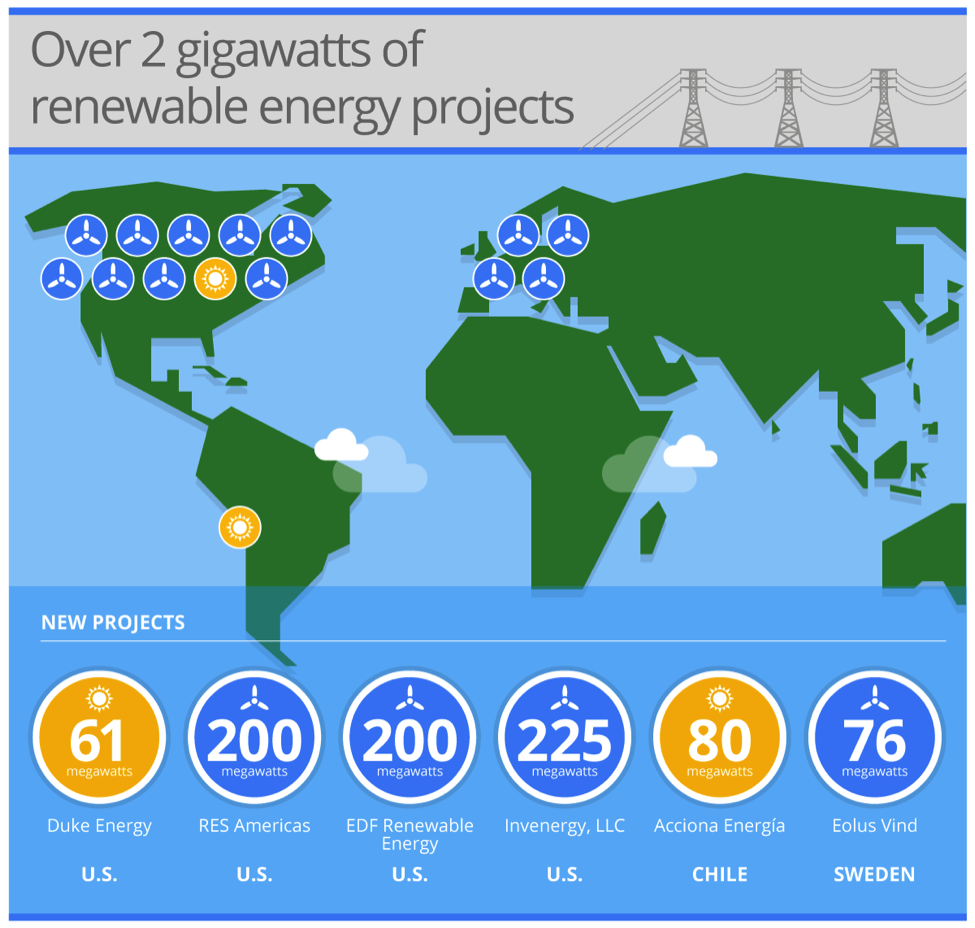
Googleblog – Today we’re announcing the largest, and most diverse, purchase of renewable energy ever made by a non-utility company. Google has already committed to purchase more renewable energy than any other company. Now, through a series of new wind and solar projects around the world, we’re one step closer to our commitment to triple our purchases of renewable energy by 2025 and our goal of powering 100% of our operations with clean energy. 842 MW of renewable energy around the world Today’s agreements will add an additional 842 megawatts of renewable energy capacity to power our data centers. Across three countries, we’re nearly doubling the amount of renewable energy we’ve purchased to date. We’re now up to 2 gigawatts—the equivalent to taking nearly 1 million cars off the road. These additional 842 megawatts represent a range of locations and technologies, from a wind farm in Sweden to a solar plant in Chile.

These long-term contracts range from 10-20 years and provide projects with the financial certainty and scale necessary to build these wind and solar facilities—thus bringing new renewable energy onto the grid in these regions. For our part, these contracts not only help minimize the environmental impact of our services—they also make good business sense by ensuring good prices. Our commitment to a sustainable energy future Since we opened our very first owned data center in 2006, we’ve been working to promote renewable and sustainable energy use in several ways:

  • First, we’re building the world’s most efficient computer infrastructure by designing our data centers to use as little energy as possible.

Tiếp tục đọc “Powering the Internet with renewable energy”

Why do we know so little about corporate human rights abuses?

Posted: 12/02/2015 12:53 pm EST

huffingtonpost – They called it “the plane that became a convertible.” In 1988, on a routine flight from Hilo to Honolulu, Aloha Airlines flight 243 depressurized mid-flight, ripping the top off the plane. A flight attendant, the only one who wasn’t strapped in, was sucked out of the plane with it.

The accident was a wake-up call for the aviation industry. For years, deregulation had attracted more companies to the sector, increasing pressure on airlines to extend the lifespan of their fleets and skip maintenance to keep them in the air.

After the accident, airlines and regulators decided to solve the safety problem head-on. The U.S. Federal Aviation Authority required every airline to report its maintenance, testing and accident data, and set statutory limits for how many times each piece of equipment could be used before it had to be retired. Tiếp tục đọc “Why do we know so little about corporate human rights abuses?”