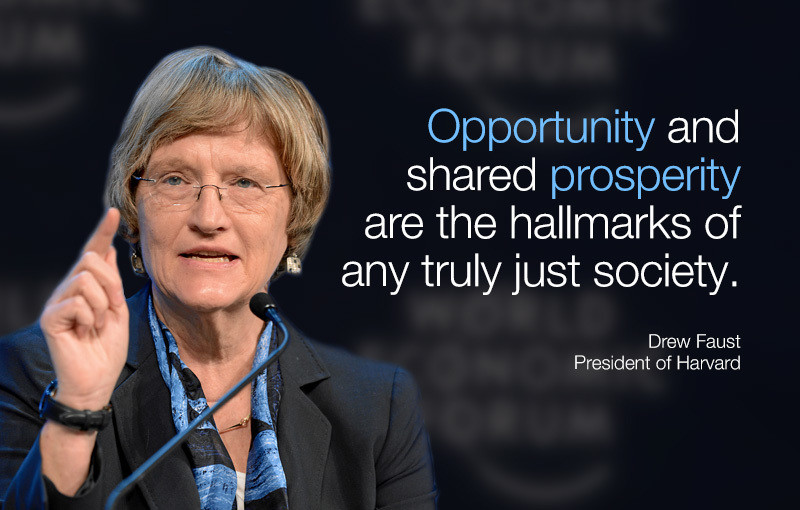
Can education beat inequality?

weforum – This year’s World Economic Forum challenges participants to consider and assess the “Fourth Industrial Revolution,” an era of sweeping and rapid technological advances that will disrupt industries and change the future in ways that none of us can predict. What is predictable, however, is that inequality will continue to cast a long shadow on humanity’s progress unless we choose to act.

What role does higher education have to play in ensuring that more individuals are prepared to reap the benefits of the coming age? Knowledge is — and will remain — the most powerful currency, and economic mobility continues to be contingent, in large part, on access to quality education.

Universities expand opportunity and prepare young people for meaningful engagement with their work and with the world. Students encounter points of view and ways of thinking that may be completely foreign to them—and learn to situate their own lives in a broader context as a result. They develop habits of mind that privilege flexibility and resilience, and they graduate with economic advantages that persist throughout their lifetimes.

The Fourth Industrial Revolution: What It Means and How to Respond

foreignaffair – We stand on the brink of a technological revolution that will fundamentally alter the way we live, work, and relate to one another. In its scale, scope, and complexity, the transformation will be unlike anything humankind has experienced before. We do not yet know just how it will unfold, but one thing is clear: the response to it must be integrated and comprehensive, involving all stakeholders of the global polity, from the public and private sectors to academia and civil society.

The First Industrial Revolution used water and steam power to mechanize production. The Second used electric power to create mass production. The Third used electronics and information technology to automate production. Now a Fourth Industrial Revolution is building on the Third, the digital revolution that has been occurring since the middle of the last century. It is characterized by a fusion of technologies that is blurring the lines between the physical, digital, and biological spheres.

There are three reasons why today’s transformations represent not merely a prolongation of the Third Industrial Revolution but rather the arrival of a Fourth and distinct one: velocity, scope, and systems impact. The speed of current breakthroughs has no historical precedent. When compared with previous industrial revolutions, the Fourth is evolving at an exponential rather than a linear pace. Moreover, it is disrupting almost every industry in every country. And the breadth and depth of these changes herald the transformation of entire systems of production, management, and governance. Tiếp tục đọc “The Fourth Industrial Revolution: What It Means and How to Respond”

Sensible subsidies – How should backing for clean technology be designed?

Governments usually provide subsidies based on overall adoption targets, such as the number of cars or solar panels they would like to see purchased over a period of time. But green technologies are often new products, and no one really knows how many consumers are waiting to buy them.

Peter Dizikes | MIT News Office
January 21, 2016

new.MIT.edu – Governments often offer subsidies to consumers for clean-technology products, from home solar panels to electric vehicles. But what are the right levels of subsidy, and how should they be calculated? As a new paper co-authored by MIT researchers shows, governments can easily make subsidies too low when they ignore a basic problem: Consumer demand for these products is usually highly uncertain.

Indeed, the paper’s analysis suggests this has already happened in the case of the Chevy Volt, an electric car introduced in 2010 that suffered slow initial sales before gaining more traction in the marketplace.

“The government will miss their target by a lot when ignoring demand uncertainty,” says Georgia Perakis, the William F. Pounds Professor of Management at the MIT Sloan School of Management and a co-author of the paper.

While discussion of “demand uncertainty” might sound a bit abstract, it matters. Governments usually provide subsidies based on overall adoption targets, such as the number of cars or solar panels they would like to see adopted over a period of time. But green technologies are often new products, and no one really knows how many consumers are waiting to buy them. Tiếp tục đọc “Sensible subsidies – How should backing for clean technology be designed?”

Why the Future Is Bright for the World’s Poorest Farmers

By Bill Gates | January 20, 2016
Gatenotes.comI have probably learned more about farming in Africa from Sam Dryden than from any other person. Sam has been spent decades working in agriculture, including a stint at the Gates Foundation, and he is passionate about improving the lives of the poorest. So when he asked me to contribute to a series of articles in Foreign Affairs on the future of farming and its role in fighting poverty, I was happy to do it. My essay is below. You can download the whole series—which includes authors like Kofi Annan and Sir Gordon Conwayhere.

One thing I’ve learned in my work with Microsoft is that the process of innovation tends to take longer than many people expect, but it also tends to be more revolutionary than they imagine. We are seeing this dynamic play out right now in the way digital technology is fundamentally reorganizing life for the poorest people in the world.

Twenty years ago, when the Internet was brand new, a lot of people thought computers would quickly become part of daily life in developing countries. And when I say “a lot of people,” I include myself. But those people weren’t thinking about all the facts.

In 1997, I traveled to South Africa for the first time. I spent most of my time in big office buildings in downtown Johannesburg. One day, though, I took a side trip to Soweto, where Microsoft was donating computers and software to a community center—the same kind of thing we did in the United States. Tiếp tục đọc “Why the Future Is Bright for the World’s Poorest Farmers”

In Asia, supporting women farmers crucial to fighting poverty, hunger and climate change

Oxfam International – Tue, 12 Jan 2016 11:35 GMT

Thomsonreutersfoundation – At the first Asia Women Farmer Forum, women farmers from 14 developing countries came together to exchange experiences on securing their right to land and enhancing their resilience in the face of climate change. Diah Dwiandani/Oxfam

On that same evening, in Colombo, Sri Lanka, women farmers from 14 developing countries – leaders and climate experts in their own right – were getting ready to head back home. They had just attended the first Asia Women Farmer Forum organized by Oxfam as part of its Asia GROW Campaign to bring women together to discuss the challenges they have faced in securing their rights and enhancing their resilience in a changing climate.

“A woman farmer who goes to bed hungry is just wrong,” said Janice Ian Manlutac, Resilience lead for Oxfam in Asia, “But this is a daily reality in many Asian countries, where women make up 50 per cent of the total agricultural workforce.”

Norly Grace Mercado, Oxfam’s Asia GROW Campaign Coordinator, added: “Women have far less access than men to productive resources like land, livestock, education, and agricultural extension and financial services. Our research has also shown that women farmers work up to 16 hours in the field but only share 10 per cent of the profit.”

To put faces to numbers, participants of the forum shared their struggles and, most importantly, their stories of courage in the face of unfavorable odds. Tiếp tục đọc “In Asia, supporting women farmers crucial to fighting poverty, hunger and climate change”

Food firms failing to tackle nutrition crisis

Rising obesity and malnutrition are indicators that a global nutrition crisis is mounting, but the world’s largest food and beverage (F&B) companies are not doing enough to solve it, a new study says.

ecobusiness – Rising rates of obesity and malnourishment indicate that a global nutrition crisis is mounting, but the world’s largest food and beverage (F&B) companies are not doing enough to solve it, a new study says.

Released on Thursday in London, the Global Access to Nutrition Index report found that while leading food firms have made some progress towards improving consumers’ diets, there is much more the sector can do to tackle these widespread issues.

The index, which was first launched by the Netherlands-based non-profit Access to Nutrition Foundation (ANF) in 2013 and is now in its second edition, assesses the 22 largest food companies on how well their corporate strategy, product offering and marketing efforts address obesity and under-nutrition. Tiếp tục đọc “Food firms failing to tackle nutrition crisis”

‘Unruly’ ‘rebels’? The situation of defenders working on corporate accountability in East Asia

Governments, business, and ASEAN and UN bodies must act to respect and protect individuals, organisations and communities working to promote corporate accountability in East Asia in the face of mounting attacks and worsening restrictions against human rights defenders and corporate accountability activists in the region. 

ISHR – (Geneva/Bangkok) – Human rights defenders working to promote corporate respect for human rights or accountability for business-related human rights violations face significant challenges across the East Asia region, regardless of the country or sector in which they work. In a joint report released publicly today, the Asian Forum for Human Rights and Development (FORUM-ASIA) and the International Service for Human Rights (ISHR) draw from information from nine different national-level human rights organisations to highlight country-specific concerns and to provide recommendations to improve the situation for defenders. Tiếp tục đọc “‘Unruly’ ‘rebels’? The situation of defenders working on corporate accountability in East Asia”

Health care in Vietnam Limping along

Ordinary folk are sick and tired of their public hospitals

Full to overflowing

economist – WAS the tumour malignant? Nguyen Thi Hoat’s doctors could not tell because their public hospital lacks brain-scanners. Ms Hoat’s only option was to travel 130km (80 miles), on the back of her sister’s motorbike, from her village to a crowded public hospital in the capital. Yet her state insurance policy covers just 30% of any medical expenses incurred outside her home province. The $150 that Ms Hoat, a rice farmer, put towards blood tests and a brain scan is equal, for her, to a month’s earnings.

It is the job of the authorities to look after health care. The Communist Party of Vietnam first pledged health-sector reform as early as the 1920s, well before it declared the country independent in 1945. It developed a publicly financed health-care system even as it was fighting wars against France and then America. The provision of health care is supposed to be one of the pillars on which the party’s legitimacy is based.
Tiếp tục đọc “Health care in Vietnam Limping along”

Finnish education guru Pasi Sahlberg: treat primary school teachers like doctors

Finnish education leader Pasi Sahlberg discusses what works and what doesn’t in education. pasisahlberg.com

The Finnish education system is one of the best performing and most equitable in the OECD.

theconversation – With Prime Minister Julia Gillard’s promise to make Australia one of the best five performing countries for education in the world, what can we learn from the Scandinavians?

One answer might be more simple than we think: elevate teachers to the same social and professional status we hold doctors and other people with whom we trust with vital aspects of our health and well-being.

Today The Conversation presents a discussion between two of the world’s leading education experts on how Australia can learn from others and improve its educational outcomes.

Pasi Sahlberg is Director General of the Centre for International Mobility and Cooperation (CIMO) in the Ministry of Education in Finland. He has worked as a teacher, teacher-educator, policy advisor and director, and for the World Bank and European Commission.

Professor John Hattie is director of the Melbourne Education Research Institute at the University of Melbourne’s Graduate School of Education. His influential 2008 book Visible Learning: A synthesis of over 800 Meta-Analyses Relating to Achievement is believed to be the world’s largest evidence-based study into the factors which improve student learning. Tiếp tục đọc “Finnish education guru Pasi Sahlberg: treat primary school teachers like doctors”

Malaysia to Ban Bauxite Mining for 3 Months to Cut Pollution

January 6, 2016 — 8:33 AM GMT Updated on January 6, 2016 — 10:52 AM GMT
  • Country supplied more than 40% of China’s imports last year
  • Suspension starts Jan. 15 as government seeks to tighten rules

bloomberg – Malaysia, the biggest shipper of bauxite to China, will stop mining ore for three months to cut river and sea pollution, Natural Resources and Environment Minister Wan Junaidi Jaafar said.

The ban takes effect from Jan. 15 in Pahang, the largest producing state, Wan Junaidi told reporters. Exports will be allowed during the moratorium to reduce port inventories, and after the suspension the government will limit bauxite production to the capacity to ship the material, he said on Wednesday.

Malaysia supplied more than 40 percent of China’s imports of the aluminum-making raw material last year after Indonesia imposed a ban on shipments in January 2014. China produces about half the world’s aluminum used in everything from aircraft to door frames and drink cans. The country’s exports of the metal and its products surged 36 percent in November from the previous month, helping push global prices down 19 percent in 2015. Tiếp tục đọc “Malaysia to Ban Bauxite Mining for 3 Months to Cut Pollution”

Vietnam begins huge effort to identify war dead

World’s largest systematic identification project will use smart DNA-testing technology.

12 January 2016 Article tools

KHAM/Reuters/Corbis

Vietnam’s Viet-Laos cemetery contains the remains of thousands of people who died in the Vietnam War — but most are still unidentified.

Nature – Digging foundations for temples or schools, harvesting rice in paddy fields: these are some of the ways that the decaying remains of Vietnam War victims still turn up, 40 years after the conflict ended. Now an effort has begun that will use smart DNA technologies to identify the bones of the half a million or more Vietnamese soldiers and civilians who are thought still to be missing.

It is the largest ever systematic identification effort; only the identification of more than 20,000 victims of armed conflicts in Bosnia and Herzegovina during the 1990s comes close.

“When I was a 21-year-old in the medical corps there, I never imagined that such a project could ever become possible,” says Vietnam veteran and genomics pioneer Craig Venter, head of the J. Craig Venter Institute in La Jolla, California. “We thought of body counts as statistics — now, decades later, it may be possible to put names to them.”

Although the United States has repatriated and identified most of its war dead, Vietnam has so far identified just a few hundred people, using outdated techniques. Yet people in Vietnam remain desperate to acquire the remains of family members. Tiếp tục đọc “Vietnam begins huge effort to identify war dead”

The Dubious Promise of Bioenergy Plus Carbon Capture

Climate change agreements rest on negative emissions technologies that may be unachievable.

technologyreview – While many scientists and climate change activists hailed December’s Paris agreement as a historic step forward for international efforts to limit global warming, the landmark accord rests on a highly dubious assumption: to achieve the goal of limiting the rise in global average temperature to less than 2 °C (much less the more ambitious goal of 1.5 °C), we don’t just need to reduce emissions of carbon dioxide to essentially zero by the end of this century. We also must remove from the atmosphere huge amounts of carbon dioxide that have already been emitted (see “Paris Climate Agreement Rests on Shaky Technological Foundations”).

Doing so will involve “negative emissions technologies”—systems that capture carbon dioxide and store it, usually deep underground. Such technologies are theoretical at best, but they are considered critical for achieving the Paris goals. Of the 116 scenarios reviewed by the Intergovernmental Panel on Climate Change to achieve stabilization of carbon in the atmosphere at between 430 and 480 parts per million (the level considered necessary for a maximum 2 °C rise in temperature), 101 involve some form of negative emissions. Tiếp tục đọc “The Dubious Promise of Bioenergy Plus Carbon Capture”

What’s really important about China’s stock market disaster, and what’s not

January 7

Washingtonpost – You can only defy financial gravity for so long. At some point, what went up for no reason must come down for a very good one, no matter what the government does to try to keep it aloft.

Which is to say that it was another disastrous day for Chinese stocks. On the plus side, though, it was a short one. Indeed, China’s market was only open for 14 minutes on Thursday before it fell the maximum 7 percent it’s allowed to in a single session. It’s the second time that’s happened this week, enough to erase almost all its gains since the summer. Tiếp tục đọc “What’s really important about China’s stock market disaster, and what’s not”

5 reasons to be worried about health security in Asia

Published on Thursday, 17 December 2015

Pharmacy at a health clinic in Poipet, Cambodia.

blogs.adb.org – If you live in Asia and the Pacific, do you ever wonder how high your risk is of contracting antimicrobial-resistant bacteria or emerging infectious diseases such as a new strain of avian influenza? Unfortunately, I have to tell you that the risk here is higher that in any other region in the world.

1. South and Southeast Asia are epicenters for antimicrobial resistance.

South and Southeast Asia are home to the highest number of major bacterial pathogens for which there is antimicrobial resistance. Most developing countries in the region do not monitor or reinforce standards in antibiotic use and prescription, and the limited available data paints a picture of widespread non-compliance with antibiotic treatment regimen. Self-medication with antibiotics available over-the-counter is common throughout Asia, and an estimated 50% of patients fail to follow the recommended antibiotics course of treatment, mainly because it’s expensive. Traces of antimicrobials used in the animal husbandry sector find their way into the food chain; so most of the meat that was not grown organically was likely treated with antibiotics. Even fish is often bathed in antibiotic solution in many commercial fisheries. And of course the water you drink might also be contaminated due to lack of adequate water treatment plants. Constant exposure to antibiotics increases the risk of developing antimicrobial resistance.

2. Asia is a hotspot for emerging infectious diseases.

Asia as where new emerging infectious diseases are most likely to originate, particularly zoonosis (diseases transmitted from animals), vector-borne diseases and drug-resistant pathogens. This is evident in the increasing frequency of these events over the last decade and is correlated directly with socio-economic, environmental and ecological factors. Numerous outbreaks of emerging infectious diseases have had a huge impact in Asia. SARS rapidly decimated tourism to the region in 2003, costing the industry $18 billion or approximately $2 million per person infected. The H5N1 virus had a profound effect on the poultry industry: in 2003-2004 Viet Nam culled 45 million birds and lost $118 million, while a Thai ban on poultry reduced the country’s income from poultry exports by 93%, from $598 million in 2003 to $44 million in 2004.

3. Health risks are increasing in Asia.

Asia is one of the most globalized, mobile regions in the world, and trade facilitates the rapid spread of diseases that otherwise may have been contained by geographical boundaries. Climate change and the associated rise in temperature and flooding lead to more vector-borne diseases such as chikungunya, malaria and dengue. Pollution and natural disasters are also significant risk factors for respiratory tract infections and water-borne diseases.

4. Fragmented supply chains impact the efficiency of drugs and vaccines.

Too much medicine that needs cold storage but is exposed to heat and humid environments can lead to an overestimation of actual effective vaccination coverage and decreased efficacy of medicines – both contributing to increasing risk of disease outbreaks. You might have seen this affect in your own children, who have been vaccinated in Asia but still developed certain diseases they were supposed to be protected against because the vaccine probably wasn’t effective anymore.

5. Unregulated health service providers.

Chronic under-investment in public health systems has resulted in private sector provision of health services, which are often unregulated (threatening quality) and not required to report routinely to health management information systems. A consequence of this data gap is that critical information on incidence of infectious diseases or drug resistance identified in the private sector takes much longer to reach public health sector officials.

The above risks can only be addressed with strengthened health systems and increased accountability, both of which arise from collaboration between countries and development partners to invest in public health services. To combat health threats and to avoid significant economic losses, we must step up health financing and redouble their efforts in cross-sector, cross-border and regional coordination on health policies and practices.

Investing in health systems today will yield not only direct health and economic benefits tomorrow, but will also help protect populations from emerging health threats both within and beyond the region. Donors outside of the region must continue to support health system strengthening in Asia, as weak health systems in any country can pose threats to their own public health and economic security.

Health is having the same disease as your neighbor – so make sure your neighbor has no diseases.

Family planning in Vietnam Running deer

A draft population law looks ill-considered and discriminatory