Vietnam crude oil imports to hit record as refinery gets ready to start

Reuters.com

* Vietnam’s second refinery has started importing crude

* Imports jump as country’s crude production stalls

* Kuwait, Brunei and Azerbaijan supplying Vietnam with crude

By Henning Gloystein

SINGAPORE, Aug 18 (Reuters) – Vietnam’s crude oil imports will soar to record highs in August as the country ramps up fuel refining at a time when local crude output is dwindling.

August will mark the first month on record in which Vietnam is a net importer of crude oil, according to shipping data in Thomson Reuters Eikon, with the trend set to continue in coming months as the Southeast Asian nation’s refinery capacity grows.

The surge in overseas orders comes as Vietnam’s 200,000 barrels per day (bpd) Nghi Son refinery, its second such facility, prepares to produce liquefied petroleum gas, gasoline, diesel, kerosene and jet fuel, mainly for the domestic market, likely starting later this year or in early 2018.

With local oil production stalling, traders said the country of over 90 million people and 6-percent annual economic growth would gradually increase its crude imports.

“We expect to send bigger and more frequent volumes of crude to Vietnam in the future. Vietnam is one of the key new centres of oil demand growth, and we wouldn’t want to miss this opportunity,” said a senior oil trading manager. He asked not to be identified as he was not allowed to discuss trading strategies.

Shipping data in Thomson Reuters Eikon shows that Vietnam will import around 100,000 bpd of crude in August, on three tankers, versus exports of 70,000 bpd. September tanker imports are scheduled at similar levels.

Vietnam’s orders are still small compared with Asian’s top buyers, China and India, which import around 8 million and 4 million bpd of crude per day respectively.

“But in an environment of oversupply, this incremental new demand is very welcome for crude suppliers,” the trading manager said. Tiếp tục đọc “Vietnam crude oil imports to hit record as refinery gets ready to start”

Trong khi Bắc Kinh phát triển Năng lượng tái tạo, thì các công ty Trung Quốc xây nhiệt điện than ở Việt Nam và các nước nghèo – As Beijing Joins Climate Fight, Chinese Companies Build Coal Plants

When China halted plans for more than 100 new coal-fired power plants this year, even as President Trump vowed to “bring back coal” in America, the contrast seemed to confirm Beijing’s new role as a leader in the fight against climate change.

But new data on the world’s biggest developers of coal-fired power plants paints a very different picture: China’s energy companies will make up nearly half of the new coal generation expected to go online in the next decade.

Tiếp tục đọc “Trong khi Bắc Kinh phát triển Năng lượng tái tạo, thì các công ty Trung Quốc xây nhiệt điện than ở Việt Nam và các nước nghèo – As Beijing Joins Climate Fight, Chinese Companies Build Coal Plants”

Venezuela is likely to be the first country to lose all of its glaciers, but unfortunately it will not be the last country.

Venezuela is losing its last glacier

Glacierhub.com

Humboldt Glacier, 14 December 2011 (Source: The Photographer/ Creative Commons).

Venezuela used to have five glaciers. Today, only one remains. The last glacier in Venezuela, the Humboldt glacier, is about to disappear. “Reduced to an area of ten football pitches, a tenth of its size 30 years ago, it will be gone within a decade or two,” reports The Economist. Once Venezuela loses the Humbolt, it will become the first country in modern history to have lost all of its glaciers.

The glacier is expected to completely vanish in ten to twenty years, and scientists have expressed the importance of studying the glacier in its last stages. However, the political and economic crisis in Venezuela makes it difficult to study the glacier. In the past, studies have shown how rapid glacier retreat affects the water cycle in glacier-dependent basins, which changes water regulation and availability. Thus, the disappearance of the Humboldt glacier will impact local communities as run-off stability and water supply for agriculture change. Tiếp tục đọc “Venezuela is likely to be the first country to lose all of its glaciers, but unfortunately it will not be the last country.”

HSBC accused of breaking EU sanctions rules by co-financing Vietnam coal plant

HSBC might be breaking European Union rules on working with Russian banks by funding a new 1,200 megawatt coal-fired power station in Vietnam. The bank, which recently announced a US$100 billion fund to fight climate change, denies this.

 eco-business_HSBC, one of the world’s largest financial services groups, may have broken European Union (EU) sanctions regulations by working with a Russian bank on the financing of a new coal-fired power plant in Vietnam, according to an investigation by Market Forces, an environmental group that campaigns against the funding of fossil fuel power projects.

The London-based global banking giant is the lead arranger and global coordinator for the financing of LongPhu1, a 1,200 megawatt coal-fired power station that is also being funded by Russian development bank Vnesheconombank. Tiếp tục đọc “HSBC accused of breaking EU sanctions rules by co-financing Vietnam coal plant”

Skills and occupational needs in renewable energy and Green Buildings – Kỹ năng và nghề nghiệp cần thiết trong ngành năng lượng tái tạo và công trình xanh

The renewable energy sector is growing fast: about half of the new electricity-generating capacity added globally in 2008 and 2009 came from renewable energy additions. Fast deployment has led to skill shortages in technical occupations such as solar installers and electrical engineers, but also in more general occupations, such as sales and finance specialists, inspectors, auditors and lawyers.
This report brings together the findings from 33 countries and arises from a joint EC/ILO project on Knowledge sharing in early identification of skill needs.

Green Building

Download: Skills and occupational needs in green building‎pdf – 1.8 MB‎ 

Demand for workers in retrofitting and new green construction is expected to grow over the coming years but the lack of appropriate skills in the workforce can hamper the development of the sector and its potential benefits. New skill needs related to energy efficiency, water management and renewable energies in buildings are emerging. Skills-led strategies can drive the green building sector forward.
This report brings together the findings from 34 countries and arises from a joint EC/ILO project on Knowledge sharing in early identification of skill needs.

</div

Vietnam Sustainability Forum (VSF 2018), 18-19 January 2018, Hanoi, Vietnam

The Vietnam Sustainability Forum (VSF 2018) aims at providing an international exchange platform for various stakeholders including policymakers, academics, entrepreneurs, practitioners, and the NGOs to present, discuss and debate the worldwide visionary initiatives, practices, and trends for a harmonious society. Some sessions devote a particular focus on Vietnam with her uniqueness. Keynote speeches will be delivered during the plenary sessions by members of the Vietnamese Government to discuss on current Vietnam’s policies for a prosperous growth and internationally well-known economists to present a view on Sustainable Development. In addition, several workshops will be held on various topics. Dedicated time will be reserved for breaks and social events to facilitate discussions and networking between and among delegates.

The VSF 2018 is jointly organized by the Association of Vietnamese Scientists and Experts (AVSE Global) and the  Academy of Policy and Development (APD) under the patronage of the Ministry of Planning and Investment of Vietnam.

20 Award tickets for Excellent Local Vietnamese Students and Young Academics.
Please send your CV & motivation letter to vsf@a-vse.org

More information at http://www.vsf.a-vse.org/about-us/

Renewable Energy: Finance guide for policy-makers – Hướng dẫn tài chính cho người làm chính sách: Năng lượng tái tạo và hạ tầng xanh

About the Finance Guide

bloomberg_The Paris UN Climate Agreement in December 2015 refocused attention on the need to mobilize substantial private capital flows into climate solutions at the pace and scale required to combat climate change with the required urgency.

Implementation of national clean energy or ‘green’ infrastructure plans will require unprecedented levels of private investment, not only for climate reasons, through NDCs, but also to deliver energy security and access to energy for those who lack them, as well as creating the conditions for sustainable development.

Now, more than ever, it is critically important for policy-makers and non-financiers to understand and interface with the financial community to establish effective conditions at national level, where the investment case will have to be made.

As a practical contribution, the Finance Guide provides a factual overview of the landscape of finance – sources of capital, what the capital markets do, how transactions work – and more broadly to set common finance terms in context.
Tiếp tục đọc “Renewable Energy: Finance guide for policy-makers – Hướng dẫn tài chính cho người làm chính sách: Năng lượng tái tạo và hạ tầng xanh”

Plankton decline hits marine food chain

DW_Plankton is the basis for the entire marine food web – and it is under threat. From the Mediterranean to the Pacific, animals have been struggling to survive, due apparently to changes with plankton.

Food chains represent the greatest interdependency within the webs of life. The marine food chain, for instance, is essential for oceans – and depends on plankton. But environmental changes and human activities may be threatening plankton– and therefore all marine animals.

According to a recent study,the biomass of sardines and anchovies has been decreasing at alarming rates in the Mediterranean Sea. At the same time, sea lions are struggling to forage on the coasts of California. Both cases have shed light on how a single food chain element can affect all others.

While it is still unknown whether species will be able to adapt to new conditions, the marine food chain is already experiencing drastic changes – and plankton plays a crucial role across the board.

“If anything happens to the plankton, an immediate cascade effect will take place on the food chain,” Ivan Nagelkerken, a University of Adelaide’s biology professor, told DW.

Shark swimming (Picture: Imago/OceanPhoto)Even top predators depend on plankton – indirectly

Building blocks of life

Plankton are tiny aquatic organisms that drift through the sea, forming the basis of the marine food chain.

For plankton, both quantity and quality – in terms of nutrients – affect life up the food chain. Tiếp tục đọc “Plankton decline hits marine food chain”

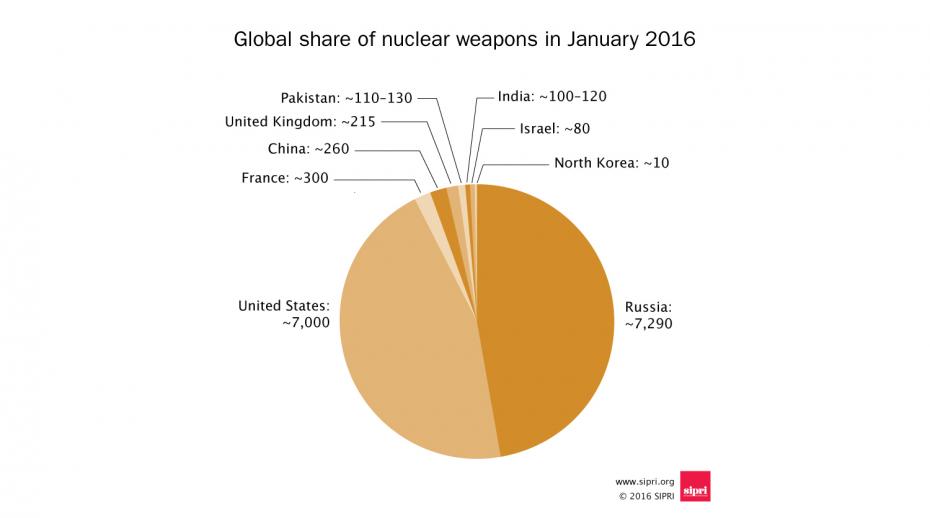
Global nuclear weapons: downsizing but modernizing

Pie chart showing gloal share of nuclear weapons in January 2016

SPIRI_(Stockholm, 13 June 2016) The Stockholm International Peace Research Institute (SIPRI) today launches its annual nuclear forces data, which highlights the current trends and developments in world nuclear arsenals. The data shows that while the overall number of nuclear weapons in the world continues to decline, none of the nuclear weapon-possessing states are prepared to give up their nuclear arsenals for the foreseeable future.

At the start of 2016 nine states—the United States, Russia, the United Kingdom, France, China, India, Pakistan, Israel and North Korea—possessed approximately 4,120 operationally deployed nuclear weapons. If all nuclear warheads are counted, these states together possessed a total of approximately 15,395 nuclear weapons compared with 15,850 in early 2015 (see table 1).


Table 1. World nuclear forces, 2016 Tiếp tục đọc “Global nuclear weapons: downsizing but modernizing”

Universities and students are revolutionalizing Sustainability

worldwatch_As leaders of knowledge and innovation, universities are places where sustainable futures are imagined. They are institutions where experts research emerging issues and generate new ideas. They contain multitudes of idealistic and adaptive young students who can be mobilized to protect their futures. It is only natural that some of the most progressive sustainability ideas are emerging from universities.

Universities around the world are striving to curb their wasteful tendencies as well as to foster an atmosphere that encourages environmental consciousness. Here are three areas of campus life that universities have sought to make greener:

bikeshare

  1. Fostering sustainable lifestyles through transportation initiatives

One of the most pressing issues pertaining to environmental sustainability at universities is transportation. A 2011 study by Complete College America reports that 75 percent of all college students in the United States commute to campus, often traveling by car, bus, and other carbon-emitting vehicles. Overall, the transportation sector is one of the country’s highest contributors to greenhouse gas emissions.
Tiếp tục đọc “Universities and students are revolutionalizing Sustainability”

Using real-time satellite data to track water productivity in agriculture

New FAO tool offers water-scarce countries and river basins a way to boost productivity

Photo: ©FAO/Olivier Asselin

Watering crops in the Democratic Republic of Congo.

FAO 20 April 2017, Rome – Measuring how efficiently water is used in agriculture, particularly in water-scarce countries, is going high-tech with the help of a new tool developed by FAO.

The WaPOR open-access database has gone live, tapping satellite data to help farmers achieve more reliable agricultural yields and allowing for the optimization of irrigation systems.

WaPOR was presented this week during a high-level partners meeting for FAO’s Coping with water scarcity in agriculture: a global framework for action in a changing climate. It allows for fine-grained analysis of water utilised through farming systems, generating empirical evidence about how it can be most productively used.

Worldwide water utilization – the majority of which is used by agriculture – has outpaced the rate of population growth for most of the last century and some regions are close to breaching viable limits. Tiếp tục đọc “Using real-time satellite data to track water productivity in agriculture”

John Kerry is plotting a renewable energy future … starting in Vietnam

Vietnam wants to build a massive number of coal plants. But a former United States secretary of state is offering the country a cleaner path forward.

John Kerry is working with the Vietnamese government on an alternative to its coal plan — one that could provide the same amount of electricity, but with hydroelectric dams and solar panels instead of fossil fuels. It’s a scheme that would save the country billions of dollars, prevent pollution-related deaths, and keep greenhouse gases out of the atmosphere.

Hints of this effort have surfaced in the Vietnamese press, but a representative for Kerry said he was not ready to speak about his efforts on the record. However, the former presidential candidate discussed his work last week at the Clean Energy Finance Forum held at Stanford University. While remarks made at the forum were initially off the record, Stanford’s Precourt Institute for Energy subsequently posted a video online of Kerry’s chat with Anne Finucane, a Bank of America vice chairman. (Update: Since Grist published this story, Stanford has taken down the video featuring Kerry and Finucane.)

Phát hiện ô nhiễm môi trường, hãy gọi ngay: 086.900.0660

11:26, 31/10/2017 (GMT+7)

(TN&MT) – Ngày 30/10, Tổng cục Môi trường (Bộ TN&MT) đã công bố đường dây nóng cấp trung ương để tiếp nhận phản ánh, kiến nghị về ô nhiễm môi trường theo số điện thoại 086.900.0660

baotainguyenmoitruong_Theo đó, khi phát hiện những hành vi xả chất thải gây ô nhiễm môi trường; các vụ việc ô nhiễm, suy thoái môi trường, người dân có thể gọi ngay đến Đường dây nóng của Tổng cục môi trường theo số 086.900.0660

Đường dây nóng 086.900.0660 sẽ tiếp nhận thông tin phản ánh, kiến nghị về ô nhiễm môi trường liên tục 24/24 giờ trong ngày và 7 ngày trong tuần (bao gồm cả ngày nghỉ, ngày lễ).

Phát hiện ô nhiễm môi trường, hãy gọi ngay: 086.900.0660

Tiếp tục đọc “Phát hiện ô nhiễm môi trường, hãy gọi ngay: 086.900.0660”