The Mekong river under THREAT

Milton Osborne

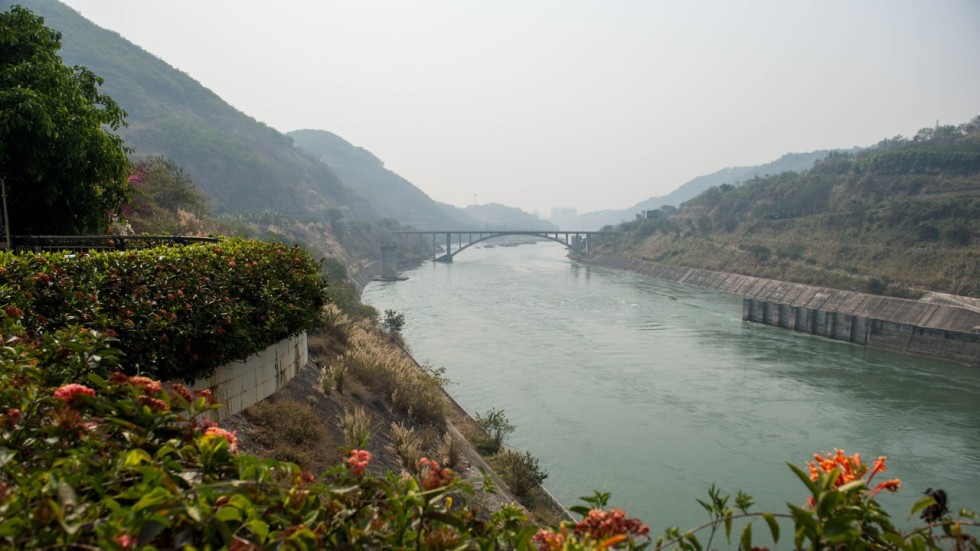
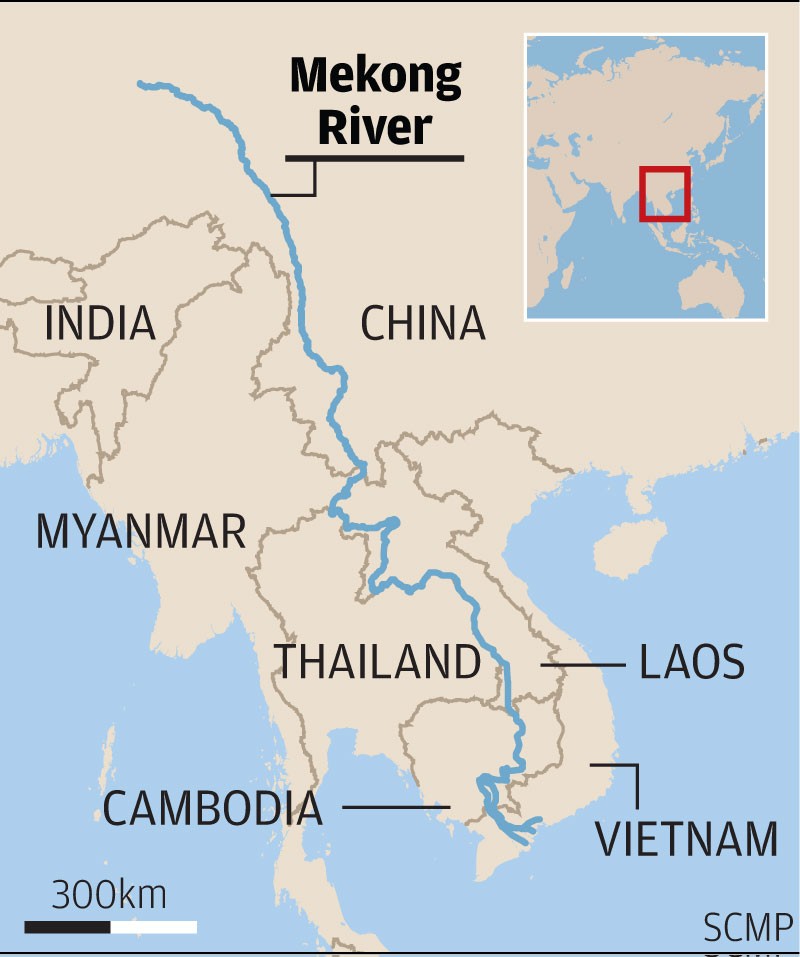
Even if no dams are built on the mainstream below China, the cascade to which it is committed will ultimately have serious effects on the functioning of the Mekong once the dams are used to control the river’s flow. This will be the case because the cascade will:

• alter the hydrology of the river and so the current ‘flood pulse’, the regular rise and fall of the river on an annual basis which plays an essential part in the timing of spawning and the migration pattern. This will be particularly important in relation to the Tonle Sap in Cambodia, but will have an effect throughout the river’s course;

• block the flow of sediment down the river which plays a vital part both in depositing nutrients on the agricultural regions flooded by the river and also as a trigger for fish migration — at present well over 50% of the river’s sediment comes from China;

• at least initially cause problems by restricting the amount of flooding that takes place most importantly in Cambodia and Vietnam; and

• lead to the erosion of river banks.

So China’s dam-building plans are worrying enough, but the proposed new mainstream dams would pose even more serious concerns. Those built at sites higher upstream would cause the least damage to fish stocks, but if, as currently seems possible, the most likely dams to be built would be at Don Sahong and Sambor the costs to fish stocks could be very serious. This is because unanimous expert opinion judges that there are no ways to mitigate the blocking of fish migration that would occur if these dams are constructed. None of the suggested possible forms of mitigation — fish ladders, fish lifts, and alternative fish-passages — are feasible for the species of fish in the Mekong and the very large biomass that is involved in their migratory pattern. Fish ladders were tried and failed at the Pak Mun dam on one of the Mekong’s tributaries in Thailand in the 1990s. Tiếp tục đọc “The Mekong river under THREAT”

Israel’s agriculture minister leads prayers for water

WHAT DO YOU DO IF YOUR COUNTRY IS FACING WATER SHORTAGES EXACERBATED BY CLIMATE CHANGE? PRAY, APPARENTLY — ISRAEL’S AGRICULTURE MINISTER LEADS PRAYERS FOR WATER

by James Ayre 0 comment
What Do You Do If Your Country Is Facing Water Shortages Exacerbated By Climate Change? Pray, Apparently — Israel’s Agriculture Minister Leads Prayers For Water

Fighting climate change with bioenergy may do ‘more harm than good’

Mongabay.com

  • A new study finds land-use like grazing and managing forests for resource extraction may have released more carbon than previously thought. Its results indicate the world’s terrestrial vegetation is currently sequestering less than half its full carbon-storage potential.
  • Of that missing half, the researchers discovered 42 to 47 percent is attributed to land uses that don’t technically change the vegetation cover type. The researchers say that climate change mitigation strategies often focus on reducing intensive land-use like deforestation, with less-intensive uses that don’t change cover type largely overlooked and under-researched.
  • One of these less-intensive uses is managing forests for biomass energy production. Many countries are trying to replace fossil fuels with biomass energy in-line with international climate agreements like the Paris Accord.
  • The researchers warn that strategies developed under the assumption that producing biomass energy doesn’t come at a carbon cost could harm efforts to fight climate change. They urge that in addition to stopping deforestation, the protection of forest functions, like carbon stocks, should be moved more into focus when it comes to land-use and climate change planning.

As nations try to stem emissions to keep the world from warming more than 2 degrees Celsius in line with their commitments towards the Paris Accord, replacing fossil fuels with renewable alternatives is widely seen as a big step in the right direction. A major source of energy oft-extolled as renewable is biomass from trees, which are usually harvested from managed forests either established on land that has already been deforested or planted where forests didn’t naturally grow. But a new study finds land-use like managing forests for biomass production may come at a much higher carbon cost than previously thought.
Tiếp tục đọc “Fighting climate change with bioenergy may do ‘more harm than good’”

12 Charts That Shook the Earth in 2017: trends in the global energy transformation

by Emma Foehringer Merchant 
January 09, 2018

Greentechmedia

1. Here comes storage

Toward the end of last year, Tesla installed the largest lithium-ion battery ever deployed in South Australia. It was a high-profile example of a powerful trend: storage combinations that are starting to compete with natural-gas power plants.

According to a GTM Research analysis of South Australia’s electricity market, by 2025, solar-plus-storage and standalone batteries will compete with new and existing open-cycle gas turbines for meeting peak load. By 2035, renewables and storage will beat gas for baseload and peak power. Tiếp tục đọc “12 Charts That Shook the Earth in 2017: trends in the global energy transformation”

Grocery store program improves farmers’ adoption of environmental practices

Date:January 9, 2018

Sciencedaily

Source: Stanford’s School of Earth, Energy & Environmental Sciences
Summary: In one of the first analyses of a company-led sustainability program in the food and agriculture space, researchers found a major grocery chain fostered increased adoption of environmental practices at the farm level.
FULL STORY

Leafy green vegetables are produced in a growing facility in Western Cape Province, South Africa. A new study shows a company-led sustainability program at a major food retailer in South Africa drove increased adoption of environmental practices at the farm level.
Credit: Tannis Thorlakson
When grocery stores tout sustainable products, consumers may take their claims at face value. Yet few studies have analyzed whether or not companies who claim to improve the sustainability of their products are actually changing practices in their supply chains.

In a new study published online Dec. 22 in the journal Global Environmental Change, Stanford researchers carried out one of the first analyses of a company-led sustainability program in the food and agriculture space. Studying the agricultural supply chain of Woolworths Holding Ltd. (Woolworths), one of the five largest supermarket chains in South Africa, they found that its Farming for the Future program drove increased adoption of environmental practices at the farm level. Agriculture is one of the largest global environmental polluters, driving deforestation and contributing an estimated 30 percent of total greenhouse gas emissions.
Tiếp tục đọc “Grocery store program improves farmers’ adoption of environmental practices”

Vietnam priorities energy security: Party official

VNA PRINT

Vietnamplus.vn

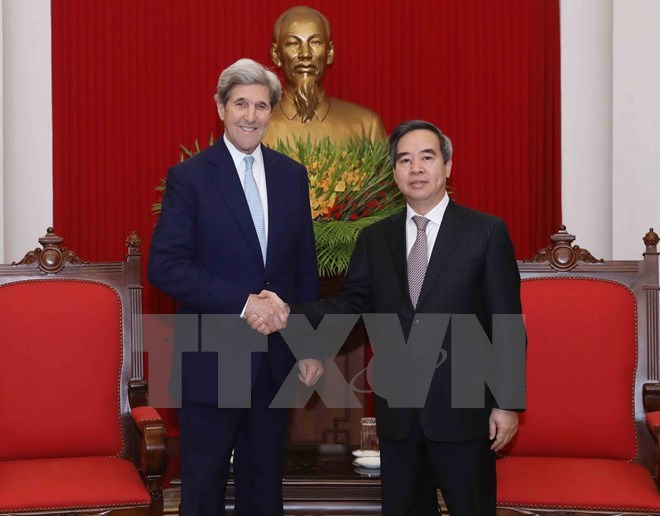
Head of the Communist Party of Vietnam Central Committee’s Commission for Economic Affairs (R) welcomes former US Secretary of State John Kerry.(Photo: VNA)

Hanoi (VNA) – Vietnam always attaches importance to energy security, considering it a top priority in the country’s energy development policy and strategy, said Nguyen Van Binh, head of the Communist Party of Vietnam Central Committee’s Commission for Economic Affairs.

At a reception for former US Secretary of State John Kerry in Hanoi on January 10, he said Vietnam wants to promote renewable energy development for power generation, contributing to energy security, climate change mitigation, environmental protection and sustainable development. Tiếp tục đọc “Vietnam priorities energy security: Party official”

Impacts of 25 years of groundwater extraction on subsidence in the Mekong delta, Vietnam

IOPscience

Many major river deltas in the world are subsiding and consequently become increasingly vulnerable to flooding and storm surges, salinization and permanent inundation. For the Mekong Delta, annual subsidence rates up to several centimetres have been reported. Excessive groundwater extraction is suggested as the main driver. As groundwater levels drop, subsidence is induced through aquifer compaction. Over the past 25 years, groundwater exploitation has increased dramatically, transforming the delta from an almost undisturbed hydrogeological state to a situation with increasing aquifer depletion. Yet the exact contribution of groundwater exploitation to subsidence in the Mekong delta has remained unknown. In this study we deployed a delta-wide modelling approach, comprising a 3D hydrogeological model with an integrated subsidence module. This provides a quantitative spatially-explicit assessment of groundwater extraction-induced subsidence for the entire Mekong delta since the start of widespread overexploitation of the groundwater reserves. We find that subsidence related to groundwater extraction has gradually increased in the past decades with highest sinking rates at present. During the past 25 years, the delta sank on average ~18 cm as a consequence of groundwater withdrawal. Current average subsidence rates due to groundwater extraction in our best estimate model amount to 1.1 cm yr−1, with areas subsiding over 2.5 cm yr−1, outpacing global sea level rise almost by an order of magnitude. Given the increasing trends in groundwater demand in the delta, the current rates are likely to increase in the near future.

Read full article here

Power stacked against Southeast Asia’s poor as China dams Mekong

channelnewsasia

Communities along the mighty Mekong blame China for their shrinking catches. (Photo: AFP/TANG CHHIN SOTHY)

Read more at https://www.channelnewsasia.com/news/asiapacific/power-stacked-against-southeast-asia-s-poor-as-china-dams-mekong-9841686

KANDAL, Cambodia: Cambodian fisherman Sles Hiet lives at the mercy of the Mekong: A massive river that feeds tens of millions but is under threat from the Chinese dams cementing Beijing’s physical – and diplomatic – control over its Southeast Asian neighbours.

The 32-year-old, whose ethnic Cham Muslim community live on rickety house boats that bob along a river bend in Kandal province, says the size of his daily catch has been shrinking by the year. Tiếp tục đọc “Power stacked against Southeast Asia’s poor as China dams Mekong”

Climate change is triggering a migrant crisis in Vietnam

Theconversation

The Vietnamese Mekong Delta is one of Earth’s most agriculturally productive regions and is of global importance for its exports of rice, shrimp, and fruit. The 18m inhabitants of this low-lying river delta are also some of the world’s most vulnerable to climate change. Over the last ten years around 1.7m people have migrated out of its vast expanse of fields, rivers and canals while only 700,000 have arrived.

On a global level migration to urban areas remains as high as ever: one person in every 200 moves from rural areas to the city every year. Against this backdrop it is difficult to attribute migration to individual causes, not least because it can be challenging to find people who have left a region in order to ask why they went and because every local context is unique. But the high net rate of migration away from Mekong Delta provinces is more than double the national average, and even higher in its most climate-vulnerable areas. This implies that there is something else – probably climate-related – going on here. Tiếp tục đọc “Climate change is triggering a migrant crisis in Vietnam”

What species is most fit for life? All have an equal chance, scientists say

Sciencedaily.com
Elephants and giant sequoias have no advantage over algae and bacteria

January 8, 2018 Source:SUNY College of Environmental Science and ForestrySummary:There are more than 8 million species of living things on Earth, but none of them — from 100-foot blue whales to microscopic bacteria — has an advantage over the others in the universal struggle for existence.A trio of scientists report that regardless of vastly different body size, location and life history, most species are equally ‘fit’ in the struggle for existence.

There are more than 8 million species of living things on Earth, but none of them — from 100-foot blue whales to microscopic bacteria — has an advantage over the others in the universal struggle for existence.

In a paper published Jan. 8 in the journal Nature Ecology & Evolution, a trio of scientists from universities in the United States and the United Kingdom describe the dynamic that began with the origin of life on Earth 4 billion years ago. They report that regardless of vastly different body size, location and life history, most plant, animal and microbial species are equally “fit” in the struggle for existence. This is because each transmits approximately the same amount of energy over its lifetime to produce the next generation of its species. Tiếp tục đọc “What species is most fit for life? All have an equal chance, scientists say”

Five things to know about the Lancang-Mekong Cooperation summit

TĐH: We don’t hear discussion on the VNese media about this China-pushed five-year development plan at all. I wonder if Vietnam will have a public discussion about this plan, or whoever attending the LMC summit will just simply approve the plan on behalf of Vietnam?


scmp: Five-year development plan, including construction of hydropower dams, is expected to top agenda at Mekong River nations’ conference in Cambodia

PUBLISHED : Tuesday, 09 January, 2018, 8:03am
UPDATED : Tuesday, 09 January, 2018, 2:57pm

When China and the leaders of nations along the Mekong River meet on Wednesday at the Lancang-Mekong Cooperation summit in Cambodia, a top item will be mapping out a five-year development plan that would include building hydropower dams and other projects for the region – pointing to its importance in China’s ambitious belt and road infrastructure plan.

But while the cooperation mechanism was created to help ease tension over development projects, environmentalists remain unsatisfied.

Concern is growing that the potential for causing ecological damage will make the Mekong a flashpoint for China and Southeast Asia’s territorial disputes – effectively creating a new South China Sea.

Amid the backdrop of the river’s importance in connecting Europe through Southeast Asia and beyond in the grand infrastructure programme launched by President Xi Jinping, Chinese delegation leader Premier Li Keqiang will be looking to bolster China’s influence in the Mekong region as he faces his counterparts from Cambodia, Vietnam, Thailand, Laos and Myanmar.

Here are five key things to know about the summit and the significance of the Mekong River:

1. The river’s significance for China and Southeast Asia

Tiếp tục đọc “Five things to know about the Lancang-Mekong Cooperation summit”

Forty per cent of global e-waste comes from Asia

Forty per cent of global e-waste comes from Asia

Copyright: Panos

Speed read

  • E-waste generated in 2016 equivalent to 4,500 Eiffel Towers
  • Asian countries account for 40 per cent of the discarded goods
  • Developing countries still lack formal e-waste recycling systems

scidev.net_[NEW DELHI] Humans generated a staggering 44.7 million metric tonnes of electronic waste (e-waste) in 2016 — the equivalent of 4,500 Eiffel Towers, and five per cent more than the electrical and electronic goods discarded just two years earlier, says a new study.

The trend is set to continue, with volumes of e-waste expected to rise to 52.2 million metric tonnes by 2021. Tiếp tục đọc “Forty per cent of global e-waste comes from Asia”

Critical Issues to Watch in 2018

Reprint |    |  Print | 

ipsnews_Martin Khor is Executive Director of the South Centre, a think tank for developing countries, based in Geneva

More than 480 billion plastic bottles were sold in the world in 2016, in 2018 we can expect international cooperation to reduce the use of plastic and how to treat plastic waste. Credit: Athar Parvaiz/IPS

PENANG, Malaysia, Jan 2 2018 (IPS) – Another new year has dawned, and on a world facing serious disruption on many fronts.  What are the trends and issues to watch out for in 2018?

One obvious answer is to anticipate how Donald Trump, the most unorthodox of American Presidents, will continue to upset the world order.  But more about that later.

Just as importantly as politics, we are now in the midst of several social and environmental trends that have important long-lasting effects.  Some are on the verge of reaching a tipping point, where a long-term trend produces critical and sometimes irreversible events. We may see some of that in 2018.
Tiếp tục đọc “Critical Issues to Watch in 2018”

1MDB looms large in Asian banks’ war on money laundering

Tags:  |  |  | 
— Anti-Corruption News Story Curated by Anti-Corruption Digest International Risk & Compliance News

It would be difficult to write about money laundering controls in Asia without mentioning 1MDB, a Malaysian sovereign wealth fund embroiled in an ongoing international money laundering scandal. Yet, when Risk.net contacted six of the banks penalised for the wrong-doing to talk about lessons learned, our enquiries were greeted with either radio silence or a flat ‘no’.

One reason for this reticence could be a reluctance to show their hand to money launderers. But another is likely to be a fear of publicising anti-money laundering (AML) breaches – a sometimes bigger worry than the risk of regulatory fines.
Tiếp tục đọc “1MDB looms large in Asian banks’ war on money laundering”