
DW_Earthworms help recuperate soil and enrich it with much needed minerals. But environmentalists are concerned as earthworms have come under threat from intensive use of manure and acidic soil.
Tác giả: Đào Thu Hằng
I'm from Hanoi, Viet Nam.
I'm an author of Dot Chuoi Non (dotchuoinon.com/author/hangbelu/), a blog on Positive thinking, founded by Dr. Tran Dinh Hoanh, an attorney in Washington DC.
I'm a co-founder of Conversations on Vietnam Development - cvdvn.net, a virtual think tank. I am a co-founder of two companies in Viet Nam working on children education services. I advise companies on STEAM education, English language education for children and students in Vietnam.
I'm studying the Buddha's teaching and the teaching of Jesus. I practice mindful living including meditation.
I hold a PhD on Sustainable Energy Systems from University of Lisbon and Aalto University.
I graduated from Hanoi University of Technology on Environmental Engineering. I obtained a Master degree of the same major from Stanford University and Nanyang Technological University.
My English-language blog at: hangbelu.wordpress/.
I play table tennis as a hobby.

Groundwater in the Mekong River Basin
3.11. Vietnam
• Salinization of groundwater in the coastal area
• Ammonium contamination in groundwater
• Groundwater level drops in Hanoi (-1 m/yr, total 30 m drop), Ho Chi Minh City (total 30 m), and in many other places in the Mekong River Basin; groundwater levels also decreased greatly.
• Land subsidence in Hanoi because of over-extraction
• High and increasing amount of arsenic in groundwater
Download full report http://unesdoc.unesco.org/images/0024/002436/243616E.pdf
Mekong Delta calls for over $340 million investment in tourism and infrastructure
vietnamnet.vn_Localities in the Mekong Delta region have called for investment in 33 projects in the groups of real estate and tourism, with a total investment of nearly VND7.8 trillion (US$343.2 million), along with 45 other projects related to industry, agriculture, processing and logistics infrastructure development with a total capital of VND150 trillion (US$6.6 billion).

Tourism development in the Mekong Delta has not been on a par with its potential.
The figures were introduced at the 5th Annual Mekong Delta Investment Forum (MekongInvest) 2017, hosted by the Vietnam Chamber of Commerce and Industry (VCCI) – Can Tho branch, in collaboration with Mekong Promotion Club (Mekong PC), gathering centres for trade, investment and tourism promotion of 13 Mekong Delta provinces, on October 25. Tiếp tục đọc “Mekong Delta calls for over $340 million investment in tourism and infrastructure”
Singapore has declared 2018 the year of climate action—so why are its banks still funding coal?
eco-business_2018 is officially the year of climate action in Singapore, and yet the country’s powerful banks are bankrolling huge, greenhouse gas-producing coal-fired power stations in Asia Pacific, a report has found.
DBS is co-financing four 1200 MW coal-fired power plants in Vietnam—Nam Dinh 1, Nghi Son 2, Vinh Tan 4 and Vung Ang 2—and is a financial adviser for a number of planned coal-fired projects in Indonesia including the Jawa-6, Jawa-9 and Jawa-10 plants.

Rohingya children left stranded amid garbage and muck in Myanmar

Global development is supported by

Tens of thousands of Rohingya children have been left “trapped and almost forgotten” in remote, squalid camps and isolated villages in Myanmar’s Rakhine state, the UN has said. Tiếp tục đọc “Rohingya children left stranded amid garbage and muck in Myanmar”
Sông Mekong sẽ là Biển Đông thứ hai?
tuoitre.vn TTO – Kế hoạch 5 năm phát triển sông Mekong thuộc cơ chế Hợp tác Mekong – Lan Thương (LMC) do Trung Quốc khởi xướng đang gây lo ngại trong giới chuyên gia, đặc biệt là về động cơ chính trị của Bắc Kinh.
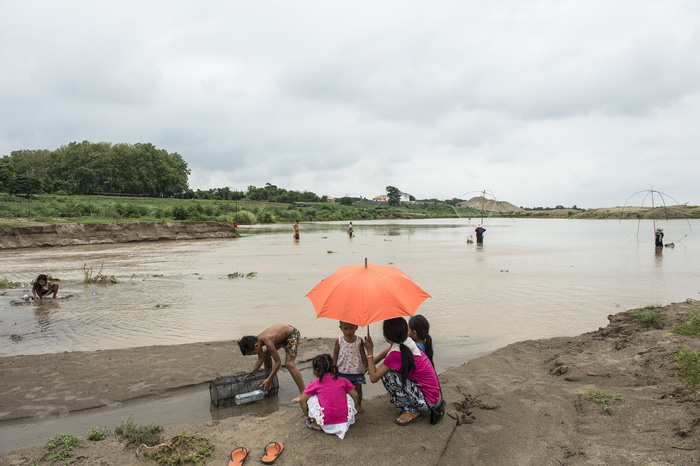
Người dân đánh bắt cá trên đoạn sông Mekong chảy qua thủ đô Vientiane của Lào – Ảnh: AFP
Tháng 12-2017, ngoại trưởng 6 nước khu vực sông Mekong nhóm họp ở thành phố Đại Lý thuộc tỉnh Vân Nam (Trung Quốc) để thông qua đề cương kế hoạch 5 năm phát triển dòng sông này. Dự kiến các nhà lãnh đạo sẽ chốt lại đề xuất trong cuộc họp dự kiến diễn ra cuối tháng 1-2018 ở Campuchia. Tiếp tục đọc “Sông Mekong sẽ là Biển Đông thứ hai?”
The Mekong river under THREAT
Milton Osborne
Even if no dams are built on the mainstream below China, the cascade to which it is committed will ultimately have serious effects on the functioning of the Mekong once the dams are used to control the river’s flow. This will be the case because the cascade will:
• alter the hydrology of the river and so the current ‘flood pulse’, the regular rise and fall of the river on an annual basis which plays an essential part in the timing of spawning and the migration pattern. This will be particularly important in relation to the Tonle Sap in Cambodia, but will have an effect throughout the river’s course;
• block the flow of sediment down the river which plays a vital part both in depositing nutrients on the agricultural regions flooded by the river and also as a trigger for fish migration — at present well over 50% of the river’s sediment comes from China;
• at least initially cause problems by restricting the amount of flooding that takes place most importantly in Cambodia and Vietnam; and
• lead to the erosion of river banks.
So China’s dam-building plans are worrying enough, but the proposed new mainstream dams would pose even more serious concerns. Those built at sites higher upstream would cause the least damage to fish stocks, but if, as currently seems possible, the most likely dams to be built would be at Don Sahong and Sambor the costs to fish stocks could be very serious. This is because unanimous expert opinion judges that there are no ways to mitigate the blocking of fish migration that would occur if these dams are constructed. None of the suggested possible forms of mitigation — fish ladders, fish lifts, and alternative fish-passages — are feasible for the species of fish in the Mekong and the very large biomass that is involved in their migratory pattern. Fish ladders were tried and failed at the Pak Mun dam on one of the Mekong’s tributaries in Thailand in the 1990s. Tiếp tục đọc “The Mekong river under THREAT”
Israel’s agriculture minister leads prayers for water
WHAT DO YOU DO IF YOUR COUNTRY IS FACING WATER SHORTAGES EXACERBATED BY CLIMATE CHANGE? PRAY, APPARENTLY — ISRAEL’S AGRICULTURE MINISTER LEADS PRAYERS FOR WATER

Fighting climate change with bioenergy may do ‘more harm than good’
Mongabay.com
- A new study finds land-use like grazing and managing forests for resource extraction may have released more carbon than previously thought. Its results indicate the world’s terrestrial vegetation is currently sequestering less than half its full carbon-storage potential.
- Of that missing half, the researchers discovered 42 to 47 percent is attributed to land uses that don’t technically change the vegetation cover type. The researchers say that climate change mitigation strategies often focus on reducing intensive land-use like deforestation, with less-intensive uses that don’t change cover type largely overlooked and under-researched.
- One of these less-intensive uses is managing forests for biomass energy production. Many countries are trying to replace fossil fuels with biomass energy in-line with international climate agreements like the Paris Accord.
- The researchers warn that strategies developed under the assumption that producing biomass energy doesn’t come at a carbon cost could harm efforts to fight climate change. They urge that in addition to stopping deforestation, the protection of forest functions, like carbon stocks, should be moved more into focus when it comes to land-use and climate change planning.
As nations try to stem emissions to keep the world from warming more than 2 degrees Celsius in line with their commitments towards the Paris Accord, replacing fossil fuels with renewable alternatives is widely seen as a big step in the right direction. A major source of energy oft-extolled as renewable is biomass from trees, which are usually harvested from managed forests either established on land that has already been deforested or planted where forests didn’t naturally grow. But a new study finds land-use like managing forests for biomass production may come at a much higher carbon cost than previously thought.
Tiếp tục đọc “Fighting climate change with bioenergy may do ‘more harm than good’”
If you park in a handicapped space in Brazil – Khi có người đỗ xe vào chỗ dành cho người khuyết tật
12 Charts That Shook the Earth in 2017: trends in the global energy transformation
Greentechmedia
1. Here comes storage
Toward the end of last year, Tesla installed the largest lithium-ion battery ever deployed in South Australia. It was a high-profile example of a powerful trend: storage combinations that are starting to compete with natural-gas power plants.
According to a GTM Research analysis of South Australia’s electricity market, by 2025, solar-plus-storage and standalone batteries will compete with new and existing open-cycle gas turbines for meeting peak load. By 2035, renewables and storage will beat gas for baseload and peak power. Tiếp tục đọc “12 Charts That Shook the Earth in 2017: trends in the global energy transformation”
Grocery store program improves farmers’ adoption of environmental practices
Date:January 9, 2018
Source: Stanford’s School of Earth, Energy & Environmental Sciences
Summary: In one of the first analyses of a company-led sustainability program in the food and agriculture space, researchers found a major grocery chain fostered increased adoption of environmental practices at the farm level.
FULL STORY

Leafy green vegetables are produced in a growing facility in Western Cape Province, South Africa. A new study shows a company-led sustainability program at a major food retailer in South Africa drove increased adoption of environmental practices at the farm level.
Credit: Tannis Thorlakson
When grocery stores tout sustainable products, consumers may take their claims at face value. Yet few studies have analyzed whether or not companies who claim to improve the sustainability of their products are actually changing practices in their supply chains.
In a new study published online Dec. 22 in the journal Global Environmental Change, Stanford researchers carried out one of the first analyses of a company-led sustainability program in the food and agriculture space. Studying the agricultural supply chain of Woolworths Holding Ltd. (Woolworths), one of the five largest supermarket chains in South Africa, they found that its Farming for the Future program drove increased adoption of environmental practices at the farm level. Agriculture is one of the largest global environmental polluters, driving deforestation and contributing an estimated 30 percent of total greenhouse gas emissions.
Tiếp tục đọc “Grocery store program improves farmers’ adoption of environmental practices”
Vietnam priorities energy security: Party official
 Head of the Communist Party of Vietnam Central Committee’s Commission for Economic Affairs (R) welcomes former US Secretary of State John Kerry.(Photo: VNA)
Hanoi (VNA) – Vietnam always attaches importance to energy security, considering it a top priority in the country’s energy development policy and strategy, said Nguyen Van Binh, head of the Communist Party of Vietnam Central Committee’s Commission for Economic Affairs.
At a reception for former US Secretary of State John Kerry in Hanoi on January 10, he said Vietnam wants to promote renewable energy development for power generation, contributing to energy security, climate change mitigation, environmental protection and sustainable development. Tiếp tục đọc “Vietnam priorities energy security: Party official”
Impacts of 25 years of groundwater extraction on subsidence in the Mekong delta, Vietnam
Many major river deltas in the world are subsiding and consequently become increasingly vulnerable to flooding and storm surges, salinization and permanent inundation. For the Mekong Delta, annual subsidence rates up to several centimetres have been reported. Excessive groundwater extraction is suggested as the main driver. As groundwater levels drop, subsidence is induced through aquifer compaction. Over the past 25 years, groundwater exploitation has increased dramatically, transforming the delta from an almost undisturbed hydrogeological state to a situation with increasing aquifer depletion. Yet the exact contribution of groundwater exploitation to subsidence in the Mekong delta has remained unknown. In this study we deployed a delta-wide modelling approach, comprising a 3D hydrogeological model with an integrated subsidence module. This provides a quantitative spatially-explicit assessment of groundwater extraction-induced subsidence for the entire Mekong delta since the start of widespread overexploitation of the groundwater reserves. We find that subsidence related to groundwater extraction has gradually increased in the past decades with highest sinking rates at present. During the past 25 years, the delta sank on average ~18 cm as a consequence of groundwater withdrawal. Current average subsidence rates due to groundwater extraction in our best estimate model amount to 1.1 cm yr−1, with areas subsiding over 2.5 cm yr−1, outpacing global sea level rise almost by an order of magnitude. Given the increasing trends in groundwater demand in the delta, the current rates are likely to increase in the near future.
Read full article here
Power stacked against Southeast Asia’s poor as China dams Mekong

KANDAL, Cambodia: Cambodian fisherman Sles Hiet lives at the mercy of the Mekong: A massive river that feeds tens of millions but is under threat from the Chinese dams cementing Beijing’s physical – and diplomatic – control over its Southeast Asian neighbours.
The 32-year-old, whose ethnic Cham Muslim community live on rickety house boats that bob along a river bend in Kandal province, says the size of his daily catch has been shrinking by the year. Tiếp tục đọc “Power stacked against Southeast Asia’s poor as China dams Mekong”
 CVD
CVD 