Quý III/2025, cả nước ghi nhận 1,6 triệu thanh niên 15-24 tuổi không có việc làm, không tham gia học tập đào tạo, chiếm 11,5% tổng số thanh niên Việt Nam.
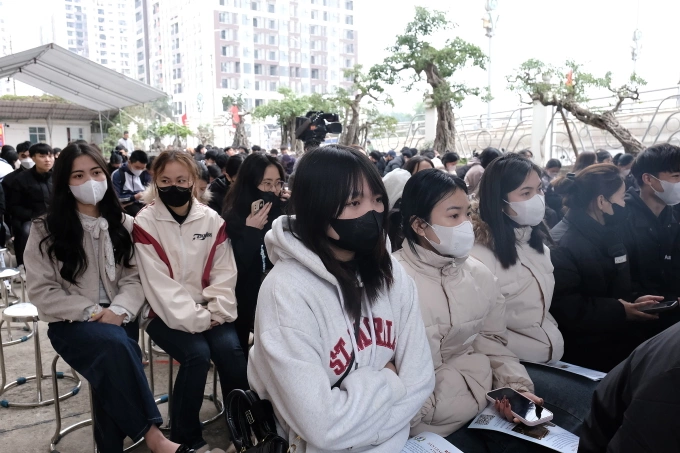
Thanh niên nghe tư vấn về việc làm tại Bắc Ninh đầu năm 2025. Ảnh: Gia Đoàn
Cục Thống kê ngày 6/10 cho biết con số trên tăng hơn 222.000 người so với quý II/2025, tăng 183.000 người so với cùng kỳ năm 2024. Tỷ lệ thanh niên không việc làm, không đào tạo ở nông thôn cao hơn thành thị, lần lượt ở nữ là 13% so với 9%; nam là 13% so với 9,8%. Số lượng tăng do nhiều thanh niên vừa tốt nghiệp các trường đại học, cao đẳng hoặc trung cấp, đang chuyển đổi từ môi trường giáo dục sang thị trường lao động.
A tunnel collapse opened up a sinkhole more than 18m deep along a Bangkok road early on Sept 24.
PHOTO: REUTERS Published Sep 25, 2025, 11:42 AM
BANGKOK – The Mass Rapid Transit Authority of Thailand (MRTA) has taken responsibility for the massive sinkhole dozens of metres deep in front of Vajira Hospital in Bangkok.
The location falls under Contract 1, which covers the design and construction of the tunnel and underground stations along the Taopoon-National Library section, involving a distance of 4.8km and worth 19.43 billion baht (S$778 million).
The contractor for this section is the CKST-PL joint venture, comprising CH Karnchang and Sino-Thai Engineering and Construction.
Such a simple query might seem trivial, but making it possible across billions of sessions requires immense scale. While OpenAI reveals little information about its operations, we’ve used the scraps we do have to estimate the impact of ChatGPT—and of the generative AI industry in general.
OpenAI’s actions also provide hints. As part of the United States’ Stargate Project, OpenAI will collaborate with other AI titans to build the largest data centers yet. And AI companies expect to need dozens of “Stargate-class” data centers to meet user demand.
Estimates of ChatGPT’s per-query energy consumption vary wildly. We used the figure of 0.34 watt-hours that OpenAI’s Sam Altman stated in a blog post without supporting evidence. It’s worth noting that some researchers say the smartest models can consume over 20 Wh for a complex query. We derived the number of queries per day from OpenAI’s usage statistics below. illustrations: Optics Lab
OpenAI says ChatGPT has 700 million weekly users and serves more than 2.5 billion queries per day. If an average query uses 0.34 Wh, that’s 850 megawatt-hours; enough to charge thousands of electric vehicles every day.
2.5 billion queries per day adds up to nearly 1 trillion queries each year—and ChatGPT could easily exceed that in 2025 if its user base continues to grow. One year’s energy consumption is roughly equivalent to powering 29,000 U.S homes for a year, nearly as many as in Jonesboro, Ark.
Though massive, ChatGPT is just a slice of generative AI. Many companies use OpenAI models through the API, and competitors like Google’s Gemini and Anthropic’s Claude are growing. A report from Schneider Electric Sustainability Research Institute puts the overall power draw at 15 terawatt-hours. Using the report’s per-query energy consumption figure of 2.9 Wh, we arrive at 5.1 trillion queries per year.
AI optimists expect the average queries per day to jump dramatically in the next five years. Based on a Schneider Electric estimate of overall energy use in 2030, the world could then see as many as 329 billion prompts per day—that’s about 38 queries per day per person alive on planet Earth. (That’s assuming a global population of 8.6 billion in 2030, which is the latest estimate from the United Nations.) As unrealistic as that may sound, it’s made plausible by plans to build AI agents that work independently and interact with other AI agents.
The Schneider Electric report estimates that all generative AI queries consume 15 TWh in 2025 and will use 347 TWh by 2030; that leaves 332 TWh of energy—and compute power—that will need to come online to support AI growth. That implies the construction of dozens of data centers along the lines of the Stargate Project, which plans to build the first ever 1-gigawatt facilities. Each of these facilities will theoretically consume 8.76 TWh per year—so 38 of these new campuses will account for the 332 TWh of new energy required.
While estimates for AI energy use in 2030 vary, most predict a dramatic jump in consumption. The gain in energy consumption will be driven mostly by AI inference (the power used when interacting with a model) instead of AI training. This number could be much lower or much higher than the Schneider Electric estimate used here, depending on the success of AI agents that can work together—and consume energy—independent of human input.



 CVD
CVD 