

Published: April 7, 2025 1.46pm BST
Author
- Tarek Alexander HassanProfessor of Economics, Boston University
Disclosure statement
Tarek Alexander Hassan does not work for, consult, own shares in or receive funding from any company or organisation that would benefit from this article, and has disclosed no relevant affiliations beyond their academic appointment.
Partners
Boston University provides funding as a founding partner of The Conversation US.

We believe in the free flow of information
Republish our articles for free, online or in print, under Creative Commons licence.
When U.S. President Donald Trump imposed sweeping new tariffs on imported goods on April 2, 2025 – upending global trade and sending markets into a tailspin – he presented the move as a response to a crisis. In an executive order released the same day, the White House said the move was necessary to address “the national emergency posed by the large and persistent trade deficit.”
A trade deficit – when a country imports more than it exports – is often viewed as a problem. And yes, the U.S. trade deficit is both large and persistent. Yet, as an economist who has taught international finance at Boston University, the University of Chicago and Harvard, I maintain that far from a national emergency, this persistent deficit is actually a sign of America’s financial and technological dominance.
The trade deficit is the flip side of an investment magnet
A trade deficit sounds bad, but it is neither good nor bad.
It doesn’t mean the U.S. is losing money. It simply means foreigners are sending the U.S. more goods than the U.S. is sending them. America is getting more cheap goods, and in return it is giving foreigners financial assets: dollars issued by the Federal Reserve, bonds from the U.S. government and American corporations, and stocks in newly created firms.
That is, a trade deficit can only arise if foreigners invest more in the U.S. than Americans invest abroad. In other words, a country can only have a trade deficit if it also has an equally sized investment surplus. The U.S. is able to sustain a large trade deficit because so many foreigners are eager to invest here.
Why? One major reason is the safety of the U.S. dollar. Around the world, from large corporations to ordinary households, the dollar is used for saving, trading and settling debts. As the world economy grows, so does foreigners’ demand for dollars and dollar-denominated assets, from cash to Treasury bills and corporate bonds.
Because the dollar is so attractive, the Federal Reserve gets to mint extra cash for use abroad, and the U.S. government and American employers and families can borrow money at lower interest rates. Foreigners eagerly buy these U.S. financial assets, which enables Americans to consume and invest more than they ordinarily could. In return for our financial assets, we buy more German machines, Scotch whiskey, Chinese smartphones, Mexican steel and so on.
1,107
Blaming foreigners for the trade deficit, therefore, is like blaming the bank for charging a low interest rate. We have a trade deficit because foreigners willingly charge us low interest rates – and we choose to spend that credit.
US entrepreneurship attracts global capital – and fuels the deficit
Another reason for foreigners’ steady demand for U.S. assets is American technological dominance: When aspiring entrepreneurs from around the world start new companies, they often decide to do so in Silicon Valley. Foreigners want to buy stocks and bonds in these new companies, again adding to the U.S. investment surplus.
This strong demand for U.S. assets also explains why Trump’s last trade war in 2018 did little to close the trade deficit: Tariffs, by themselves, do nothing to reduce foreigners’ demand for U.S. dollars, stocks and bonds. If the investment surplus doesn’t change, the trade deficit cannot change. Instead, the U.S. dollar just appreciates, so that imports get cheaper, undoing the effect of the tariff on the size of the trade deficit. This is basic economics: You can’t have an investment surplus and a trade surplus at the same time, which is why it’s silly to call for both.
It’s worth noting that no other country in the world enjoys a similarly sized investment surplus. If a normal country with a normal currency tries to print more money or issues more debt, its currency depreciates until its investment account – and its trade balance – goes back to something close to zero. America’s financial and technological dominance allows it to escape this dynamic.
That doesn’t mean all tariffs are bad or all trade is automatically good. But it does mean that the U.S. trade deficit, poorly named though it is, does not signify failure. It is, instead, the consequence – and the privilege – of outsized American global influence.
The president’s frenzied attacks on the nation’s trade deficit show he’s misreading a sign of American economic strength as a weakness. If the president really wants to eliminate the trade deficit, his best option is to rein in the federal budget deficit, which would naturally reduce capital inflows by raising domestic savings.
Rather than reviving U.S. manufacturing, Trump’s extreme tariffs and erratic foreign policy are likely to instead scare off foreign investors altogether and undercut the dollar’s global role. That would indeed shrink the trade deficit – but only by eroding the very pillars of the country’s economic dominance, at a steep cost to American firms and families.
It can be an exhausting exercise when things are changing so fast. This is why I co-write a weekly business and economy email newsletter. It brings a curated summary of the week’s briefings from academic experts straight to your inbox. And it’s free.
Get our business newsletter

Steven Vass
Business + Economy Editor, The Conversation UK
You might also like
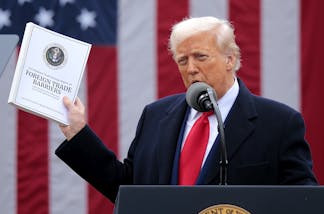
New modelling reveals full impact of Trump’s ‘Liberation Day’ tariffs – with the US hit hardest

Trump’s trade war will hurt everyone – from Cambodian factories to US online shoppers

Consumers are boycotting US goods around the world. Should Trump be worried?

EPA must use the best available science − by law − but what does that mean?
Privacy policyTerms and conditionsCorrections
Copyright © 2010–2025, The Conversation

 CVD
CVD 
Hi anh,
Trump đánh thuế cao, thì giá hàng hóa nhập vào Mỹ sẽ cao, và dân Mỹ sẽ phải mua hàng đắt hơn chứ được gì ạ?
Hoặc đánh thuế cho các công ty đến Mỹ sản xuất để tạo thêm công ăn việc làm cho dân Mỹ, nhưng sản xuất tại Mỹ thì giá thành sản phẩm sao rẻ hơn sản xuất tại các nước như Việt Nam được?
Ngoài ra còn liên quan đến chuỗi cung ứng nên chắc sẽ rất khó cho các công ty muốn sản xuất tại Mỹ.
E hiểu thế có đúng không ạ? Hay Trump có lí do nào khác?
ThíchĐã thích bởi 1 người
Anh chịu thua. Trump là thương gia chuyên nghiệp. Có lẽ ông ấy cho xem nước Mỹ như một công ty – công ty tôi phải thu vào nhiều hơn là chi ra thì công ty mới mạnh được.
A. Hoành
ThíchThích