What are the High Seas (and why should we care?)

Mongbay.com Abhishyant Kidangoor 23 Oct 2024

High seas cover over half of our planet’s surface, and represent two-thirds of the entire ocean. They serve as a crucial habitat for countless marine species, many of which remain undiscovered. They also play a vital role in climate regulation. The high seas are also home to secret treasures that could potentially reshape medical science. Painkillers, antibiotics and many other drugs have been produced from genetic material found in the depths of the ocean.

Despite their immense ecological and medical importance, only 1% of these international waters are legally protected. Since they fall outside the jurisdiction of any country, high seas are not governed by anyone. This has led to patchy regulation and uncoordinated management, leaving them vulnerable to threats like overfishing, shipping traffic, and ocean acidification.

An international treaty aims to address these concerns. Last year, countries around the world agreed upon the Agreement on Marine Biodiversity of Areas Beyond National Jurisdiction (BBNJ Treaty) after decades of discussions and negotiations. The historic treaty aims to establish legal frameworks for the conservation and sustainable use of marine resources. The treaty has created a blueprint for countries that want to propose and create protected areas in the high seas. It tackles prior assessment of potentially damaging activities like deep sea mining while also trying to figure out a way to share and distribute marine resources in an equitable manner. Sixty countries will have to ratify the treaty before it goes into effect.

Watch this video to learn more about the high seas, the significance of the BBNJ treaty and the questions that remain unanswered
The Role of Traceability in Critical Mineral Supply Chains

Download report at IEA

As global demand for critical minerals grows, it will be important to anticipate and address the potential harms the mining and metals sector can have on societies, communities and the environment. Overlooking these risks can ultimately disrupt supply for clean energy technologies.

Traceability systems can, when used as part of a wider risk-based due diligence process, help meet emerging policy goals by providing ways to integrate data on origin, evolution, and ownership of minerals. Some traceability approaches can also provide a platform for embedding data on environmental, social and governance issues. To work effectively, however, traceability systems must be carefully designed – balancing standardisation and context, maintaining data quality, and adapting to varying supply chain complexities. They also require strong collaboration among companies, governments and civil society, backed by cost-sharing, reliable verification and secure data-sharing protocols. Above all, traceability should serve clear objectives rather than become an end in itself: policy makers and practitioners should adopt a measured approach, progressively deploying mechanisms where necessary while allowing for inclusive participation and access to markets and investment.

This report includes a practical eight-step roadmap, from setting policy objectives to building trust mechanisms, which can help ensure traceability systems are fit for purpose and aligned with the realities of global supply chains.

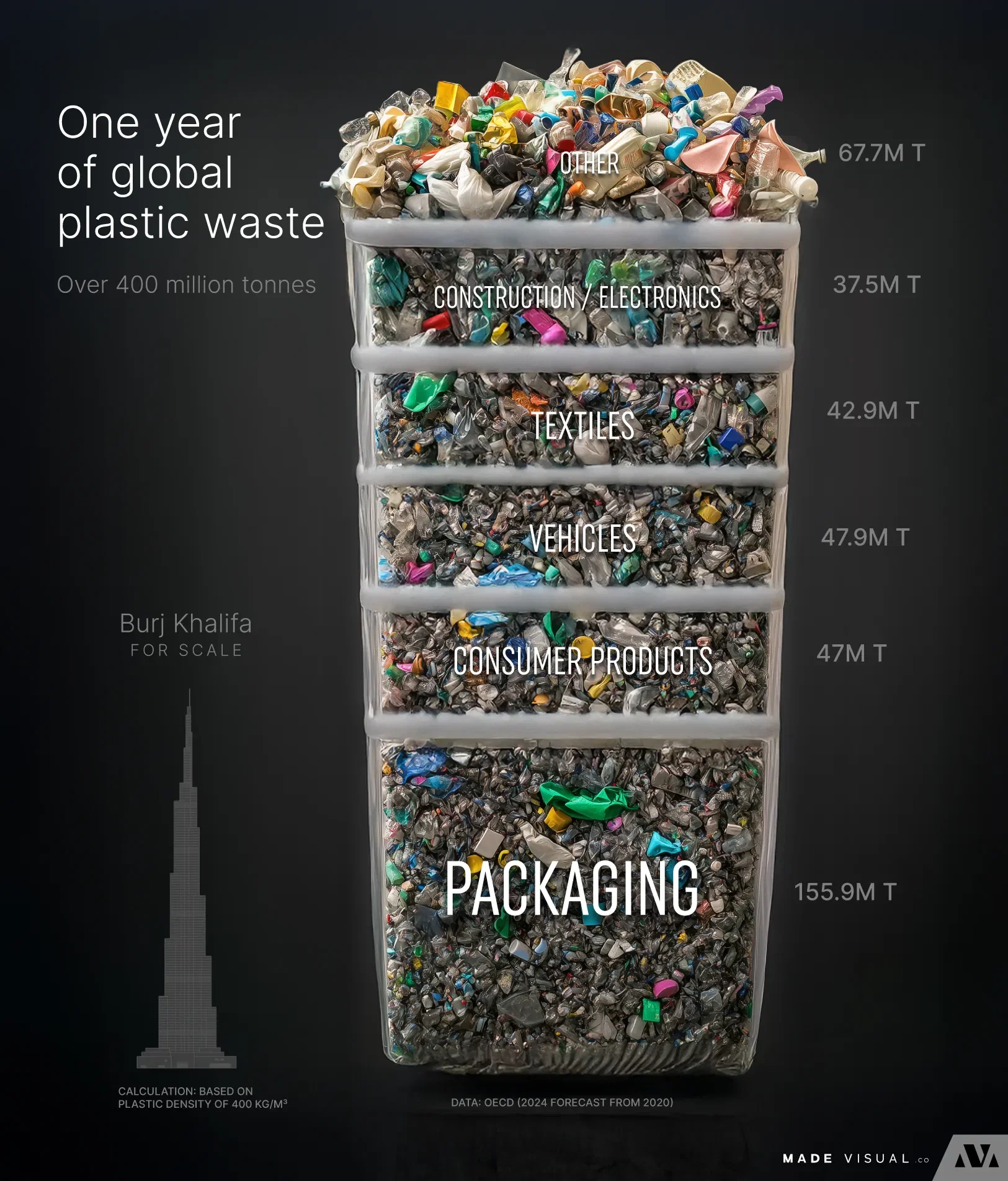
One year of global plastic waste visualized

voronoi.com

One year of global plastic waste visualized

The Data

Over 400 million tonnes of plastic was projected to be wasted in 2024 according to an OECD report from 2020. Further, plastic waste is expected to nearly triple worldwide by 2060, with half of all waste expected to be in landfill while less than one-fifth of it will be recycled.

Unbelievably, if all this plastic waste were put in a kitchen bin and scaled up uniformly, this would double the height of the Burj Khalifa.

Dataset

CategoryWeight of Waste (Millions of Tonnes)
Other67.7
Construction/Electronics37.5
Textiles42.9
Vehicles47.9
Consumer Products47
Packaging155.9

Data sources

OECD, Statista

https://www.oecd.org/en/publications/policy-scenarios-for-eliminating-plastic-pollution-by-2040_76400890-en/full-report.html

https://www.statista.com/chart/32385/global-plastic-waste-production-by-application/