The Countries with the Most Stateless People

Visual Capitalist: By Arciom Antanovič  Featured Creator Article/Editing: Ryan Bellefontaine

Demographics

Mapped: The Countries with the Most Stateless People
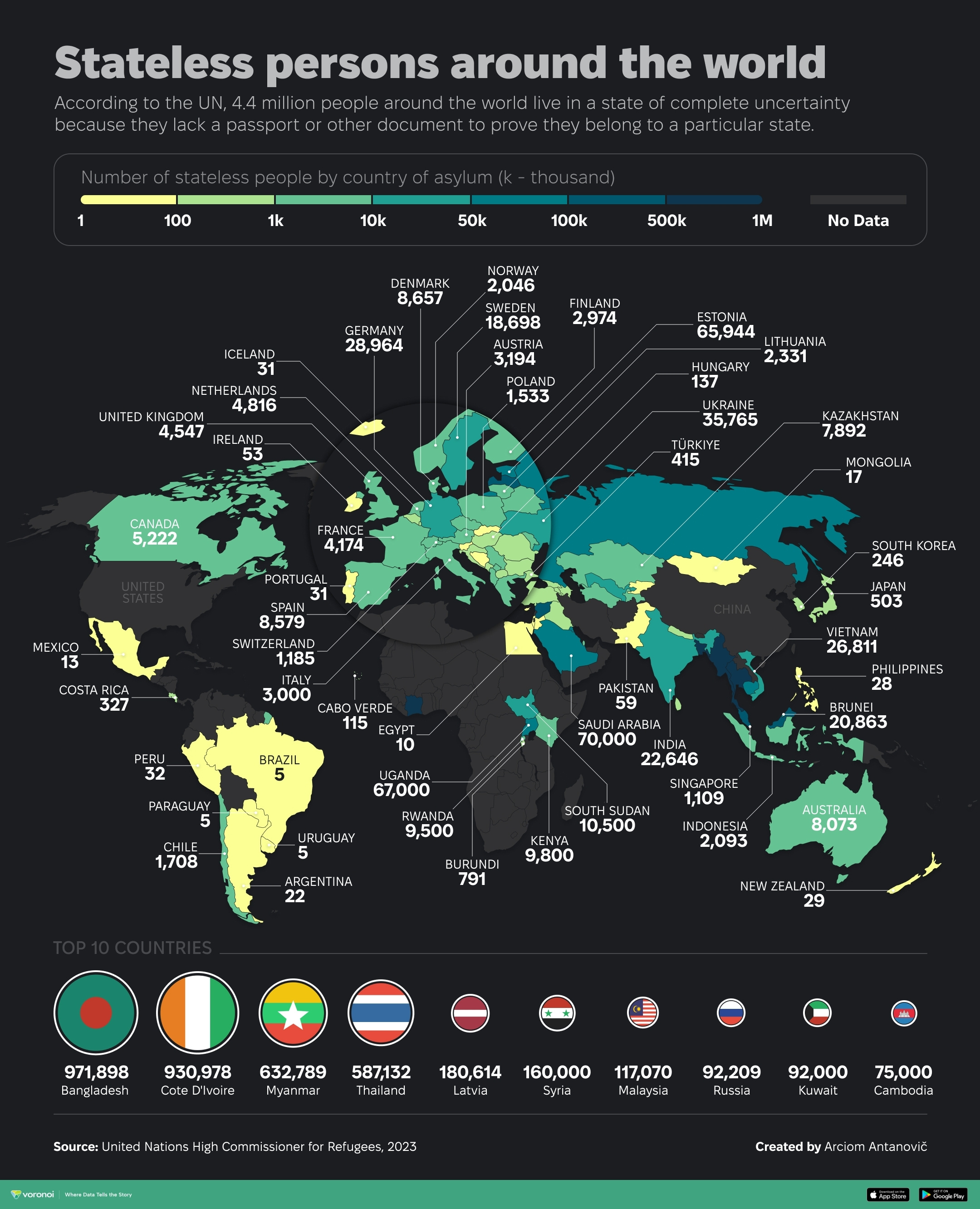
A map of the countries with the most stateless persons in 2023, using data from the United Nations High Commissioner for Refugees.

Mapped: The Countries with the Most Stateless People

This was originally posted on our Voronoi app. Download the app for free on iOS or Android and discover incredible data-driven charts from a variety of trusted sources.

The United Nations High Commissioner for Refugees (UNHCR) officially recognizes over 4.4 million people worldwide as stateless or of undetermined nationality. However, the actual number is likely much higher due to data collection challenges.

Stateless persons—those not recognized as citizens of any country—are deprived of fundamental rights such as education, healthcare, and employment, leaving them highly vulnerable to exploitation and discrimination. But which countries have the most?

This map, created by Arciom Antanovič, uses data from the United Nations High Commissioner for Refugees to show the countries with the most stateless persons in 2023.

Bangladesh Tops the List

Certain countries are home to a disproportionate share of the world’s stateless people, often due to historical, social, and legal complexities.

Bangladesh comes in first with 971,898, followed by Côte d’Ivoire with 930,978, while Myanmar comes in third with 632,789.Search:

Country of AsylumStateless Persons
🇦🇱 Albania2,018
🇦🇷 Argentina22
🇦🇲 Armenia520
🇦🇺 Australia8,073
🇦🇹 Austria3,194
🇦🇿 Azerbaijan513
🇧🇩 Bangladesh971,898
🇧🇾 Belarus5,567
🇧🇪 Belgium936
🇧🇦 Bosnia and Herzegovina21

‹12345…10›

The raw number drops significantly after the fourth-placed Thailand with 587,132, as the fifth-placed Latvia only has 180,614.

The Causes of Statelessness

One of the primary drivers of statelessness is that in some countries, nationality can only be inherited through the father. When fathers are absent, the children may be left without a recognized nationality. This issue is particularly harmful for single mothers and families separated by conflict or migration.

Another significant cause of statelessness is racial and ethnic discrimination. Some governments use citizenship laws to exclude specific minority groups. In Myanmar, the Rohingya are a well-known example of such discrimination.

Geopolitical changes, such as shifting borders and citizenship revocation, also contribute to the issue. Governments sometimes strip individuals of their nationality as a punitive measure.

Amanda Nguyen on making history as first Vietnamese woman in space

CBS Mornings – 29-1-2025

Amanda Nguyen, a civil rights activist and astronaut, is set to become the first Vietnamese and Southeast Asian woman to travel to space. Nguyen, who fought for the rights of sexual assault survivors, shares her journey of resilience and activism, including her groundbreaking work on the Sexual Assault Survivors’ Bill of Rights, signed in 2016. She will travel to space with Blue Origin later this year.

Addicted: how the world got hooked on illicit drugs – and why we need to view this as a global threat like climate change

theconversation.com

It has taken decades for some to accept the devastating effects of climate change on our planet. Despite scientific evidence that was available years ago, many people were reluctant to make the connection between increasing use of fossil fuels, rising global temperatures and devastating weather events.

A key reason for this reluctance is the dislocation of cause and effect, both in time and geography. And here there are clear parallels with another deadly human activity that is causing increasing levels of suffering across the planet: the production, trafficking and consumption of illicit drugs. Here are some troubling “highlights” from the UN’s latest World Drugs Report:

Cocaine production is reaching record highs, with production climbing in Latin America coupled with drug use and markets expanding in Europe, Africa and Asia.

Synthetic drugs are also inflicting great harm on people and communities, caused by an increase in methamphetamine trafficking in south-west Asia, the near and Middle East and south-eastern Europe, and fentanyl overdoses in North America.

Meanwhile, the opium ban imposed by the de facto authorities in Afghanistan is having a significant impact on farmers’ livelihoods and incomes, necessitating a sustainable humanitarian response.

The report notes how organised criminal groups are “exploiting instability and gaps in the rule of law” to expand their trafficking operations, “while damaging fragile ecosystems and perpetuating other forms of organised crime such as human trafficking”.

Tiếp tục đọc “Addicted: how the world got hooked on illicit drugs – and why we need to view this as a global threat like climate change”

What’s happening in Myanmar?


Al Jazeera English
– 1- 2- 2025

Myanmar’s military regime is under pressure, four years after it seized back power in a coup. The military has lost significant territory and a patchwork of anti-military groups now control different parts of the country. What’s happening? Who are the groups fighting against the military? And could the regime actually fall? #AJStartHere with Sandra Gathmann explains

Tiếp tục đọc “What’s happening in Myanmar?”

Nói KHÔNG với kết hôn sớm – Bộ phim về tảo hôn

Plan International Vietnam – 29-1-2024

Sanh chưa bao giờ nghĩ mình sẽ kết hôn khi mới chỉ lớp 9. Như bao bạn gái khác tại địa phương, cuộc sống sau hôn nhân của em có vô vàn trắc trở. Con của Sang không có giấy khai sinh, khi ốm đau cũng không đưa đi bệnh viện được mà chỉ ở nhà sử dụng thuốc Nam.

Nhưng Sanh vẫn tiếp tục hỗ trợ cho cộng đồng nơi em sinh sống. Là một nhà truyền thông tài ba, Sanh chia sẻ câu chuyện của mình tại những buổi sinh hoạt tại xã, tại trường để lan tỏa thông điệp nói không với tảo hôn và sống trọn vẹn với tuổi trẻ đáng giá của mình.

Trump’s tariffs are a $1.4 trillion gamble with the economy and prices

Analysis by Matt Egan, CNN

 5 minute read 

Updated 9:02 AM EST, Sun February 2, 2025

New York CNN — 

President Donald Trump is on the verge of hitting America’s three biggest trading partners with sweeping tariffs, a far more aggressive use of his favorite economic weapon than anything he did during his first term.

The looming import taxes on Mexico, Canada and China will be a major test of Trump’s unorthodox use of tariffs, which he’s described as “the greatest thing ever invented.”

It’s an enormous gamble, arguably a bigger one than any economic policy Trump enacted during his four-plus years in the White House. And this strategy has the potential to upend the thing many voters care about the most: the economy and the cost of living.

But Trump’s tariffs pose a big risk: They could backfire, lifting already-high consumer prices at the grocery store, rocking the shaky stock market or killing jobs in a full-blown trade war.

Tiếp tục đọc “Trump’s tariffs are a $1.4 trillion gamble with the economy and prices”

Dân bản ‘phất’ lên nhờ làm YouTuber

VNE – Chủ nhật, 2/2/2025, 00:07 (GMT+7)

Tuyên Quang – 9h sáng, thống nhất xong kịch bản với người em họ được giao quay phim, Trúc Thị Mụi cùng chồng Hà Tòn Chài vác dụng cụ ra đồng.

Trúc Thị Mụi (áo xanh), 31 tuổi, ở bản Khau Cau, xã Phúc Yên, huyện Lâm Bình, tỉnh Tuyên Quang cùng chồng Hà Tòn Chài (áo sọc đen) làm YouTube về cuộc sống vùng cao, tháng 1/2024. Ảnh: Nga Thanh

Cặp vợ chồng 31 tuổi ở bản Khau Cau, xã Phúc Yên, huyện Lâm Bình là chủ kênh YouTube với 108.000 người theo dõi. Nội dung tập phim hôm nay quay cảnh vợ chồng Mụi bắt cua trong khe suối để bán ở chợ phiên, lên rừng hái rau củ và nấu cơm trưa.

Khi người quay phim giơ tay đếm “3,2,1” và bấm máy, vợ chồng Mụi bắt đầu hoạt động. Hai người cố gắng không trò chuyện để thu được rõ cả tiếng chim chóc, suối chảy. Quen với ống kính và biết cách diễn họ chỉ tốn vài phút cho một cảnh quay. Các động tác dùng vợt bắt cua, rửa sạch, đổ vào thúng được làm nhanh gọn.

Tiếp tục đọc “Dân bản ‘phất’ lên nhờ làm YouTuber”