The National Security Imperative of USAID’s Food Security Programs

Climateandsecurity.org

As of today, the Trump Administration has paused two essential US global food security initiatives, Feed the Future and the Famine Early Warning Systems Network (FEWS NET). Created in reaction to the 2007-8 global food crisis and resulting instability, Feed the Future is a marquee US government food security program and tool for implementing the bipartisan Global Food Security Act, working in 20 countries to build a more resilient food system and supporting agricultural innovation at 17 US universities. Operating since 1985, FEWS NET provides rigorous analysis and forecasting of acute food insecurity to inform US and other humanitarian responses in 30 countries.

These programs make invaluable contributions to US national security and global stability. For example, Feed the Future builds resilience in five countries where the US National Intelligence Estimate on climate change assesses “building resilience…would probably be especially helpful in mitigating future risks to US interests.” In Central America, where drought during growing seasons has driven increased migration to the United States, Honduran Feed the Future beneficiaries report a 78% lower intent to migrate than the wider population. Meanwhile, FEWSNET’s data and analysis more quickly and efficiently direct US humanitarian support in reaction to conflict, economic shocks, and extreme weather, including in regions where the US military is deployed. 

Both programs have historically received consistent bipartisan support. Speaking at the launch of a new Feed the Future initiative last year, Senator John Boozman (R-AR) noted, “food security is national security.” Another Feed the Future supporter, Representative Tracey Mann (R-KS 1st District), has highlighted the value of his district’s Feed the Future Innovation Lab and stated that global food security programs have “an especially strong return on investment because they support American agriculture producers today, while greatly reducing the need for conflict or war-related dollars spent tomorrow” and are “a way to stop wars before they start.” As Executive Director of the World Food Program (2017-2023), former South Carolina Governor and Representative David Beasely testified to the Senate that “Investments in early warning systems like USAID’s Famine Early Warning System…allow humanitarian partners to project and respond in real time to potential emergencies….Without this capacity to forecast food insecurity, the cost of humanitarian intervention is much greater, both in dollars and lives lost.”

Last year, dozens of national security leaders, including the former commanders of Indo-Pacific Command (INDOPACOM), Africa Command (AFRICOM), and Central Command (CENTCOM), endorsed the Council on Strategic Risks’ The Feeding Resilience Plan: Safeguarding US National Security at the Crossroads of Food and Climate Change. The report makes recommendations to US policymakers to better anticipate, prevent, and respond to food- and climate-driven national security threats, including to:

  • “Support long-term resilience building in vulnerable countries by sustaining and expanding Feed the Future,” noting it and similar programs “bolster vulnerable countries’ ability to withstand food shocks and forestall security threats or need for costly US assistance,” and
  • “Expand on USAID’s FEWS NET to include longer-term food insecurity warnings” and to have security and defense agencies better “integrate FEWSNET projections with processes to forecast political instability and conflict.”

Amid multiplying threats from instability, extreme weather, and geopolitical competition, these recommendations remain critical today, and highlight the important national security benefits of capabilities like Feed the Future and FEWS NET.  
USAID Provides Critical Benefits to US National Security

Councilonstrategicrisks.org February 4, 2025

Center for Climate and Security, CSR Blog


The Trump Administration’s effort to try to shut down USAID and pause all foreign aid directly harms US national security, including by interrupting critical investments into resilience, adaptation, conflict prevention, and peacebuilding. In 2021, 79 senior national security leaders, including 8 retired 4-star generals and admirals, a former Director of National Intelligence, and a former Director of the Central Intelligence Agency, signed the Challenge Accepted report, which argued that USAID investments in resilience and adaptation were critical to preventing instability and conflict and maintaining the US competitive edge with China. 

In the Indo-Pacific, USAID investments in disaster response and resilience pay dividends in strengthening relationships with allies and partners critical to that competition with China. Take Papua New Guinea as an example, where the US signed a new security pact in 2022, gaining exclusive access to develop and operate out of PNG bases. As Admiral Sam Locklear, former head of US INDOPACOM, and Erin Sikorsky, Director of CCS, wrote, “To sustain and maintain this presence, the United States will need access to reliable energy sources, clean, fresh water, and an economically vibrant, healthy local population.” Those functions are all supported by USAID efforts, such as the $3.5 million in disaster response funds the agency allocated to PNG in 2024. 

Meanwhile, in the Sahel region of Africa, USAID investments in climate adaptation and resilience help prevent extremist and terrorist group recruitment in communities affected by climate hazards.  For example, the Resilience in the Sahel Enhanced (RISE) program funded by USAID aims to break cycles of crisis in the region that enable groups like Boko Haram and ISIS-W to thrive. AS US AFRICOM Commander Michael Langley noted in testimony to Congress, international aid and development programs “attack the roots of terrorism and tyranny more than bullets and air strikes ever will.”

Further, as we outlined in this article last week, USAID programs focused on agriculture resilience have helped curb irregular migration from Honduras to the United States by helping local farmers weather risk and stay in the country. Upstream investments before crises hit cost significantly less than waiting until such challenges become full-blown crises. 

The bottom line is that addressing critical, bipartisan national security priorities requires a robust 3D approach to US foreign policy—defense, diplomacy, and development. Anything less is short-sighted and puts the country at risk. CCS Advisory Board member and former commander of US Central Command General Anthony Zinni (USMC, Ret.) has endorsed CCS recommendations to expand USAID work on climate and food security. He said as Co-Chair of the US Global Leadership Coalition’s National Security Advisory Council, “a freeze on all U.S. foreign assistance – at a time when our rivals are playing to win – takes the U.S. off the playing field and diminishes U.S. strength around the world.”

Online fraud leaves nobody safe – The vast and sophisticated global enterprise that is Scam Inc

economist.com

EDGAR MET Rita on LinkedIn. He worked for a Canadian software company, she was from Singapore and was with a large consultancy. They were just friends, but they chatted online all the time. One day Rita offered to teach him how to trade crypto. With her help, he made good money. So he raised his stake. However, after Edgar tried to cash out, it became clear that the crypto-trading site was a fake and that he had lost $78,000. Rita, it turned out, was a trafficked Filipina held prisoner in a compound in Myanmar.

In their different ways, Edgar and Rita were both victims of “pig-butchering”, the most lucrative scam in a global industry that steals over $500bn a year from victims all around the world. In “Scam Inc”, our eight-part podcastThe Economist investigates the crime, the criminals and the untold suffering they cause. “Scam Inc” is about the most significant change in transnational organised crime in decades.

Pig-butchering, or sha zhu pan, is Chinese criminal slang. First the scammers build a sty, with fake social-media profiles. Then they pick the pig, by identifying a target; raise the pig, by spending weeks or months building trust; cut the pig, by tempting them to invest; and butcher the pig by squeezing “every last drop of juice” from them, their family and friends.

The industry is growing fast. In Singapore scams have become the most common felony. The UN says that in 2023 the industry employed just under 250,000 people in Cambodia and Myanmar; another estimate puts the number of workers worldwide at 1.5m. In “Scam Inc” we report how a man in Minnesota lost $9.2m and how a bank in rural Kansas collapsed when its chief executive embezzled $47m to invest in crypto, under the tutelage of a fake online woman, called Bella. A part-time pastor, he also stole from his church.

Online scamming compares in size and scope to the illegal drug industry. Except that in many ways it is worse. One reason is that everyone becomes a potential target simply by going about their lives. Among the victims we identify are a neuroscience PhD and even relatives of FBI investigators whose job is to shut scams down. Operating manuals give people like Rita step-by-step instructions on how to manipulate their targets by preying on their emotions. It is a mistake to think romance is the only hook. Scammers target all human frailties: fear, loneliness, greed, grief and boredom.

The Countries with the Most Stateless People

Visual Capitalist: By Arciom Antanovič  Featured Creator Article/Editing: Ryan Bellefontaine

Demographics

Mapped: The Countries with the Most Stateless People

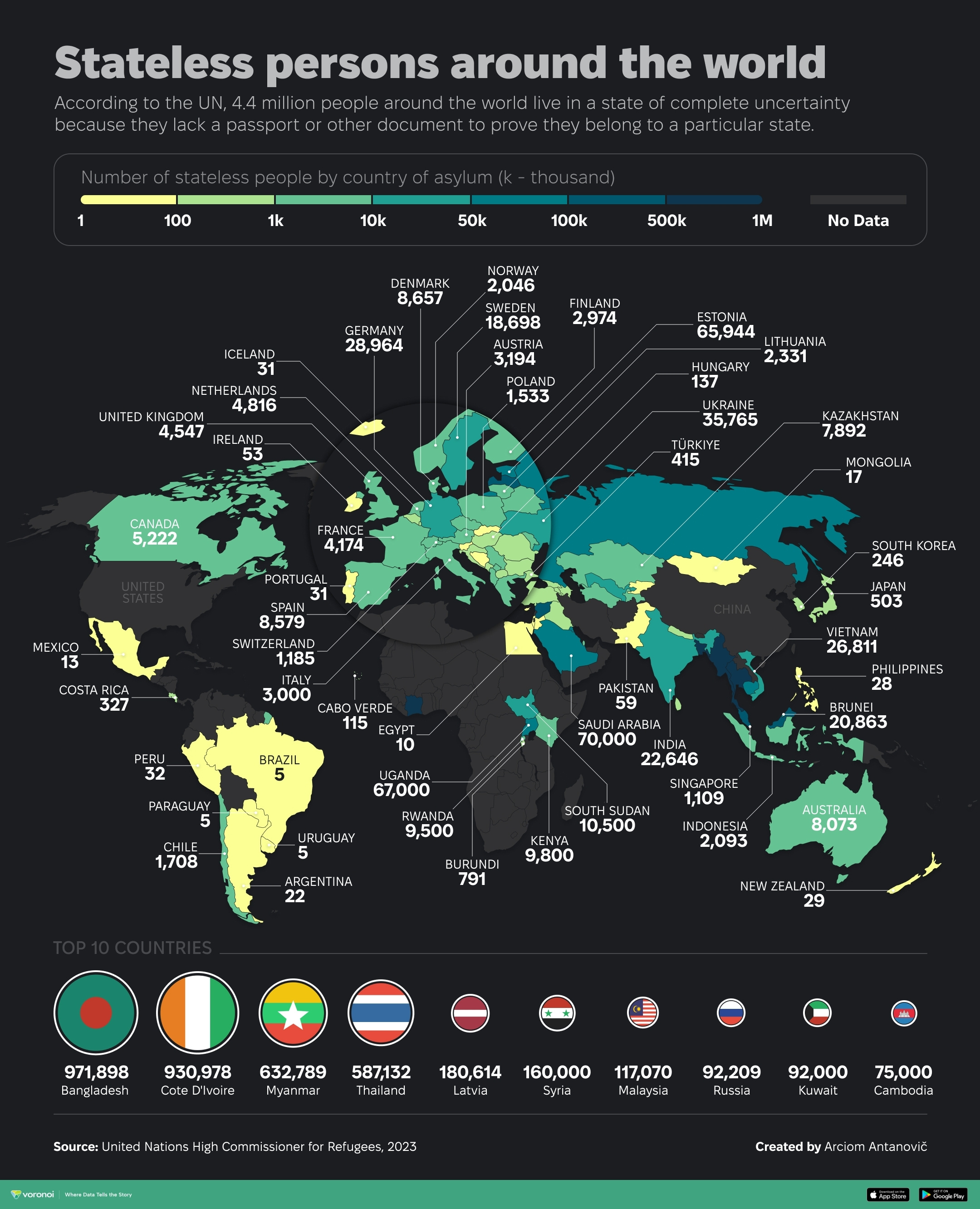
A map of the countries with the most stateless persons in 2023, using data from the United Nations High Commissioner for Refugees.

Mapped: The Countries with the Most Stateless People

This was originally posted on our Voronoi app. Download the app for free on iOS or Android and discover incredible data-driven charts from a variety of trusted sources.

The United Nations High Commissioner for Refugees (UNHCR) officially recognizes over 4.4 million people worldwide as stateless or of undetermined nationality. However, the actual number is likely much higher due to data collection challenges.

Stateless persons—those not recognized as citizens of any country—are deprived of fundamental rights such as education, healthcare, and employment, leaving them highly vulnerable to exploitation and discrimination. But which countries have the most?

This map, created by Arciom Antanovič, uses data from the United Nations High Commissioner for Refugees to show the countries with the most stateless persons in 2023.

Bangladesh Tops the List

Certain countries are home to a disproportionate share of the world’s stateless people, often due to historical, social, and legal complexities.

Bangladesh comes in first with 971,898, followed by Côte d’Ivoire with 930,978, while Myanmar comes in third with 632,789.Search:

Country of AsylumStateless Persons
🇦🇱 Albania2,018
🇦🇷 Argentina22
🇦🇲 Armenia520
🇦🇺 Australia8,073
🇦🇹 Austria3,194
🇦🇿 Azerbaijan513
🇧🇩 Bangladesh971,898
🇧🇾 Belarus5,567
🇧🇪 Belgium936
🇧🇦 Bosnia and Herzegovina21

‹12345…10›

The raw number drops significantly after the fourth-placed Thailand with 587,132, as the fifth-placed Latvia only has 180,614.

The Causes of Statelessness

One of the primary drivers of statelessness is that in some countries, nationality can only be inherited through the father. When fathers are absent, the children may be left without a recognized nationality. This issue is particularly harmful for single mothers and families separated by conflict or migration.

Another significant cause of statelessness is racial and ethnic discrimination. Some governments use citizenship laws to exclude specific minority groups. In Myanmar, the Rohingya are a well-known example of such discrimination.

Geopolitical changes, such as shifting borders and citizenship revocation, also contribute to the issue. Governments sometimes strip individuals of their nationality as a punitive measure.