

A U.S. Army CH-47 Chinook helicopter assigned to the 25th Infantry Division delivers essential medical supplies and logistical equipment for the Lahaina National Guard Role I facility, supporting Maui County authorities to provide immediate security, safety, and well-being to those affected by the wildfires to ensure unwavering support for the community of Maui and first responders. (U.S. Army photo by Spc. Abreanna Goodrich)
Since June 2022, MiRCH has identified military deployments for floods, storms, droughts, heat, wildfires, and other hazards on every continent, involving the armed services of 68 countries. With the growing severity and frequency of climate hazards, the scale of some MiRCH incidents have been immense, placing enormous pressure on defense forces to provide assistance. For instance, wildfires in Canada burned through a record high of more than 45 million acres in 2023 requiring the Canadian Armed Forces to engage in firefighting for over 100 days. Meanwhile, extreme precipitation and flooding in Libya, East Africa, and elsewhere have displaced millions of people, resulting in the deployment of thousands of military personnel.
The pace and breadth of climate hazards present additional challenges to militaries worldwide. MiRCH has recorded 10 countries where their armed services responded to more than one climate hazard in the same month. In December 2023, India’s southern state of Tamil Nadu was still recovering from the damage caused by Cyclone Michaung when intense rainfall later in the month led to severe flooding in the region again, prompting the Indian Armed Forces to amplify their recovery efforts. Additionally, although defense forces continue to widely perform more traditional disaster relief duties, such as providing logistical support, conducting search and rescue operations, evacuating affected areas, and delivering critical aid and supplies, they are also being deployed for missions beyond these roles. For example, the Swiss army has airlifted water to thousands of livestock during water shortages, the West Virginia National Guard conducted aerial firefighting for the first time, and Indonesia ordered the military to assist farmers in planting rice since drought has reduced production of the staple crop.
Record high temperatures, combined with a strong El Niño event, contributed to unprecedented extreme weather events that required military responses in 2023, from the first Category-5 storm in recorded history to make landfall in the Mexican Pacific to Canada’s historic fire season. As global temperatures continue to rise, climate hazards are projected to further intensify, placing an even greater demand on armed services to provide relief in the future. In the near term, extreme weather events in the next few months could be particularly severe as the current El Niño is expected to continue at least until April.
High Demand Poses Readiness Questions for Militaries
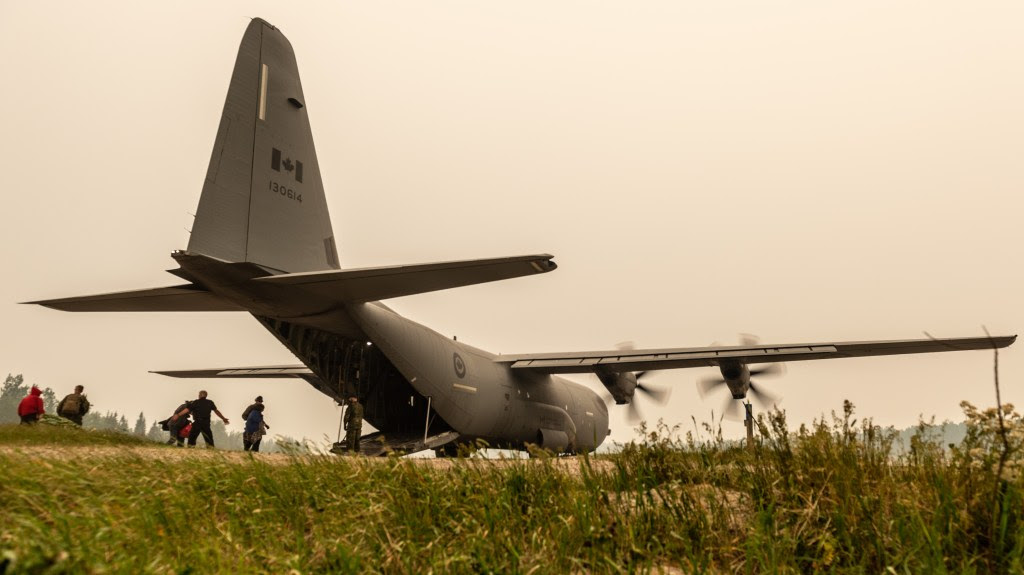
Canadian Rangers from Canadian Army and CC-130J Hercules aircrew from Royal Canadian Air Force work hard to help conduct evacuations of vulnerable members of the Pikangikum First Nation community as part of Operation Lentus on July 6, 2019. (Canada Government photo)
In some countries, the pace and scope of deployments in response to climate hazards is raising questions about the capacity of militaries to maintain readiness for other threats. Debates are emerging within governments about how best to resource the increased demand for climate-driven humanitarian assistance and disaster relief (HA/DR) operations. Some policymakers and security leaders are concerned that HA/DR deployments are distracting the military from preparing for other, more traditional threats, while others argue such deployments should be a core mission for militaries. In practice, militaries are called on because even in many wealthy countries, no other arm of government has the capacity to respond so quickly and at scale.
As mentioned earlier, in Canada this year the federal government deployed thousands of military personnel to fight wildfires in response to provincial requests, with the Canadian Air Force deploying for an unusual 130 consecutive days. Overall, between May and September 2023, the military fought fires in six of the 10 Canadian provinces, in some cases deploying multiple times. According to the military’s own calculations, the Canadian Armed Forces’ involvement in response to natural disasters has broadly doubled every five years since 2010, when it first launched Operation Lentus as a standing mission to prepare for domestic disaster response. Such a trend worries some Canadian security leaders; former top national security advisor Richard Fadden told Parliament last year that, “…domestic emergency operations — such as cleaning up after storms and fighting forest fires — distract the military from the training it needs in an increasingly unstable world.” In the wake of this year’s fires, Minister of Defense Anita Anand said she would work with government counterparts to explore new approaches to expand Canada’s capability outside of the military to respond to wildfires, yet it’s not clear that the country can move quickly enough to establish new response mechanisms to match the pace of climate hazards.
In Australia, a similar debate has emerged, as the country’s defense forces have deployed repeatedly to perform rescue missions in the face of flooding and fight bushfires across the country. The 2023 Defense Strategic Review identified climate change as a national security issue and stated, “The acceleration of major climate events risks overwhelming the Government’s capacity to respond effectively and detracting from Defence’s primary objective of defending Australia. Climate events already place concurrency pressures on the Australian Defence Force (ADF) and this has negatively affected force preparedness, readiness and combat effectiveness.” Some in parliament have also argued the pace of ADF domestic deployment is unsustainable. The government has increased its investment in a volunteer relief organization, Disaster Relief Australia, as an alternative, and just this month, as the military deployed once again to respond to extreme precipitation and flooding, Prime Minister Anthony Albanese announced the government was considering the creation of a standby reserve body to help with domestic HA/DR. It’s unlikely, however, that a volunteer group and a new reserve effort can match the capabilities of the ADF in the near term, particularly in rural and remote areas.
Benefits and Opportunities: Saving Lives & Strengthening Cooperation

Specialists from the Royal New Zealand Navy ship HMNZS Manawanui deliver food and other relief supplies across Fiji following Tropical Cyclone Mal. (RNZN photo)
Military involvement in humanitarian assistance and disaster relief is often lifesaving, particularly during large incidents that can overwhelm civilian emergency management authorities. As noted previously, armed forces generally have the capacity to offer vast resources, mobilize quickly, and operate at scale, rapidly moving thousands of people and tons of supplies to affected areas. They also have specialized vehicles, equipment and expertise that supplement the capabilities of local emergency services. Thus, through robust civil-military cooperation, military engagement can strengthen the effectiveness of the immediate response to climate hazards.
Furthermore, many incidents have demonstrated that military responses to climate hazards can be a source of international cooperation. MiRCH has documented 29 international deployments so far, taking place in 14 countries. The devastating floods in Libya in 2023 saw one of the largest international responses, with eight foreign militaries dispatched to assist with recovery efforts and deliver aid supplies. Bilateral agreements have also increasingly focused on disaster and humanitarian response coordination, highlighting the critical intersection between defense and diplomacy. For example, New Zealand and Fiji signed a defense agreement in June 2023, providing a legal framework for their militaries to provide emergency assistance. The agreement was soon seen in action when the Royal New Zealand Navy aided the Fiji National Disaster Management Office in transporting food, supplies, and emergency personnel to several islands following Tropical Cyclone Mal in mid-November.
Climate-driven hazards have also created opportunities to strengthen relations between countries with historical tensions. Türkiye was one of the many countries that provided wildfire assistance to Greece as the country’s military and fire services tackled heatwave-driven wildfires in July 2023. Yet, while rivals India and Pakistan both deployed military forces to their own provinces in response to Cyclone Biparjoy in June 2023, there was limited real-time coordination between the two governments, highlighting how traditional security considerations can still hinder collaborative responses to transboundary hazards. Nevertheless, as extreme weather events become more common and destructive, the need for international assistance will likely grow, likely increasing interest in more bilateral and multilateral military response frameworks.
Risks: Empowering Bad Actors

“Medicane” Daniel as it made landfall in northeastern Libya, September 10, 2023. (NASA satellite imagery via Earth Observatory)
At the same time, MiRCH data highlights that increasing military deployments in response to climate hazards also carry risks, particularly in countries with poor human rights records, polarized politics, or predatory governments. In many countries with intersecting climate vulnerability and governance challenges, militaries are the most powerful and capable institution, but often play problematic domestic roles. In this way, similar to dilemmas that face the broader humanitarian and development sector, domestic or third country military relief of climate-related disasters can risk reinforcing problematic governance, empowering abusive actors, or feeding corruption. The US Leahy Amendment on human rights protections in military assistance includes an exception for natural disasters, and while not a pretext to refrain from aid to vulnerable populations, mitigating human rights and governance risks in these contexts warrants more examination going forward.
For example, some of the most significant third country military assistance for climate-related disasters was prompted by flooding in November 2022 in Pakistan and September 2023 in Libya, justifiably so given the thousands killed and displaced. Following the failure of neglected infrastructure and devastating floods in Derna, Libya, military strongman Khalifa Haftar repressed press coverage, locked down the affected area, and has used control of aid flows to entrench his domestic power and relationships with international partners. Meanwhile, Pakistan has a fraught history of civil-military relations and the Pakistani military has a record of using flood relief to bolster its public image. Militaries with abusive human rights records or challenging civil-military relations in places like Algeria, Ethiopia, Iran, the Philippines, Syria, Turkiye, and Venezuela have likewise deployed to relieve climate-related disasters, raising questions about how this increasing demand will shape politics in these countries.
What About China and Russia?

Soldiers assigned to a brigade under the PLA 82nd Group Army strengthen an embankment near Beijing throughout the night of August 2, 2023. (PLA photo by Deng Qinghua)
The MiRCH tracker is probably undercounting Chinese and Russian military responses due to the countries’ more closed militaries and media environments and the tracker’s focus on English-language open source material. In China, MiRCH has identified 8 deployments by the Chinese Army and paramilitary forces in response to extreme precipitation and flooding, particularly Typhoon Doksuri, which battered the country in July 2023. In the case of Doksuri, the Chinese military publicly touted its rescue and response operations, probably in part to counter some public criticism in rural areas regarding a perceived lack of government support.
The MiRCH has not identified any Russian military responses to climate hazards in the past 18 months. This could reflect a mix of language and reporting barriers as well as Moscow’s focus on its invasion of Ukraine. This does not mean that the country has not suffered climate extremes, however. For example, in late November 2023 extreme storms and precipitation caused coastal flooding and knocked out power for nearly 2 million people in parts of southwest Russia and Russian-occupied Ukraine. There were reports that the storms damaged Russian military facilities and equipment in Crimea.
Conclusion
These observations point to potential research avenues for MiRCH over the coming year, and emphasize several trends to watch for as El Niño continues to intersect with climate change to drive extreme heat around the globe. Drawing on a growing amount of data, future MiRCH research, analysis, and progress could include deep dives into countries of particular security concern, expanding MiRCH’s foreign language capabilities, and exploring questions about military readiness, human rights, and civil-military relations.

 CVD
CVD 