
Dec 22, 2023 at 9:52 AM EST00:32
Chinese Ships Confronts Philippine Vessels Near Second Thomas Shoal
China News Reporter, Newsweek
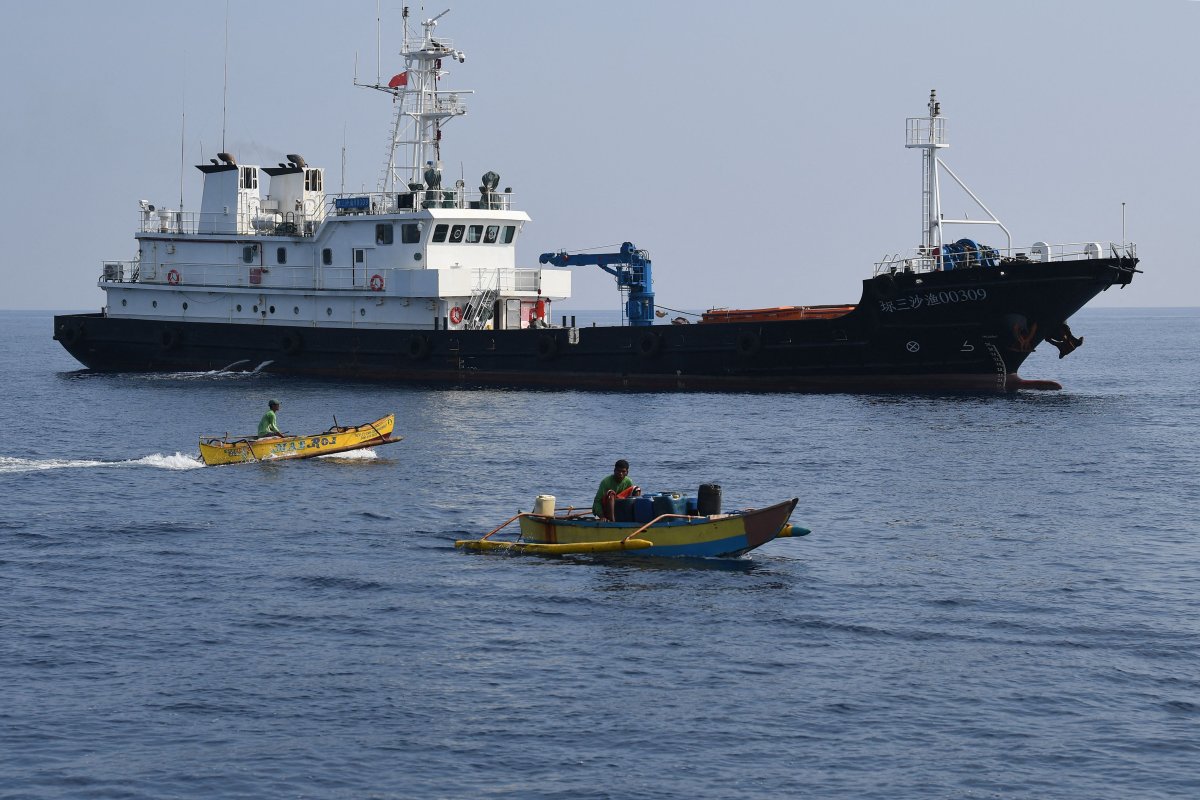
The maritime militia fleet is the vanguard of Beijing’s strategy to reshape the geopolitical landscape in the region, experts say, with its blue-hulled ships a frequent sight at territorial standoffs in the South China Sea.
The maritime militia is considered by analysts to be China’s third sea force alongside its navy and coast guard. The Chinese government maintains the fleet is little more than a group of patriotic fishermen.
Dubbed “little blue men” by Andrew Erickson, professor of strategy at the U.S. Naval War College’s China Maritime Studies Institute, the ships regularly join China’s coast guard in blockades against supply missions to a Philippine military outpost at the Spratly Islands’ Second Thomas Shoal, including the most recent tense showdown on December 10. A blockading militia ship was involved in a collision with a Philippine coast guard boat in October, and Manila accused another of using a sonic weapon against a fisheries bureau convoy on December 9.
The maritime militia is “a set of mariners and their vessels which are trained, equipped, and organized directly by the PLA’s (People’s Liberation Army) local military commands,” Erickson said in a 2017 interview with think tank the Center for Strategic and International Studies (CSIS).
READ MORE
- Congressional report lists “military options” to aid US ally against China
- Dozens of China’s paramilitary boats occupying disputed territory—pictures
- Satellites capture China’s militia ships parked in US ally’s territory
- China says relations with US ally facing “serious difficulties”
Essentially the militia is a “third sea force of China that in its own way plays a direct role in promoting China’s position in sovereignty disputes,” he said.
China asserts sovereignty over upward of 90 percent of the South China Sea, despite an international tribunal’s 2016 decision that shot down Beijing’s claim.
Earlier this month, satellite images showed a substantial maritime militia presence at Whitsun Reef in the Spratly Islands, with the Philippine coast guard reporting more than 130 ships at their peak.
China’s Foreign Ministry said the reef, which lies within the Philippines internationally recognized exclusive economic zone (EEZ), was a usual spot for its fishing ships to shelter from inclement weather.
Some experts observed on social media that the ships appeared to be manned by a skeleton crew and were remarkably clean for fishing ships. In addition, many were lashed together in a configuration called “rafting,” a gray-zone tactic that makes it more difficult to dislodge the occupying vessels.
The Chinese Foreign Ministry didn’t respond to Newsweek‘s written request for comment by publication time.
Sign up for Newsweek’s daily headlines
“[The maritime militia] is eroding U.S. and allied interests by operating surreptitiously in the “gray zone” between peace and war, an approach Chinese sources term “War without Gun Smoke,” Erickson said.
Gray-zone operations use nontraditional forces or methods in pursuit of objectives without resorting to armed conflict.
The maritime militia can be divided into two main categories. One comprises purpose-built professional ships that receive funds for maritime militia affairs; the other, commercial fishing ships that meet the minimum requirements and are recruited through subsidies, according to CSIS.
Vessels in the first category are equipped with water cannons, reinforced hulls for ramming—and at least some apparently with caches of light weapons. Erickson cited open-source Chinese information about a ship’s interior that appeared to have dedicated weapons and ammunition storage rooms.
“And while at sea, these units—the most advanced units that are charged with intervention, involvement in international sea incidents or sensitive sea areas, they typically answer to the PLA chain of command, and they’re certain to do so when they’re activated for missions,” Erickson said in his interview with CSIS.
The militia has its roots in the years following the communist victory in the Chinese Civil War in 1949. Local fisheries were collectivized and workers given military-level training to shore up the nascent government’s weak maritime defenses, according to RAND Corporation think tank defense analyst Derek Grossman and author Logan Ma.

The maritime militia was involved in the 1974 Battle of the Paracel Islands, which resulted in China wresting the isles from then-South Vietnam.
Vietnam, which like the Philippines has competing maritime claims with China, is the only other country with a maritime militia.
The militias of both countries were involved in a 2014 standoff over an oil rig China began operating within Vietnam’s EEZ.
China’s militia began engaging in increasingly aggressive activities in the early 2000s, including interfering with U.S. Navy vessels. The fleet also played a major role in China’s seizure of Scarborough Shoal, a traditional fishing ground for Filipino fishermen lying within the Philippines‘ EEZ.
The militia has been more active, and in greater numbers, in the Spratlys since China constructed a number of artificial islands in the archipelago in the 2010s.
Since August 2018, there have been approximately 300 maritime militia ships deployed in the island chain at any given time, according to CSIS, citing remote sensing data.
Request Reprint & Licensing Submit Correction View Editorial Guidelines
About the writer
Micah McCartney is a reporter for Newsweek based in Taipei, Taiwan. He covers U.S.-China relations, East Asian and Southeast Asian … read more

 CVD
CVD 