
SITUATION OVERVIEW
Eight months after fighting between the Sudanese Armed Forces (SAF) and the Rapid Support Forces (RSF) erupted in mid-April, more than 6.9 millionpeople have fled their homes, taking refuge inside and outside the country, with children representing about half of the people displaced. Sudan is now the country with the largest number of displaced people and the largest child displacement crisis in the world.
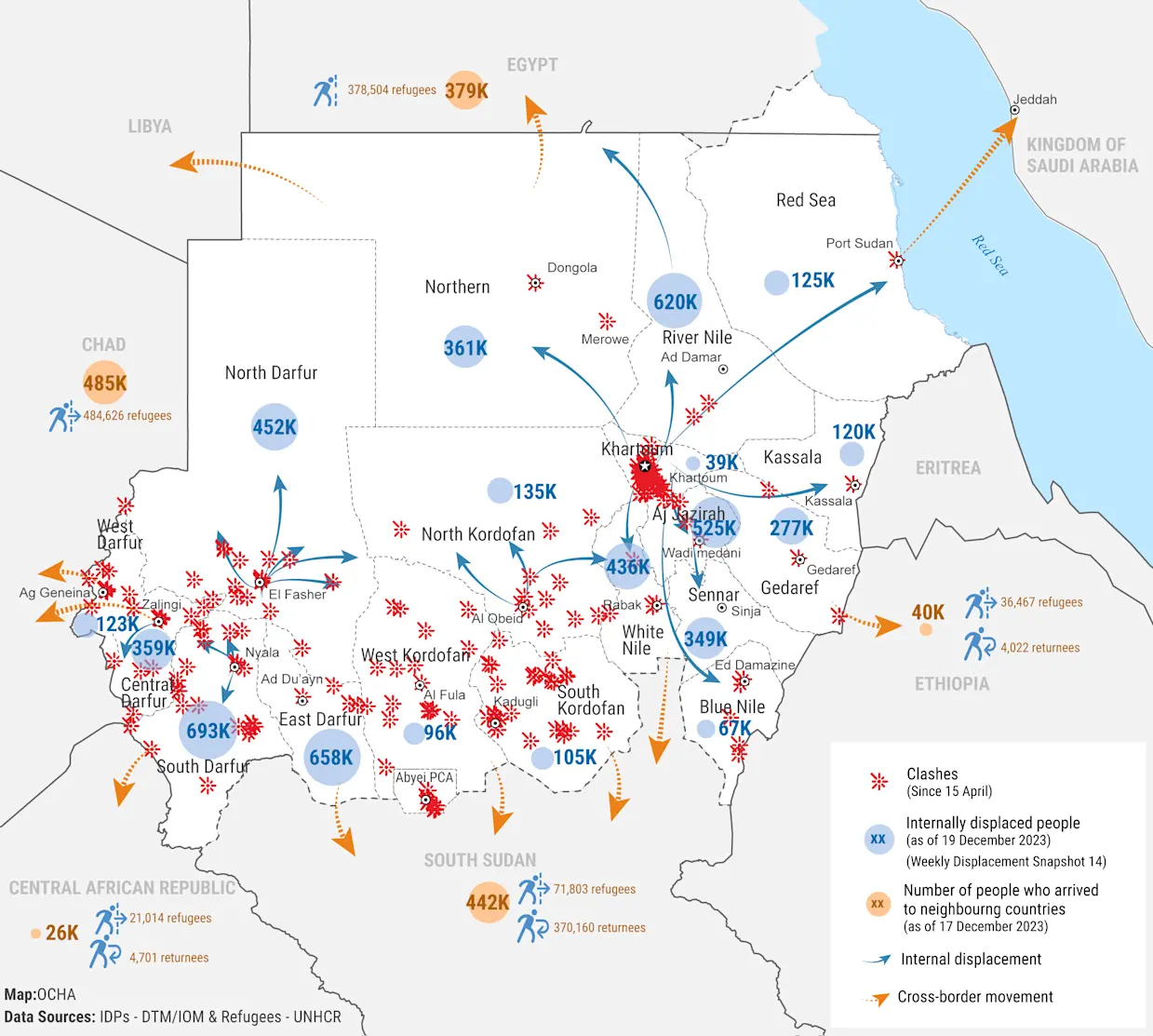
According to the International Organization for Migration Displacement Tracking Matrix (IOM DTM) Sudan Weekly Displacement Snapshot (13), more than 5.5 million people have been displaced within Sudan since April 2023. People have been displaced in 6,089 locations across the country’s 18 states, an increase of 115,000 people and 160 locations in one week. The highest proportions of IDPs have been observed across South Darfur (13 per cent), East Darfur (12 per cent), River Nile (11 per cent), Aj Jazirah (9 per cent), and North Darfur (8 per cent). THE IDPs were initially displaced from 11 states. The majority of IDPs – 3.5 million people or 64 per cent of the total – have been reportedly displaced from Khartoum State; followed by South Darfur (17 per cent), North Darfur (9 per cent), Central Darfur (4 per cent), West Darfur (3 per cent) and other states. In addition, about 1.4 million people crossed into neighbouring countries since 15 April, according to UNHCR.
The total number of people displaced within Sudan is likely to increase further when the estimated 250,000-300,000 people who have been newly displaced from Wad Medani and surrounding areas in Aj Jazirah State over the past few days are registered and verified in the locations where they have sought shelter and assistance.
About 250,000-300,000 people displaced from Wad Medani and surrounding areas, Aj Jazirah State
About 250,000 – 300,000 people have fled Aj Jazirah State following the clashes between the Sudanese Armed Forces (SAF) and the Rapid Support Forces (RSF) around Wad Madani, the capital of Aj Jazirah State, according to the International Organization for Migration’s Displacement Tracking Matrix (DTM). Fighting broke out in the morning of December 15 between the SAF and the RSF in the outskirts of Wad Medani, 136 km southeast of the national capital Khartoum. On December 18, RSF reportedly entered Wad Medani town and by December 19 took control of the city.
The head of the World Health Organization Tedros Adhanom Ghebreyesus said on his X (formerly Twitter) account that the WHO is particularly worried about the situation in Wad Medani. “We are appalled by reports of attacks on a hospital in the same area that has caused the death of two health workers. WHO’s operations hub is also temporarily suspended; we are taking steps to ensure the safety of our staff while exploring alternative modalities of continuing our health emergency operations,” he said. WHO’s ability to help Sudanese people is affected as the humanitarian space is shrinking and there are no guarantees of safe access. WHO said that at least three hospitals in and around Wad Medani were closed, and the ones still operating face a critical staff shortage.
Meanwhile, people displaced from Wad Medani have fled to Gedaref, Sennar and White Nile states, according to partner reports received. Many IDPs reportedly arrived at the existing IDP gathering sites (collective centers) in and around the Gedaref and Sennar localities. The majority sought shelter within the host communities, and local authorities and partners in Gedaref estimate that more than 10,000 people have sought shelter with the host communities in Gedaref town.
It is estimated that thousands of people displaced from Wad Medani might have arrived in Sennar State enroute to Gedaref, Kassala and Blue Nile. The number of displaced people will be available once the numbers are registered and verified. There are reports of IDPs moving to White Nile State to cross over to South Sudan if the situation deteriorates. Poor mobile network and internet connectivity in parts of Aj Jazirah, Sennar, White Nile, Blue Nile and other adjacent areas are impacting the ability of humanitarian partners on the ground to gather and collate the latest information on population movements, protection concerns, immediate needs and other issues of humanitarian concern.
Clashes between SAF and RSF in Al Fasher, North Darfur State
On 16 December 2023, clashes renewed between SAF and RSF in Al Fasher Town of Al Fasher locality, North Darfur. As a result of the violence, the DTM reported three individuals were reportedly killed, and 10 others were injured. It was also reported that approximately 750 people have been displaced. Affected residents have been displaced from Abu Shock and Al Salam IDP camps to eastern neighborhoods within Al Fasher Town. Personal and commercial property was reportedly burnt and looted. The situation remains tense and unpredictable.
Situation in River Nile State
On 17 December, the River Nile State authorities decided to close the Nile crossings and bridges from 22.00 to 06.00 hours. These include the nightly closure of the Umm Al-Tuyour and Al-Bashir bridges constituting Nile crossing points for movement between the River Nile State and the Northern and Khartoum states. Following RSF’s attack and looting of the Sudanese Police Force Station at Umm Shadida, in Shendi locality there have been increased fears of possible assaults on Atbara or Ed Damer due to their strategic connection with the rest of Sudan, including eastern Sudan and Northern State.
Impact of conflict and inter-communal violence on civilians
In West Kordofan, two persons were killed, and an unconfirmed number injured when clashes erupted on 16 December between the SAF and RSF at the military headquarters and Al Idia local market in Al Idia town in West Kordofan State. IOM’s DTM field teams also reported displacement from Al Idia town to western neighborhoods within the same town. There were also reports of looting of commercial and personal property.
In South Darfur, about 850 people fled their homes in Nyala, the capital of South Darfur State, on 14 December after armed clashes renewed between the SAF and RSF in the area. IOM DTM field teams reported that most newly displaced people have sought refuge in Chad and South Sudan. DTM field teams also reported that about 100 people have sought refuge in Deribat town, Sharg Aj Jabal locality. The field teams also reported an unconfirmed number of deaths and injuries because of the violence. The situation remains tense and unpredictable.
In North Kordofan State, inter-communal clashes erupted on 15 December between Al Asra tribesmen and Shanabla tribesmen in Um Rawaba town. The cause of the incident is unknown, according to IOM DTM. Clashes were reported in the Al-sika Hadeed neighborhood. As a result of the violence, six people were reportedly killed. IOM DTM field teams reported that 15 people have been displaced from the Al-sika Hadeed neighborhood to the Tayba neighborhood of Um Rawaba town. The situation in the area remains tense and unpredictable.
The number of suspected cholera cases increased by 136 per cent in one month
The number of suspected cholera cases continues to increase and reached 7,725 cases (including 216 associated deaths) as of 15 December, having increased by about 136 per cent over the past month, according to the Federal Ministry of Health (FMoH) and WHO Sudan Outbreaks Dashboard. The number of associated deaths has doubled over the past month from 104 to 216. The increase in cases has been particularly high in the Red Sea and White Nile states, where they have doubled over the past month.
There are 1,960 suspected cases of cholera and 49 associated deaths in Gedaref; 1,895 suspected cases and 70 associated deaths in Red Sea; 1,827 suspected cases and 26 associated deaths in Aj Jazirah; 984 suspected cases and 30 associated deaths in White Nile; 525 suspected cases and 26 associated deaths in Khartoum; 346 suspected cases and eight associated deaths in South Kordofan; 111 suspected cases and four associated deaths in Sennar; 74 suspected cases and three associated deaths in Kassala; and three suspected case in Blue Nile.
WHO said that the treatment of cholera and cardiac patients in Wad Medani is at risk after the clashes between the SAF and RSF over the past few days and RSF taking over the city.
Humanitarian response
Various challenges – insecurity, looting, bureaucratic impediments, poor network and phone connectivity, lack of cash, and limited technical and humanitarian staff on the ground – have been affecting the delivery of humanitarian assistance in many parts of the country. Fuel shortages also affect the movement of humanitarian staff and supplies and the generation of power needed for operations (maintaining cold chain storage, supplying water, etc). Despite all these challenges, humanitarian partners continue to provide life-saving assistance to the vulnerable people they can reach.
Overall, between 15 April and 15 November 2023, 163 humanitarian partners provided about 4.9 million people across Sudan with life-saving assistance and 5.7 million people received agricultural and livelihood support, according to the latest Humanitarian Response Dashboard. The number of people UN and humanitarian partners reached with lifesaving assistance increased by about 200,000 compared to the previous reporting period (15 April – 31 October 2023). Between 31 October and 15 November, 200,000 people were provided access to health care services. About 100,000 people were newly reached with emergency food, livelihood and agricultural assistance.
For more information on cluster-specific response see the latest Sudan Humanitarian Response Dashboard.
HUMANITARIAN RESPONSE PLAN FUNDING OVERVIEW
The revised 2023 Sudan Humanitarian Response Plan (HRP) requires US$2.6 billion to provide life-saving multi-cluster and protection assistance to 18.1 million people in desperate need through the end of this year. The appeal is only 39.5 per cent funded, with $1,012.5 million received as of 21 December, according to the Financial Tracking Service.
For previous humanitarian updates:
- Sudan Humanitarian Update (14 December 2023)
- Sudan Humanitarian Update (7 December 2023)
- Sudan Humanitarian Update (23 November 2023)
- Sudan Humanitarian Update (12 November 2023)
- Sudan Humanitarian Update, 2 November 2023
- Sudan Humanitarian Update, 26 October 2023
- Sudan Humanitarian Update, 19 October 2023
- Sudan Humanitarian Update, 13 October 2023
- Sudan Humanitarian Update, 7 October 2023
- Sudan Humanitarian Update, 28 September 2023
- Sudan Humanitarian Update, 22 September 2023
- Sudan Humanitarian Update, 14 September 2023
- Sudan Humanitarian Update, 7 September 2023

 CVD
CVD 