
India is home to 223 million child brides — the world’s highest. India accounts for 1 in 3 of the world’s child brides, UNICEF data shows.
By Sanket Jain // 12 December 2023
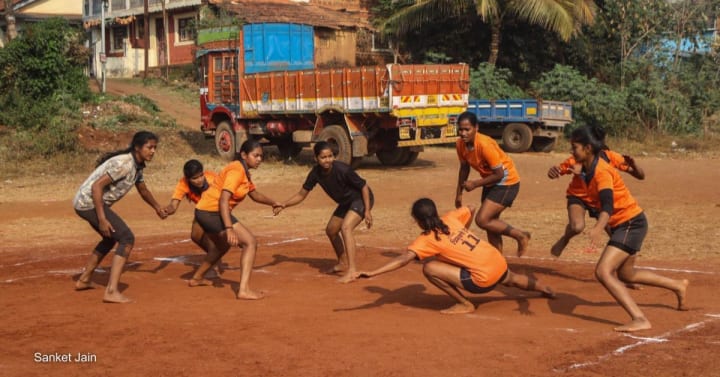
When Pandurang Terase, a sugarcane and rice farmer from India’s Maharashtra state, failed to turn his passion for kabaddi into a career, he ventured on a mission to train rural girls in sports for free. He never envisioned his work would someday save thousands from early and child marriage.
Every minute, 23 girls are married globally before they turn 18, according to the United Nations Population Fund. That’s over 12 million young women every year. So widespread is the problem that nearly 650 million women alive today became brides before turning 18 years old. India is home to 223 million child brides, the world’s highest. India accounts for one in three of the world’s child brides, UNICEF data shows.
“I wanted to help girls by making sports accessible to them,” says the now 66-year-old sports coach who doubles up as a farmer on his family plot. In his remote Pethewadi village in western India, with fewer than 150 people, sports was never considered a career, nor was any girl encouraged to pursue it.
But within a few years of taking up the sport in 1979, Terase became a renowned national-level player of kabaddi, which is a South Asian seven-a-side contact sport similar to rugby. He also started coaching fellow villagers in kabaddi, wrestling, and athletics. At first, Terase couldn’t even find 10 students, so he went house to house in the nearby villages, convincing students and parents.
Today, four decades later, Terase has trained over 15,000 boys and girls from marginalized communities across hundreds of villages in Maharashtra for free. Many have successfully overcome poverty and inspired more still, all using sports.
Using sports to prevent early and child marriage
As a child, Savitri Bhadvankar won several championships in the long jump and sprints. “As I grew, everyone around me would say that a career in sports was not meant for girls. I was always told that after completing grade 12, I would have to get married,” she recalls.
To get rid of the responsibility of supporting girls and bearing their education expenses, even today, many parents want to get their daughters married early.

So strong is the rudimentary practice of marrying early that Bhadvankar quit sports when she reached sixth grade. “Since then, the only thing ingrained in my mind was to get married,” remembers the now 19-year-old Bhadvankar.
She had good reason to believe she would be married off young. All three of her older sisters were wed at around 15.
“When you are poor and unaware of the opportunities, you can’t do much,” she said. Every day, she felt the constant pressure of marriage.
She tried to resist but “I had no one to talk to,” she says. This led to isolation and a constant feeling of helplessness. Many girls find themselves in this situation. Eventually, with no support system, they are forced into child or early marriage.
“Whenever I looked around, all I could see was young girls like me either getting married or becoming mothers.”
A few of her friends remained the exception. Bhadvankar, who was shy about seeking help, eventually realized how important it was to reach out to friends who were defying the trend. “I found they spent most of the time training in the field, practicing different sports,” she says.
Through one of her friends, she met Terase but was scared of asking for help.
“It was a sheer chance of luck that one day [Terase] saw me in such a disturbed mood at the bus stop,” she shares. “Do you want to learn kabaddi?” he asked.
Bhadvankar was scared to seek permission from her parents.
When she didn’t turn up for training the next day, Terase went to her house in Maharashtra’s Hajgoli Khurd village, with a population of around 500. “I told her parents they didn’t have to spend a single rupee on her training nor pay me the fees. All they have to do is send their daughter for training,” Terase says.
It wasn’t enough for the Bhadvankar family though. “Looking at their neighboring girls getting married, they came under tremendous societal pressure to do the same with their daughters,” Terase explains.
He persisted, asking them how many neighbors had become successful following traditional ways. There was complete silence. “Early marriage didn’t help,” Terase added.
Finally, Bhadvankar’s parents agreed to send her for training.
Every time she was pressured into marriage, Terase intervened and talked to her parents. And within a few months, she and her teammates started winning kabaddi championships, making her village proud, he says.
“It’s ironic. The same people who didn’t want me to become an athlete now put up my posters congratulating me for winning championships,” Bhadvankar says.
Bhadvankar owes her success to Terase and one of her seniors, Pratiksha Sasulkar, 25, who also avoided early marriage through Terase’s support.
When Sasulkar was just 16, her relatives began talking about getting her married. “Because of abject poverty, many parents think once they get their daughter married, they become free of any responsibility. Daughters are just looked at as burdens, and they believe marrying will relieve them of bearing her education and daily expenses,” Terase explains.
Sasulkar also comes from a financially challenged background. Upon Terase’s suggestion, she started her kabaddi training. In just three years, she won more than 10 championships. She not only won medals but also started mentoring young girls from across India.
Parents are reluctant to allow their daughters to travel to competitions. “Since this patriarchal society wants to restrict girls to household chores, they never let their daughters face the outside world and become independent,” Terase says.
But once Sasulkar began winning prize money, she became independent and started paying her own expenses, and her parents stopped pressuring her to marry. Sports and consistent training boosted her confidence and she started mentoring 50 girls aged 10 to 16, completed a postgraduate degree in business management, and even supported her family.
Now, Sasulkar is pursuing a course in physical education, and within a few years she aims to become a certified coach.
Humble beginnings
Early on, Terase realized that despite being a good athlete, he was unable to make a living from competitive sports. He loved kabaddi but had no mentor and lacked the financial resources to travel nationwide for competitions.
“In our village, the only occupation people practiced was farming. Sports were never looked at as a career.”
Somehow he managed to enroll in a bachelor of physical education course in Barshi town, 377 kilometers away from his village. “After graduating, my father asked me to return to the village. I always opposed this but I’m grateful when I look back,” he says.
He joined a school as a sports teacher in nearby Ajra town and spent the next 34 years teaching 10 to 25-year-olds.
Since Terase came from a remote village, he knew the problem of child marriage and how poverty plays a significant role in it. Although it was a long shot, Terase knew sports could help lift people out of poverty and ease the problem of child marriage. It was especially difficult for students from lower castes because they were considered untouchables.
But he persisted, and today after a 45-year career, there hasn’t been one student who dropped out.

 CVD
CVD 