Chinese borrowers default in record numbers as economic crisis deepens

ft.com

More than 8mn people are blacklisted by authorities after missed payments on mortgages and business loans

Under Chinese law, defaulters are blocked from a range of economic activities, such as purchasing aeroplane tickets and making mobile phone payments, representing a drag on the economy © Kevin Frayer/Getty Images

Sun Yu in Beijing DECEMBER 3 2023

Defaults by Chinese borrowers have surged to a record high since the outbreak of the coronavirus pandemic, highlighting the depth of the country’s economic downturn and the obstacles to a full recovery.

A total of 8.54mn people, most of them between the ages of 18 and 59, are officially blacklisted by authorities after missing payments on everything from home mortgages to business loans, according to local courts. That figure, equivalent to about 1 per cent of working-age Chinese adults, is up from 5.7mn defaulters in early 2020, as pandemic lockdowns and other restrictions hobbled economic growth and gutted household incomes.

The soaring number of defaulters will add to the difficulty of shoring up consumer confidence in China, the world’s second largest economy and a crucial source of global demand. It also throws a spotlight on the country’s lack of personal bankruptcy laws that might soften the financial and social impact of soaring debt.

Under Chinese law, blacklisted defaulters are blocked from a range of economic activities, including purchasing aeroplane tickets and making payments through mobile apps such as Alipay and WeChat Pay, representing a further drag on an economy plagued by a property sector slowdown and lagging consumer confidence. The blacklisting process is triggered after a borrower is sued by creditors, such as banks, and then misses a subsequent payment deadline.

“The runaway increase in defaulters is a product of not only cyclical but also structural problems,” said Dan Wang, chief economist at Hang Seng Bank China. “The situation may get worse before it gets better.” The personal debt crisis follows a borrowing spree by Chinese consumers. Household debt as a percentage of gross domestic product almost doubled over the past decade to 64 per cent in September, according to the National Institution for Finance and Development, a Beijing-based think-tank. But mounting financial obligations have become increasingly unmanageable as wage growth has stalled or turned negative in the midst of the economic malaise.

As a growing number of cash-strapped Chinese consumers have struggled to make ends meet, many have stopped paying their bills. More Chinese residents are also struggling for work: youth unemployment hit a record 21.3 per cent in June, prompting authorities to stop reporting the data. “I will pay my Rmb28,000 ($4,000) credit card balance when I have a job,” said John Wang, a Shanghai-based office worker who defaulted on his payments after being laid off in May. “I don’t know when that will happen.” China Merchants Bank said this month that bad loans from credit card payments that were 90 days overdue had increased 26 per cent in 2022 from the year before.

Tiếp tục đọc “Chinese borrowers default in record numbers as economic crisis deepens”
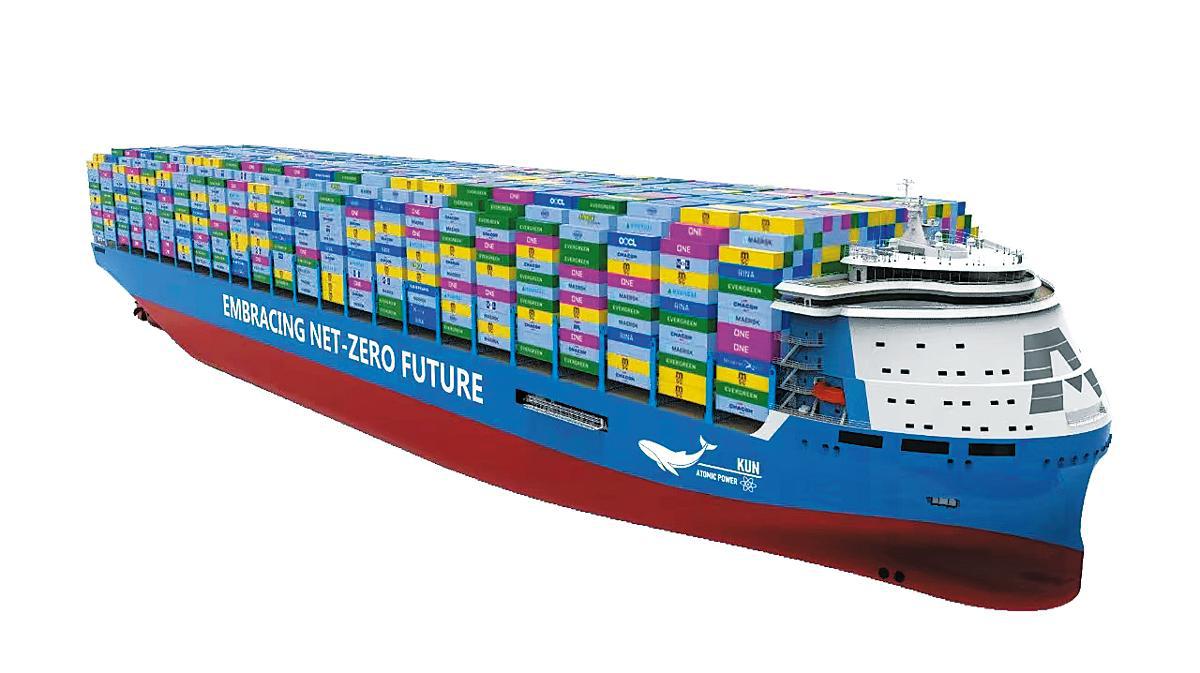
China: Design for nuclear-powered ship unveiled

By ZHAO LEI | China Daily | Updated: 2023-12-06 23:09

An illustration of the large nuclear-powered container ship, which can carry 24,000 standard containers. [Photo provided to China Daily]

China has unveiled a conceptual design for what could potentially become the world’s largest nuclear-powered container ship.

The vessel, which has yet to be named, will be powered by molten salt reactors and will have the capacity to carry 24,000 standard containers. In other words, it will be able to hold more than 1 billion boxes of Apple iPhones.

The conceptual design, made by China State Shipbuilding Corp’s Jiangnan Shipyard in Shanghai, was published on Tuesday, as the four-day Marintec China 2023 exhibition opened in the city.

The ship’s design earned an Approval in Principle certificate from the DNV, one of the world’s leading classification societies, at an unveiling ceremony.

A senior researcher at Jiangnan Shipyard, who asked to be identified only as Hu, told China Daily on Wednesday that the idea for a nuclear-powered container ship was the result of the shipyard’s endeavor to seek clean energy solutions for its products.

“Shipbuilders around the world have been under huge pressure from shipping businesses, investors and environmentalists to find cleaner fuel solutions. It is only natural for us to take nuclear power into consideration,” he said.

According to industry statistics, shipping operations account for about 3 percent of global greenhouse gas emissions. The International Maritime Organization has repeatedly pledged to reduce the emissions caused by shipping businesses.

Tiếp tục đọc “China: Design for nuclear-powered ship unveiled”

British research ship crosses paths with world’s largest iceberg as it drifts out of Antarctica

APnews.com BY SYLVIA HUIUpdated 4:23 PM GMT+7, December 5, 2023

Britain’s polar research ship RRS Sir David Attenborough has crossed paths with the world’s largest iceberg as it was drifting out of Antarctic waters. (Dec. 5)Photos

BY SYLVIA HUIUpdated 4:23 PM GMT+7, December 5, 2023Share

LONDON (AP) — Britain’s polar research ship has crossed paths with the largest iceberg in the world — a “lucky” encounter that enabled scientists to collect seawater samples around the colossal berg as it drifts out of Antarctic waters, the British Antarctic Survey said Monday.

The RRS Sir David Attenborough, which is on its way to Antarctica for its first scientific mission, passed the mega iceberg known as the A23a on Friday near the tip of the Antarctic Peninsula.

Tiếp tục đọc “British research ship crosses paths with world’s largest iceberg as it drifts out of Antarctica”

Who are the Houthis and why hasn’t the US retaliated for their attacks on ships in the Middle East?

This Nov. 12, 2018 photo shows The USS Carney in the Mediterranean Sea. The American warship and multiple commercial ships came under attack Sunday, Dec. 3, 2023 in the Red Sea, the Pentagon said, potentially marking a major escalation in a series of maritime attacks in the Mideast linked to the Israel-Hamas war. "We're aware of reports regarding attacks on the USS Carney and commercial vessels in the Red Sea and will provide information as it becomes available," the Pentagon said. (Mass Communication Specialist 1st Class Ryan U. Kledzik/U.S. Navy via AP)

1 of 2 | 

This Nov. 12, 2018 photo shows The USS Carney in the Mediterranean Sea. The American warship and multiple commercial ships came under attack Sunday, Dec. 3, 2023 in the Red Sea, the Pentagon said, potentially marking a major escalation in a series of maritime attacks in the Mideast linked to the Israel-Hamas war. “We’re aware of reports regarding attacks on the USS Carney and commercial vessels in the Red Sea and will provide information as it becomes available,” the Pentagon said. (Mass Communication Specialist 1st Class Ryan U. Kledzik/U.S. Navy via AP)Read More

FILE - The guided-missile destroyer USS Carney in Souda Bay, Greece. The American warship and multiple commercial ships came under attack Sunday, Dec. 3, 2023 in the Red Sea, the Pentagon said, potentially marking a major escalation in a series of maritime attacks in the Mideast linked to the Israel-Hamas war. "We're aware of reports regarding attacks on the USS Carney and commercial vessels in the Red Sea and will provide information as it becomes available," the Pentagon said. (Petty Officer 3rd Class Bill Dodge/U.S. Navy via AP)

2 of 2 | 

FILE – The guided-missile destroyer USS Carney in Souda Bay, Greece. The American warship and multiple commercial ships came under attack Sunday, Dec. 3, 2023 in the Red Sea, the Pentagon said, potentially marking a major escalation in a series of maritime attacks in the Mideast linked to the Israel-Hamas war. “We’re aware of reports regarding attacks on the USS Carney and commercial vessels in the Red Sea and will provide information as it becomes available,” the Pentagon said. (Petty Officer 3rd Class Bill Dodge/U.S. Navy via AP)

BY LOLITA C. BALDORUpdated 12:07 PM GMT+7, December 7, 2023 APnews

WASHINGTON (AP) — When Iranian-backed Houthi rebels in Yemen launched missiles and hit three commercial ships in the southern Red Sea last weekend, it triggered an immediate question: Will the U.S. military strike back?

The Houthis have sharply escalated their attacks against ships as they sail toward the narrow Bab el-Mandeb Strait. And U.S. Navy ships have shot down an array of drones headed their way and believed to have been launched by the militant group from territory it controls in Yemen.

But so far, the U.S. has avoided military retaliation — a marked difference from its multiple strikes against Iran-backed militias in Iraq and Syria that have fired rockets, missiles and drones at bases housing American forces in both countries.

No one has been reported hurt in the Houthi incidents, although the commercial ships suffered some damage. And U.S. officials argue that the Houthis haven’t technically targeted U.S. vessels or forces — a subtlety that Navy ship captains watching the incoming drones may question.

Tiếp tục đọc “Who are the Houthis and why hasn’t the US retaliated for their attacks on ships in the Middle East?”

The Global Credibility Gap

No one power or group can uphold the international order anymore—and that means much more geopolitical uncertainty ahead.

DECEMBER 6, 2023, 10:42 AM FP

By Jared Cohen, the president of global affairs at Goldman Sachs and a New York Times bestselling author of five books, and Ian Bremmer, the president of Eurasia Group and GZERO Media. He is also the host of the television show GZERO World with Ian Bremmer.

A globe with blocks and chunks missing from it sits atop the shoulders of a person looking into a dystopian horizon.

After decades of relative geopolitical calm, the world has entered its most volatile and dangerous period since the depths of the Cold War. Consider recent events. Despite U.S. President Joe Biden’s high-profile meeting with Chinese President Xi Jinping in San Francisco last month, relations between their two countries have deteriorated so sharply that a war between them, though unlikely, is no longer unthinkable. The COVID-19 pandemic, although largely in the rearview mirror, unleashed political and economic shocks that continue to reverberate across the global system. Russia’s brutal invasion of Ukraine plunged Europe into a destabilizing war with far-reaching consequences for trade and markets worldwide. And on Oct. 7, Hamas’s terror attacks against Israel sparked a new Middle East war that threatens to destroy years of progress toward economic transformation and regional stability.

These global shifts and shocks are often grouped together, and for good reason. According to International Monetary Fund (IMF) economists, they are among the drivers of a “policy-driven reversal of global economic integration” termed “geoeconomic fragmentation.” For some analysts, they are constituents of a so-called polycrisis, in which a series of disparate shocks “interact so that the whole is even more overwhelming than the sum of the parts.” And the White House itself has repeatedly highlighted how it helped crystalize thinking about the links between national security and economic policy to produce a “New Washington Consensus.”

Tiếp tục đọc “The Global Credibility Gap”