Two decades of Israeli policy towards the Palestinians have gone up in flames
image: ap
It is hard to see past the shock of Hamas’s bloodthirsty assault on Israel. That is because it involved thousands of rockets, and fighters attacking the south of the country by land, sea and air. And because it was completely unforeseen despite its scale, inflicting a humiliating blow against Israel’s vaunted intelligence services. But most of all because of the killing of hundreds of innocent people and the taking of scores of hostages by Hamas. As the Israel Defence Forces (idf) ponder how to respond, the world’s attention will be caught up in their desperate plight.
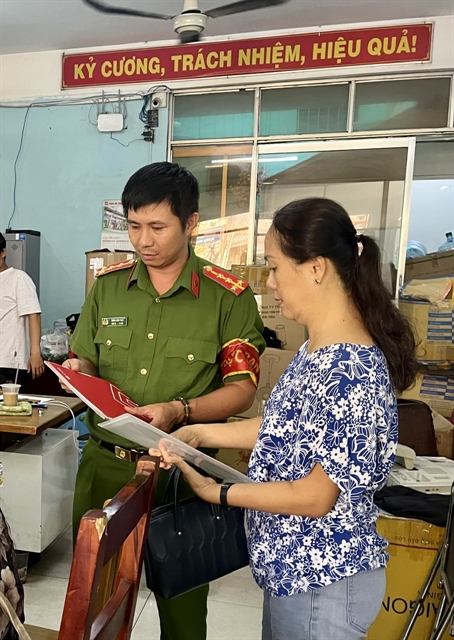
An 87-year-old man came to the Bình Thạnh District Police in HCM City last Monday morning to report a fraud related to bonds allegedly committed by one of Việt Nam’s largest property developers.
Trần Bữu Nữu, an officer belonging to the Bình Thạnh District police in HCM City, helps a victim make a complaint against Saigon Commercial Bank (SCB) where she had bought the bonds. VNS Photo Bồ Xuân Hiệp
Environmental activist group Mother Nature Cambodia has been named one of Right Livelihood’s 2023 laureates.
The award, established in 1980, recognizes groups and individuals striving to preserve the environment and those who protect it.
Mother Nature Cambodia has played a key role in campaigns against environmentally destructive dams, logging and sand mining, resulting in the imprisonment of multiple group members and banishment of its founder.
PHNOM PENH — Mother Nature Cambodia, one of the country’s most prominent environmental activism groups, was named one of Right Livelihood’s 2023 laureates on Sept. 28, making it the first group of Cambodians recognized in the award’s 43-year history.
Born out of a refusal from the Nobel Foundation to issue awards recognizing changemakers who champion environmental and social justice issues, Stockholm-headquartered Right Livelihood rewards groups and individuals committed to advancing causes around the world. The award offers recipients “a megaphone and a shield” with what Right Livelihood calls “lifelong support” to activists striving to preserve the environment and protect those who depend on it.
“Mother Nature Cambodia is a group of fearless young activists fighting for environmental rights and democracy in the face of repression by the Cambodian regime,” Ole von Uexkull, Right Livelihood’s executive director, said in a statement. “Through innovative and often humorous protests, their activism defends nature and livelihoods, while upholding communities’ voices against corrupt and damaging projects. Despite arrests, legal harassment and surveillance, they continue to fight relentlessly for Cambodians’ environmental and civic rights.”
Right Livelihood’s jury said Mother Nature Cambodia was receiving the award “for their fearless and engaging activism to preserve Cambodia’s natural environment in the context of a highly restricted democratic space.”
The banning of the Chinese blockbuster “No More Bets” warns that Beijing’s patience is wearing thin over Cambodia’s apparent inability to control cyber crime within its borders. A dramatic drop in tourism numbers may be one symptom.
All bets are off with regard to the impact in Cambodia of “No More Bets”, a hit Chinese movie based upon Southeast Asia’s cyber-scam industry.
Cambodia’s Ministry of Culture and Fine Arts last week requested the Chinese Embassy to stop screening the action thriller, banning it in Cambodia and calling for censorship in China.
International observers say the movie already is testing the limits of the two nations’ “ironclad” friendship, as well as impacting the already-collapsing Chinese tourism market in Cambodia. Indeed, the outrage generated by “No More Bets” is amplifying awareness of possible further political and economic consequences of this “scamdemic”.
Sometimes, in wars and revolutions, fundamental change arrives with a bang. More often, it creeps up on you. That is the way with what we are calling “homeland economics”, a protectionist, high-subsidy, intervention-heavy ideology administered by an ambitious state. Fragile supply chains, growing threats to national security, the energy transition and the cost-of-living crisis have each demanded action by governments—and for good reason. But when you lump them all together, it becomes clear just how systematically the presumption of open markets and limited government has been left in the dust.
For this newspaper, this is an alarming trend. We were founded in 1843 to campaign for, among other things, free trade and a modest role for government. Today these classical liberal values are not only unpopular, they are increasingly absent from political debate. Less than eight years ago President Barack Obama was trying to sign America up to a giant Pacific trade pact. Today if you argue for free trade in Washington, you will be scoffed at as hopelessly naive. In the emerging world, you will be painted as a neocolonial relic from the era when the West knew best.





 CVD
CVD 