“Going dark” refers to the gray zone tactic of strategically turning off a vessel’s Automatic Information System (AIS) transponder to avoid detection.
Miao Shou | AUGUST 17, 2023
Vessels operating without AIS inside a country’s Exclusive Economic Zone (EEZ). (Credits: Unseenlabs)
Miao Shou
Analyst
“Going dark” refers to the gray zone tactic of turning off a vessel’s Automatic Information System (AIS) transponder to avoid detection. AIS is a signaling system used to identify a vessel’s type, position, course, speed and other navigation safety information, and is required by the International Maritime Organization for larger non-military ships operating in international waters. Read our primer on the AIS system here.
Going Dark in the Recent Water Cannon Incident
In a recent incident that involved the blockade and water-cannoning of a small Philippine resupply vessel and its escorts, six of the blockading ships were from the China Coast Guard. Of these, only one ship (CCG 5402) remained AIS-visible during the entire engagement, while two other ships (CCG 4203 and CCG 3302) broadcast AIS only intermittently.
This tactic consists of blasting another ship with a powerful stream of water using a high-pressure water cannon.
Gaute Friis | AUGUST 7, 2023
CCG 31101 blasts a VCG vessel with water cannon, May 5, 2014. (Source: VCG)
Gaute Friis
Analyst
As of this writing, the Philippines has just produced evidence that its coast guard and resupply vessels were subjected to assault by water cannons from China Coast Guard ships on 5 August 2023. This occurred during the regular rotation and resupply mission to the Philippine Navy’s outpost aboard the grounded BRP Sierra Madre at Second Thomas (Ayungin) Shoal, and is reminiscent of a similar incident in November 2021.
While China’s use of maritime gray zone tactics is well known, few resources describe the actual tactics in detail. We’ve developed a publicly available systematic examination of these concrete tactics, which we will roll out for you in the coming weeks.
Spoofing is the act of deceptively and deliberately falsifying a vessel’s AIS identifying information or location.
Gaute Friis | SEPTEMBER 3, 2023
A China Coast Guard (CCG) cutter transmits fraudulent AIS signals to nearby vessels, appearing as a fishing boat on their monitoring equipment (Credit: Gaille Powell).
Gaute Friis
Analyst
Spoofing is a deception tactic meant to disrupt monitoring of maritime activities. It is frequently employed by Chinese gray zone actors in the South China Sea. In contrast to the “going dark” tactic of simply disabling a vessel’s Automatic Information System (AIS) broadcast, the spoofing tactic involves manipulating transmitting signals in order to falsify a vessel’s identity and/or location.
In 1995, Microsoft CEO Bill Gates published a memo entitled “The Internet Tidal Wave.” Gates outlined seven areas where Microsoft could increase its focus on internet features, including a web browser. The next year Microsoft launched its Internet Explorer web browser. Microsoft faced an antitrust lawsuit by the Department of Justice in 1998 during the height of the Browser Wars. Its Internet Explorer was quickly becoming the go-to web browser for the masses, but the U.S. government argued it stifled competition.
Cable-cutting is a sabotage and harassment tactic in which a ship will attempt to sever the cable to another ship’s trailing equipment, such as trawler lines or towed array sonars.
Gaute Friis | JULY 26, 2023
Chinese fisherman using a boat hook pole in an attempt to snag the cable connecting U.S ocean surveillance ship USNS Impeccable’s towed sonar array, March 8, 2009. (Source: USN)
Gaute Friis, analyst
This tactic is an act of sabotage which aim to cut the cables to a ship’s trailing equipment, such as trawler lines or towed array sonars.
Cable-cutting is most frequently used against commercial research vessels conducting survey operations in disputed maritime zones, such as within China’s huge “nine-dash line” claim in the South China Sea.
Dazzlers are non-lethal laser weapons meant to cause temporary blindness in humans or confound sensors. Recently employed against the Philippine Coast Guard, laser dazzlers have also been employed against U.S. and Australian military helicopters and surveillance planes operating in the region.
Gaute Friis | SEPTEMBER 12, 2023
CCG 5205 firing laser at Philippine Coast Guard cutter BRP Malapascua, February 6, 2023 (Source: Philippine Coast Guard)
Gaute Friis Analyst
Dazzlers are an emerging category of non-lethal but potentially dangerous weapons and a relatively recent addition to China’s gray zone arsenal. They can be used as a harassment tool; for destroying sensitive electro-optical sensors as an electronic warfare component; or as a weapon of psychological warfare.
Dazzlers are not themselves considered illegal. The U.S. military — which refers to them as “non-lethal optical distractors” — considers them an essential capability to “minimize fatalities, protect the innocent and limit collateral damage” when the alternative is lethal force, with the caveat that:
“Prior to fielding, all previously and currently fielded lasers or distracter devices have undergone legal reviews to ensure compliance with obligations assumed by the U.S. under applicable treaties, customary international law, and the law of armed conflict.”
China has used dazzlers to temporarily blind the crew of other countries’ ships. Because dazzlers have both physical and psychological effects their use against vessels at sea is hazardous, eroding their crews’ ability to navigate and react to maritime contingencies.
As detailed in our “going dark” playbook entry, a Chinese Coast Guard cutter used a dazzler to harass a Philippine resupply escort mission on February 6th, 2023.
The Philippine Coast Guard later clarified that was the second time this had occurred during a resupply mission.
Note: Any use of lasers to permanently blind personnel is illegal under Protocol IV (Blinding Laser Weapons) under the Convention on Certain Conventional Weapons, which China joined in 1998.
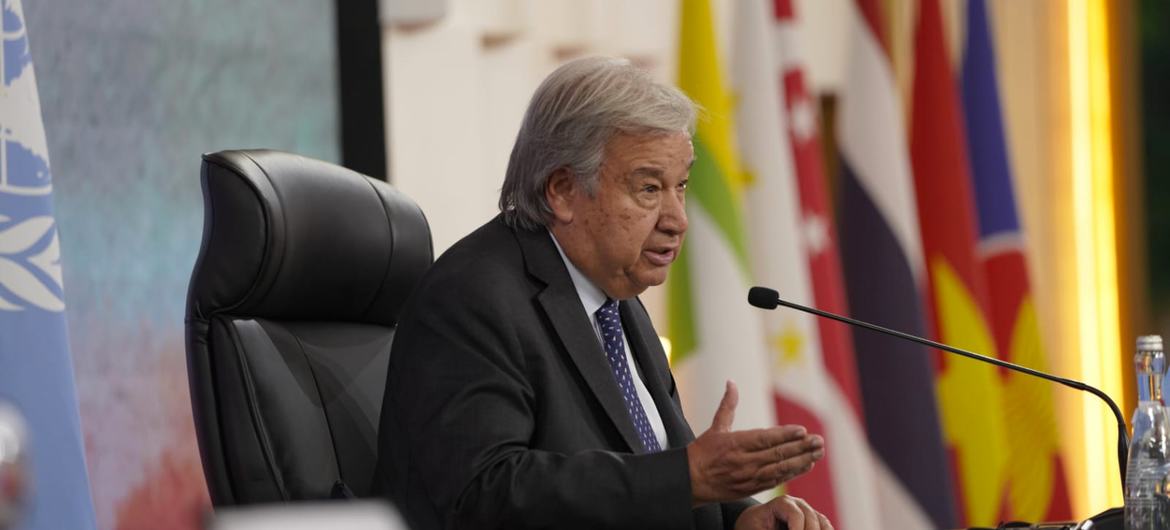
Amid rising geopolitical tension, Southeast Asia is fulfilling a “vital role in building bridges of understanding” worldwide said the UN chief on Thursday.
António Guterres was speaking in Jakarta, Indonesia, at the opening of the ASEAN-United Nations Summit, addressing Member States of the Association of Southeast Asian Nations and declaring “our partnership is more important than ever.”
Nghiên cứu này là sản phẩm thuộc chương trình: “Tăng cường pháp luật và tư pháp tại Việt Nam” (EU JULE), do Liên minh Châu Âu tài trợ với sự đóng góp tài chính từ UNDP và UNICEF. Chương trình do hai cơ quan này của Liên hợp quốc thực hiện với sự phối hợp của Bộ Tư pháp Việt Nam.
Một trong những mục tiêu chính của chiến lược quốc gia về xây dựng nhà nước pháp quyền của Việt Nam là cải thiện hệ thống tư pháp. Chính phủ Việt Nam đã làm rõ điều này bằng cách chấp nhận các khuyến nghị chu kỳ III của cơ chế Rà soát Định kỳ Phổ quát. Các khuyến nghị này kêu gọi “… tăng cường nhà nước pháp quyền, bao gồm cả việc phát triển hơn nữa hệ thống tư pháp hình sự có tính đến quyền con người của các nghi phạm và tù nhân cũng như thúc đẩy việc quản lý công lý công bằng và minh bạch.”
Nhằm góp phần thực hiện khuyến nghị trên, nghiên cứu này tập trung thu thập các thông lệ quốc tế tốt nhất liên quan đến ba cơ chế tư pháp hình sự quan trọng và nổi bật tại các khu vực tài phán thuộc hệ thống thông luật và dân luật, bao gồm: 1) xét xử bồi thẩm đoàn hình sự (hoặc sự tham gia của hội thẩm); 2) thỏa thuận nhận tội; và 3) hòa giải (tư pháp phục hồi). Báo cáo đồng thời xem xét lại luật pháp và thực tiễn hiện hành của Việt Nam đối với từng cơ chế này. Rút ra từ các thông lệ tốt của Việt Nam và quốc tế, nghiên cứu kết luận với các khuyến nghị nhằm hỗ trợ hệ thống tư pháp Việt Nam đạt được các mục tiêu chiến lược quốc gia.
(ĐTTCO) – Hướng đến kỷ niệm sinh nhật Bác Hồ, Sân khấu tư nhân Lệ Ngọc công diễn vở kịch “Lá đơn thứ 72” nói về câu chuyện Chủ tịch Hồ Chí Minh chỉ đạo xử lý thư kêu cứu của người dân bị án oan. NSND Lê Tiến Thọ ở tuổi 71 được mời làm đạo diễn, còn NSND Vương Duy Biên ở tuổi 64 đảm nhận vai trò thiết kế mỹ thuật.
Một cảnh trong vở kịch “Lá đơn thứ 72”.
NSND Lê Tiến Thọ là một nhân vật nổi tiếng bậc nhất trong nghệ thuật tuồng Việt Nam, với các vai diễn trong “Suối đất hoa”, “Hoàng hôn đen”, “Lý Phụng Đình”… và còn thể hiện năng lực trong vai trò đạo diễn các vở tuồng “Thiếu phụ Nam Xương”, “Lý Chiêu Hoàng”, “Dũng khí Đặng Đại Độ”…
Ông cũng là tác giả của nhiều kịch bản tuồng như “Chuyện tình ông vua”, “Hoàng thúc Lý Long Tường”, “Vụ án Lệ Chi Viên”… NSND Lê Tiến Thọ được trao Giải thưởng Nhà nước về văn học nghệ thuật năm 2012. Sau nhiều năm làm Giám đốc Nhà hát tuồng Việt Nam, ông tiếp tục đảm nhận những vị trí Cục trưởng Cục Nghệ thuật biểu diễn, Thứ trưởng Bộ Văn hóa Thể thao – Du lịch, Chủ tịch Hội Sân khấu Việt Nam…
The latest “standard map” released by China on August 28, 2023, has sparked a rare display of unity among its neighbours against the expanded territorial claims by Beijing. Japan joined a list of countries, which also include India, Malaysia, the Philippines and Vietnam, that have lodged protests against territorial claims by China in disputed areas in the region. The release of the new map came ahead of the attendance of Chinese Premier Li Qiang at two key summits: Asean and the Group of 20.
Central Office of Communist Party of Vietnam Hanoi, Vietnam
6:33 P.M. ICT
GENERAL SECRETARY TRỌNG: (As interpreted.) Your Honorable Joe Biden, President of the United States of America, distinguished delegates, on behalf of the leaders of the party, state, and people of Vietnam, I’d like to extend my warmest welcome to his Honorable President Joe Biden, who has great affection for the country and people of Vietnam, and for his various contributions to the strengthening of the friendship and cooperation between Vietnam and the U.S. in different capacities.
His visit to Vietnam on this occasion is of great significance, for it coincides with the celebration of the 10th anniversary of the Comprehensive Partnership between the two countries.






 CVD
CVD 