In 1945, members of the American “Deer Team,” part of the OSS, worked with Vietnamese guerrilla fighters to throw Japanese troops out of Indochina. As the war ended, the people of Vietnam looked to the United States to support their dreams of independence.
For most of World War II, the United States considered Vietnam to be a relatively unimportant French colony to someday be reclaimed from the Japanese; but America showed little interest in enlisting Vietnamese aid in that effort. All this changed rapidly in March 1945. Though the Japanese had invaded Vietnam in 1940, they allowed French colonial authorities to retain power so long as they controlled the Vietnamese and maintained the colony as a supply base for the Emperor’s army fighting in China. However, this also allowed the French to maintain covert Allied intelligence networks that supplied information to Allied personnel aiding the Chinese in their war against Japan. By early 1945, however, the war in the Pacific had shifted in favor of the Allies and the Japanese became increasingly suspicious of French activities in Vietnam. As a result, on March 10, 1945, Japanese forces launched Operation Meigo, a swift military takeover that effectively ended French colonial rule of Vietnam.
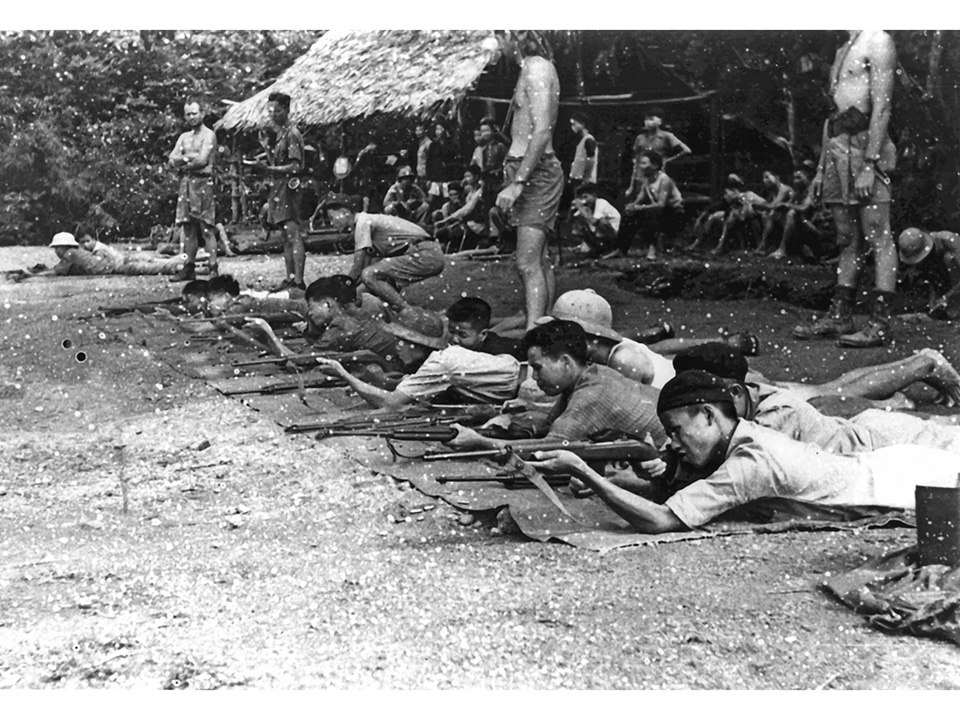
Members of the Deer Team providing instruction to the Vietnamese on use of the M-1 carbine, August 16, 1945. Photo by the National Archives and Records Administration.
With the loss of French control over the colony during Meigo, Allied intelligence networks operating in Vietnam collapsed. One such group, known as the “GBT,” had been providing information on weather conditions, the movement of Japanese troop trains and naval vessels, and on escape routes for downed Allied airmen to the 14th US Air Force stationed in China. Up to this point the GBT refused to employ Vietnamese as agents because the French claimed they were untrustworthy and were only interested in acquiring weapons to fight the French, not the Japanese. With their normally busy wires now silent, native agents became necessary.
Both the GBT and the US Office of Strategic Services (the OSS) reached out to a Vietnamese man who had drawn positive attention from the 14th Air Force the previous year when he escorted a downed American pilot out of Vietnam and into China. OSS agent Charles Fenn tracked down the man in question—Ho Chi Minh—describing him as articulate and charismatic, and both open and friendly to Americans. Fenn was convinced Ho would be an excellent intelligence agent and the group he represented, the Viet Minh, would also be valuable assets in the war against Japan. Soon thereafter, Ho Chi Minh became OSS agent “Lucius.”
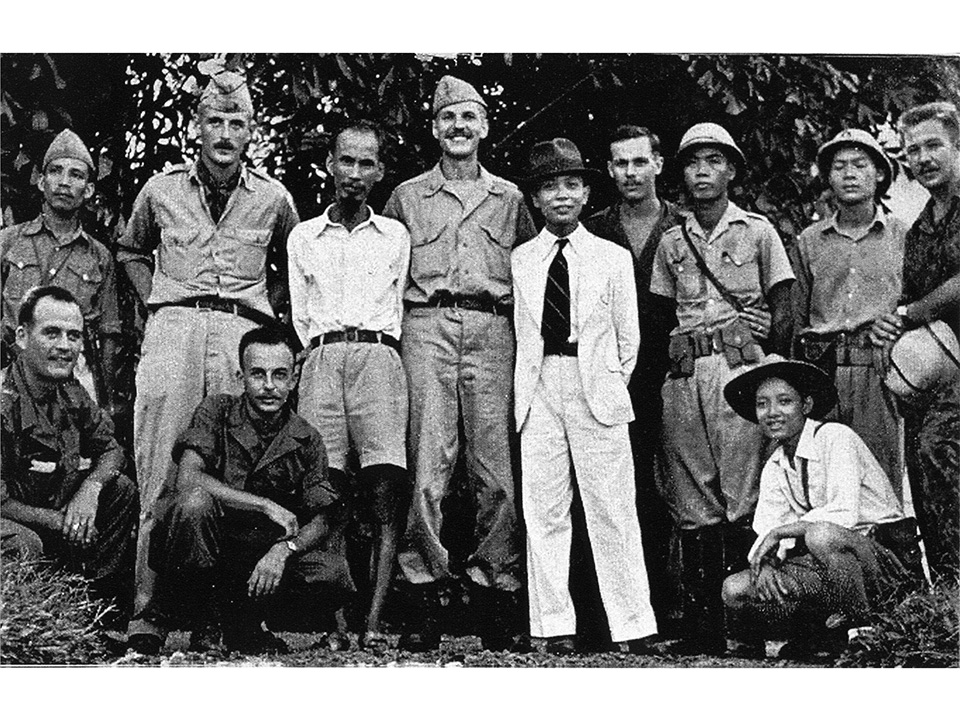
Members of the Deer Team and Viet Minh at training camp. Allison Thomas stands in the center and is flanked on his left by Vo Nguyen Giap and on his right by Ho Chi Minh. Photo by the National Archives and Records Administration.
Study finds ‘direct evidence’ of polar amplification on continent as scientists warn of implications of ice loss
An Adelie penguin in Antarctica. The icy continent is heating faster than climate models had predicted, a study has found. Photograph: Reuters/Alamy
Antarctica is likely warming at almost twice the rate of the rest of the world and faster than climate change models are predicting, with potentially far-reaching implications for global sea level rise, according to a scientific study.
Scientists analysed 78 Antarctic ice cores to recreate temperatures going back 1,000 years and found the warming across the continent was outside what could be expected from natural swings.
In West Antarctica, a region considered particularly vulnerable to warming with an ice sheet that could push up global sea levels by several metres if it collapsed, the study found warming at twice the rate suggested by climate models.
Hunter Marston is an Adjunct Research Fellow at La Trobe Asia with La Trobe University, Melbourne, a PhD candidate in International Relations at Australian National University in the Coral Bell School of Asia-Pacific Affairs, and an Associate with 9DashLine. He was previously a 2021 nonresident WSD-Handa Fellow at the Pacific Forum in Honolulu and the recipient of a Robert J. Myers Fellows Fund from the Carnegie Council for Ethics in International Affairs. From 2015-2019, he was a Senior Research Assistant for the Center for East Asia Policy Studies and The India Project at the Brookings Institution. He also worked in the Center for Strategic & International Studies’ (CSIS) Southeast Asia program. He completed his Masters in Southeast Asia Studies and Masters in Public Administration at the University of Washington in 2013. In 2012 Hunter was a Harold Rosenthal Fellow in International Relations in the U.S. Embassy in Myanmar. He is the co-host of the Undiplomatic Podcast on international affairs and writes regularly on Southeast Asian politics and U.S. foreign policy. His work has appeared in Contemporary Southeast Asia, the New York Times, Foreign Affairs, Foreign Policy, and the Washington Post.
Dr. Bich Tran is a postdoctoral fellow at the Lee Kuan Yew School of Public Policy, National University of Singapore. In addition to being an adjunct fellow at the Center for Strategic and International Studies (CSIS) in Washington DC, she has been a visiting fellow at the East West Center, International Institute for Strategic Studies (IISS-Asia), and ISEAS-Yusof Ishak Institute among others. Dr. Tran obtained her PhD in Political Science from the University of Antwerp in Belgium. Her research interests include Vietnam’s grand strategy, Southeast Asian states’ relations with major powers, and political leadership. She has published on various platforms, including Asia Pacific Issues, Asian Perspective, Asian Politics & Policy, The Diplomat, East Asia Forum, and Fulcrum. Dr. Tran is the author of “Vietnam’s Strategic Adjustments and US Policy” (Survival 64, no. 6, 77–90)
Elina Noor is a senior fellow in the Asia Program at Carnegie where she focuses on developments in Southeast Asia, particularly the impact and implications of technology in reshaping power dynamics, governance, and nation-building in the region. Previously, Elina was director of political-security affairs and deputy director of the Washington, D.C. office at the Asia Society Policy Institute. Prior to that, Elina was an associate professor at the Daniel K. Inouye Asia-Pacific Center for Security Studies in Honolulu. She spent most of her career at the Institute of Strategic and International Studies Malaysia, where she last held the position of director, foreign policy and security studies. Elina was also formerly with the Brookings Institution’s Project on U.S. Relations with the Islamic World. Between 2017 and 2019, Elina was a member of the Global Commission on the Stability of Cyberspace. She currently serves on the ICRC’s Global Advisory Board on digital threats during conflict.
Javad Heydarian is a Senior Lecturer at the University of the Philippines, Asian Center, a columnist at the Philippine Daily Inquirer, and a Television Host at TV5 Network. He has written for the world’s leading publications, including The New York Times, Washington Post, The Guardian, and Foreign Affairs. He is the author of, among others, “Asia’s New Battlefield” (Zed, 2015), The Rise of Duterte: A Populist Revolt against Elite Democracy” (Palgrave Macmillan, 2017) and “The Indo-Pacific: Trump, China, and the New Global Struggle for Mastery” (Palgrave Macmillan, 2019). He is also a regular contributor to leading global think tanks such as Center for Strategic and International Studies (CSIS), Brooking Institution, and Council on Foreign Relations (CFR). His forthcoming book is “China’s New Empire” (Melbourne University Press)
INTRODUCTION
Sailors have an expression, “fair winds and following seas,” to describe the favourable conditions which they desire when setting out to sea. Much like these seafarers, Southeast Asian maritime nations seek stable and peaceful waters for their security and prosperity. The South China Sea has long vexed regional policymakers and security strategists due to both the number and complexity of overlapping maritime territorial claims among regional actors, including Brunei, China, Malaysia, the Philippines, Taiwan and Vietnam.
In the past two decades, China’s increasingly expansionist tendencies and willingness to use force to coerce or intimidate smaller claimants has reinforced growing threat perceptions vis-à-vis Beijing and fuelled hedging strategies. In February 2023, a Chinese Coast Guard (CCG) vessel targeted Filipino counterparts with a military-grade laser in the Spratly Islands.1 The following month, a CCG vessel caused a dangerous encounter with Vietnamese patrol boats during a patrol of Vietnamese oil and gas fields around Vanguard Bank. Around this time, a CCG vessel was also seen operating in close proximity to Malaysia’s Kasawari gas project near Luconia Shoals, prompting the Malaysian Navy to dispatch a Keris-class littoral ship to the area.
As a result of Chinese intimidation, Southeast Asian states have begun to prioritise maritime security as a central component of national defence and security strategies. While power asymmetry between regional states and China makes a concerted pushback against Chinese coercion unpalatable, arguably no state has mounted a consistent or coherent response to deal with this security challenge. Rather, Southeast Asian countries have adopted an array of hedging tactics to deepen engagement with China while bolstering their own domestic defence capabilities and simultaneously expanding security cooperation with a variety of external partners, including Australia, Japan, and Korea.
Hedging refers to insurance-seeking behaviour meant to signal ambiguity in a state’s alignment while cultivating fall-back options to preserve maximum autonomy. Few existing studies of hedging have considered the central role that maritime security plays in regional countries’ foreign policies. This paper therefore clarifies the maritime security strategies of three Southeast Asian claimant states (Malaysia, the Philippines, and Vietnam) to assess how such strategies map onto or deviate from existing notions of hedging. In each of the case studies below, maritime security strategy is reflective of a state’s broader hedging strategy and mirrors the same fundamental tensions: power asymmetry, geographic proximity to a security threat, lack of political consensus, and profound strategic uncertainty, namely fears of abandonment or entrapment in a great power conflict. Seen in this light, maritime security strategy is a manifestation of states’ deeply ingrained preferences for ambiguity and unwillingness to choose sides in brewing superpower competition.
The paper concludes with a brief summary assessing the parallels between the three case studies and what they tell us about hedging and maritime security strategy


 CVD
CVD 