Rafting is the tactic of tying ships at anchor together to establish a semi-persistent floating outpost that is hard to uproot.
Gaute Friis | JULY 16, 2023
Rows of PAFMM trawlers rafting near Whitsun Reef, March 25, 2021 (Source: Asia Maritime Transparency Initiative, Maxar Technologies)
Gaute Friis
Team Member
“Rafting” refers to the gray zone tactic of tying ships together at anchor to establish semi-persistent floating outposts that are difficult disperse due to their collective mass.
The ships are generally the component of China’s People’s Armed Forces Maritime Militia (PAFMM) known as Spratly Backbone Fishing Vessels (SBFV). According to the Asia Maritime Transparency Initiative’s detailed report on the PAFMM, these SBFVs receive generous government subsidies to remain at sea for most of the year, specifically to assert Beijing’s expansive maritime claims.
This tactic describes maneuvering one’s ship dangerously across the bow of another, often forcing the other ship to take evasive action to avoid a collision.
Gaute Friis | JULY 18, 2023 Sealight 333
PLAN Destroyer Lanzhou, at right, is seen here sailing within 40 meters of the USS Decatur, to the left (Source: USN)
Gaute Friis
Team Member
Bow-crossing describes a harassment tactic in which a ship abruptly maneuvers to cross dangerously across the bow of another in violation of the 1972 International Regulations for Preventing Collisions at Sea (COLREG) and the 2014 Code for Unplanned Encounters at Sea (CUES).
This maneuver is intended to force the other ship to take evasive action to avoid a collision. It may be used to disrupt freedom of navigation operations (FONOPS) or other assertions of international law or national sovereignty.
A recent example was documented in June 2023, when a Peoples Liberation Army Navy (PLAN) vessel crossed dangerously in front of U.S. Navy destroyer USS Chung-Hoon during a joint Taiwan Strait passage with the Canadian frigate HMCS Montreal, forcing the U.S. ship to reduce speed to avoid a collision:
China’s ships use bow-crossing to protest the activities of other countries’ ships in waters over which it claims sovereignty or jurisdiction, and to send the message that Beijing is willing to escalate tensions in defense of its claims.
In nautical terms, it involves a closest point of approach (CPA) of less than 2 lengths of the ship being intercepted. They are usually referred to by the U.S. Navy as “unsafe and unprofessional maneuvers”.
Other examples:
On September 30, 2018, the PLAN Type 052C Luyang II-class destroyer Lanzhou intercepted the U.S. Arleigh Burke-class destroyer USS Decatur, which was conducting a FONOP with 12 nautical miles of Chinese-occupied artificial islands in the South China Sea. The picture at the top of this post shows how close the two ships came to colliding.
On June 21, 2014, CCG vessel Haijian 2168 approached Vietnam Coast Guard (VCG) ship CSB 4032 at high speed. The VCG ship had to change directions repeatedly to avoid a collision as the distance between the two ships came within 30 meters.
On December 5, 2013, a Chinese warship cut across the bow of the missile cruiser U.S.S. Cowpens at a distance of less than 200 yards in international waters.
In March 2009, five Chinese ships (a combination of PLAN, CCG and militia) harassed the U.S. surveillance ship USNS Impeccable in international waters in the South China Sea, forcing the American ship to make an emergency maneuver to avoid a collision.
Editor’s note: This post was originally published on 7 July under the title “Unsafe Maneuvers”, but was retracted when we decided to divide it into two separate categories. Apologies for any confusion.
Gaute Friis
Gaute is a Defense Innovation Scholar at Stanford’s Gordian Knot Center for National Sec
CCG 5201 blocks the path of BRP Malapascua, forcing it to abort its planned patrol of the Second Thomas Shoal after a 30 minute stand-off, April 26, 2023 (Source: BBC)
Gaute Friis
Team Member
Blocking is a form of bow-crossing meant to physically impede the passage of another ship to its destination. Blocking is typically used by Chinese ships to hinder other countries from resupplying or reinforcing their outposts in the South China Sea.
Distinct from other forms of bow-crossing, blocking is used for area denial rather than operations disruption and will often result in more protracted stand-offs. China uses this tactic to assert its claims of jurisdiction as well as to prevent certain activities–most notably the reinforcement of other claimants’ existing Spratly Island outposts.
One such blocking maneuver occurred on April 26th, 2023, when China Coast Guard (CCG) ship 5201 blocked the path of the Philippine Coast Guard (PCG) patrol vessel BRP Malapascua. This forced the much smaller PCG ship to abort its planned route to the entrance of Second Thomas (Ayungin) Shoal during a resupply mission to the Philippines’ outpost aboard BRP Sierra Madre:
China routinely prevents the entry of Philippine ships into the interior of Second Thomas Shoal as a cornerstone of its strategy to prevent the rusting outpost from being repaired or replaced until it breaks up or otherwise becomes uninhabitable. For nearly a decade it has allowed only small wooden boats carrying food and replacement troops to pass through its blockade.
Resupply boat brings food and replacement troops to the Philippine Navy’s outpost aboard BRP Sierra Madre, Second Thomas Shoal, 21 June 2022. Credit: Inquirer/ Marianne Bermudez
Other examples:
On September 19, 2019, also near Second Thomas Shoal, a CCG ship blocked Philippine civilian vessels while they were conducting a resupply mission to the BRP Sierra Madre.
On November 13, 2015, about 13 nautical miles from Subi Reef, CCG cutters 35115 and 2305 blocked the path of a Vietnamese replenishment ship heading towards the Vietnamese outpost on Southwest Cay, forcing the ship to find a different route to its destination. PLA Navy Type 072A landing ship 995 later blocked the ship’s path again, this time brandishing small arms and firing a warning shot.
Hiện nay, ở một số địa phương, du lịch làng nghề vẫn chưa được khai thác tương xứng tiềm năng, còn “bỏ qua” khá nhiều điểm nhấn thu hút du khách. Thực tế này đòi hỏi cần có những giải pháp phối hợp đồng bộ hơn giữa các ngành, hiệp hội, doanh nghiệp và cả những người thợ làng nghề để phát triển sản phẩm du lịch gắn với làng nghề đạt hiệu quả cao, vừa bảo tồn nghề truyền thống, vừa định vị thêm các điểm đến du lịch hấp dẫn.
Làng nghề cùng các sản phẩm được hình thành từ hoạt động lao động sản xuất của người dân làng nghề, những giá trị hữu hình và vô hình kết tinh trong sản phẩm chính là chất liệu, tài nguyên hình thành nên nhiều sản phẩm du lịch, góp phần tạo dựng, phát triển thương hiệu du lịch của từng địa phương.
Theo thống kê của Hiệp hội Làng nghề Việt Nam, hiện cả nước có khoảng 5.400 làng nghề, trong đó trên 2.000 làng nghề truyền thống, thuộc nhiều nhóm ngành nghề khác nhau, hiện diện ở khắp các địa phương.
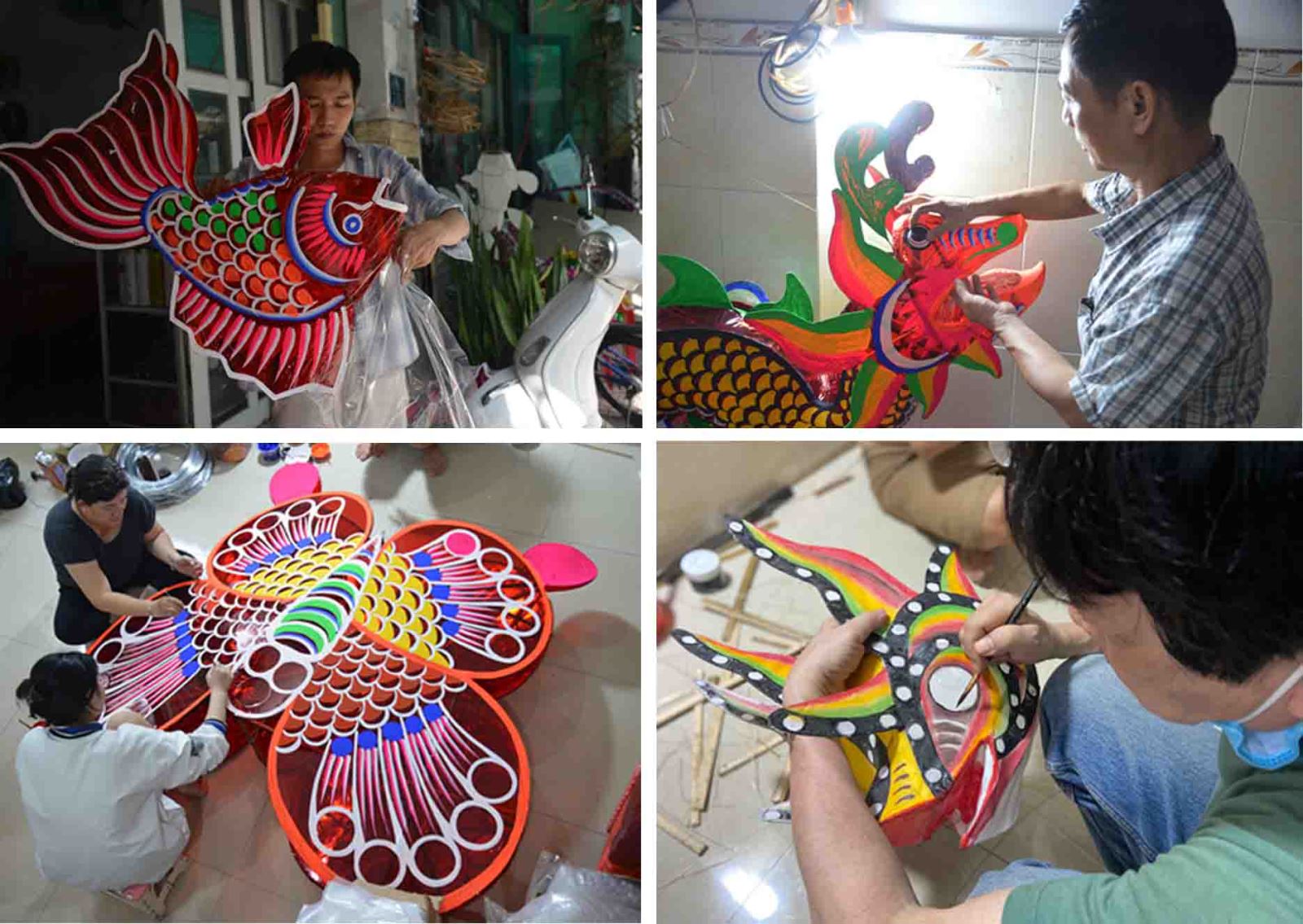
Làng lồng đèn truyền thống Phú Bình (TP Hồ Chí Minh) nhộn nhịp mùa Trung thu.
Các tỉnh, thành phố Nam Bộ, gồm khu vực Đông Nam Bộ và Đồng bằng sông Cửu Long là nơi có hệ thống làng nghề phong phú, đa dạng. Trải qua nhiều thăng trầm, nhiều làng nghề vẫn được duy trì, phát triển, phản ánh đặc trưng văn hóa làng nghề Việt Nam nói chung, đồng thời thể hiện nét riêng của từng địa phương. Nhiều chuyên gia nhận định, hầu hết các làng nghề tồn tại đến nay có từ lâu đời, gắn liền với lịch sử, dựa trên các yếu tố cơ bản là vùng nguyên liệu và giao thông, đặc biệt là đường thủy. Vì vậy, làng nghề không chỉ phản ánh mối quan hệ giữa “nghề” với “nghiệp” mà còn chứa đựng những yếu tố tinh thần đậm nét, phản ánh qua các tập tục, tín ngưỡng, lễ hội liên quan đến nghề sản xuất truyền thống.
Đề cập về làng nghề ở Đông Nam Bộ, Tiến sĩ Trần Minh Đức, Trường Đại học Thủ Dầu Một cho biết, Đông Nam Bộ gồm Thành phố Hồ Chí Minh và các tỉnh Đồng Nai, Bình Dương, Bình Phước, Tây Ninh, Bà Rịa – Vũng Tàu đang duy trì được hệ thống các làng nghề phong phú và đa dạng. Có thể kể đến Thành phố Hồ Chí Minh với các làng nghề: mành trúc Tân Thông Hội, chằm nón Tằm Lanh, bánh tráng Phú Hòa Đông, đan bồ An Nhơn Tây, chiếu Nam Đa Phước, dệt Bảy Hiền, lồng đèn Phú Bình…
Nghề trồng mai tại Phước Định (huyện Long Hồ, tỉnh Vĩnh Long) đã trở thành nghề mang lại thu nhập chính cho người dân.
How Minerals Made Civilization, the UA Lowell Institute for Mineral Resources’ YouTube video series on the role of mineral resources in history, is launching a trilogy about how mineral resources influenced the war. Part 1, posted today, covers mineral resources during the interwar buildup: how mineral resources figured in national (and transnational) politics in the 1930s, how resource-poor nations sought to build up their supplies, and how the struggle for resources eventually culminated in the outbreak of the war. From the video, here are a few fun facts you may not have known:
• Coins for combat: During the early to mid-1930s, both Germany and Japan reissued old silver coinages in nickel so they would have a nickel supply for gun steels when the war broke out. • Coal, meet hydrogen: Coal-to-oil conversion was invented too late to change the outcome of World War 1, but it was about to play a major role in supplying Germany in the next war. • Why we use molybdenum in steels: The Nazi-Soviet Pact of 1939 redirected Soviet manganese exports from the USA to Germany, so American metallurgists developed improved molybdenum-alloy steels as a substitute using molybdenum from Arizona and Colorado.




 CVD
CVD 