Buddha statues get bigger on mainland China in bid to lure tourists

scmp.com Published: 5:00pm, 4 Feb, 2014

Giant statues of sage spring up all over mainland as developers and officials bid to lure tourists
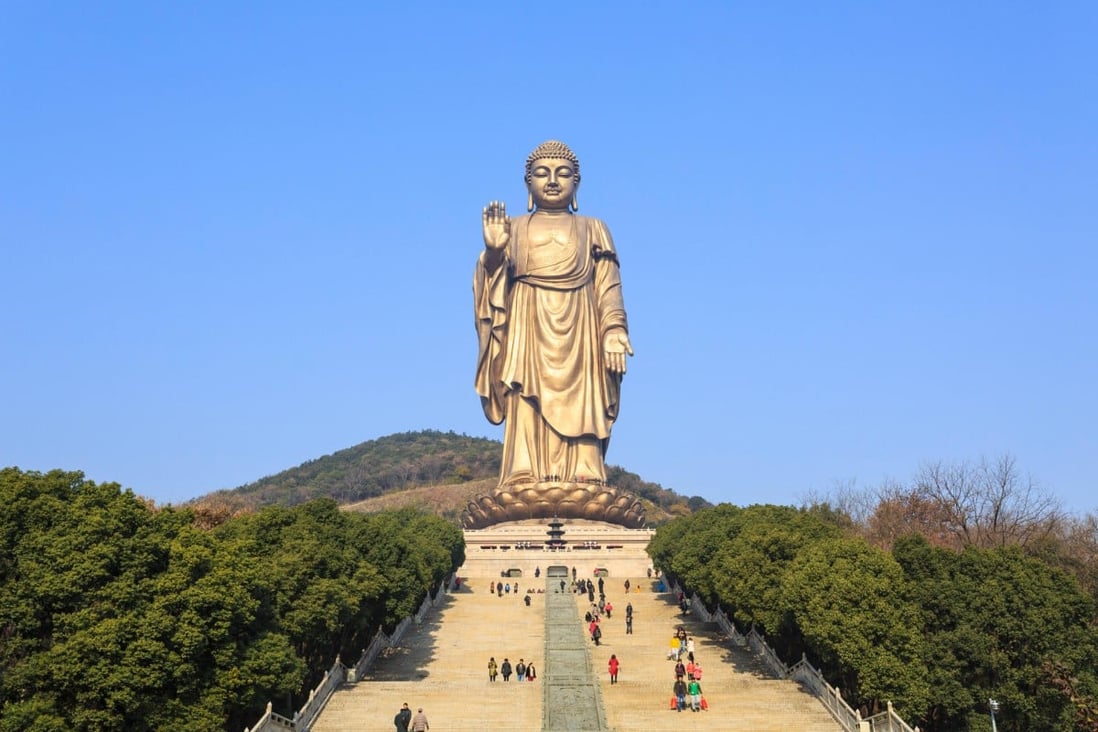
Tourists visit the popular Lingshan Grand Buddha at Wuxi, Jiangsu province, which stands 88 metres high. Photo: Shutterstock

Tourists visit the popular Lingshan Grand Buddha at Wuxi, Jiangsu province, which stands 88 metres high. Photo: Shutterstock

Local officials on the mainland are drawing inspiration from Buddha, but perhaps not in a way he might have intended.

Tourism bureaus and developers are racing to build ever-higher statues of Buddha, in an attempt to copy the success of the Lingshan Grand Buddha in Wuxi, Jiangsu province.

The 88-metre-high attraction drew about 3.8 million visitors last year, generating more than 1.2 billion yuan (HK$1.5 billion). Not a bad return on 725 tonnes of bronze sheet.

Hong Kong’s Tian Tan Buddha, at a modest 34 metres, would barely rise to the knees of the current behemoths such as the 208-metre-high Spring Temple Buddha in Lushan county in Henan province.

At least five others taller than Tian Tan are spread across the mainland and the list is set to grow, including a planned 88-metre-high statue of the bodhisattva Guanyin in Suzhou , Jiangsu province, a 99-metre depiction of the bodhisattva Ksitigarbha in Anhui province, and a 48-metre statue of Amitabha Buddha at Lu Mountain in Jiangxi province.

According to the New Weekly, the Aerosun Corporation, which built the Tian Tan Buddha on Lantau, is developing more than 10 such projects across the country this year.

Tiếp tục đọc “Buddha statues get bigger on mainland China in bid to lure tourists”
Thailand: Moving from punishment to treatment of people who use drugs

news.un.org Health

People who use drugs in Thailand are receiving more help to reduce the harm caused by their habit thanks to a change in formerly punitive drug laws and support from the UN Office on Drugs and Crime (UNODC).

“I first started taking drugs when I was 15,” says 49-year-old Prapat Sukkeaw. “I smoked marijuana, but it was laced with heroin. I felt like I was floating, and it meant that I could forget about all the problems that I faced as a teenager. It was a beautiful feeling.”

Prapat Sukkeaw is one of an estimated 57,000 people who currently injects drugs in Thailand. His drugs of choice, marijuana and heroin, reflect a period in Thailand’s recent history when both illegal narcotics were the main stimulants being trafficked out of the storied Golden Triangle, a remote and somewhat inaccessible region which includes northern Thailand as well as Myanmar and Laos.

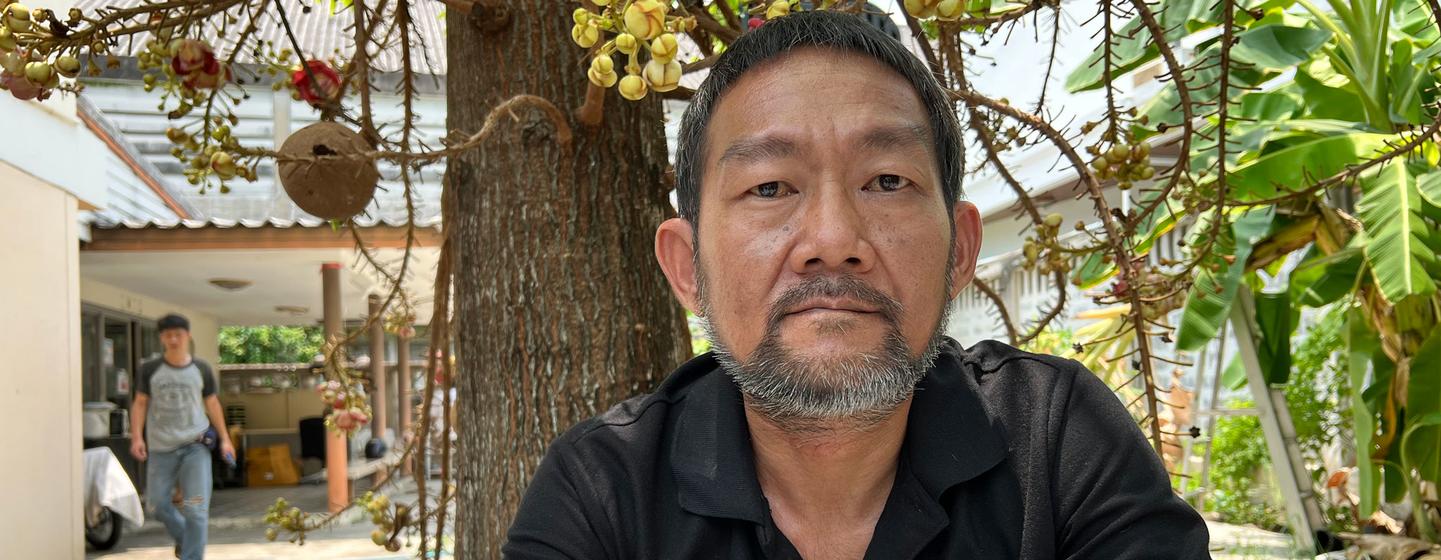
49-year-old Prapat Sukkeaw has used drugs since the age of 15.

UN News/Daniel Dickinson

49-year-old Prapat Sukkeaw has used drugs since the age of 15.

Employed by a non-governmental organization (NGO), he has on occasion wanted to give up heroin due to pressure from family and friends. Now, he has recognized that, even if he admits to being addicted, taking drugs “is my preference and my right”. He has now started taking the synthetic drug methamphetamine, as heroin has become progressively more expensive.

Tiếp tục đọc “Thailand: Moving from punishment to treatment of people who use drugs”

Huge increase in transnational crime and synthetic drugs in SE Asia requires cross-border cooperation

United Nations Office on Drugs and Crime

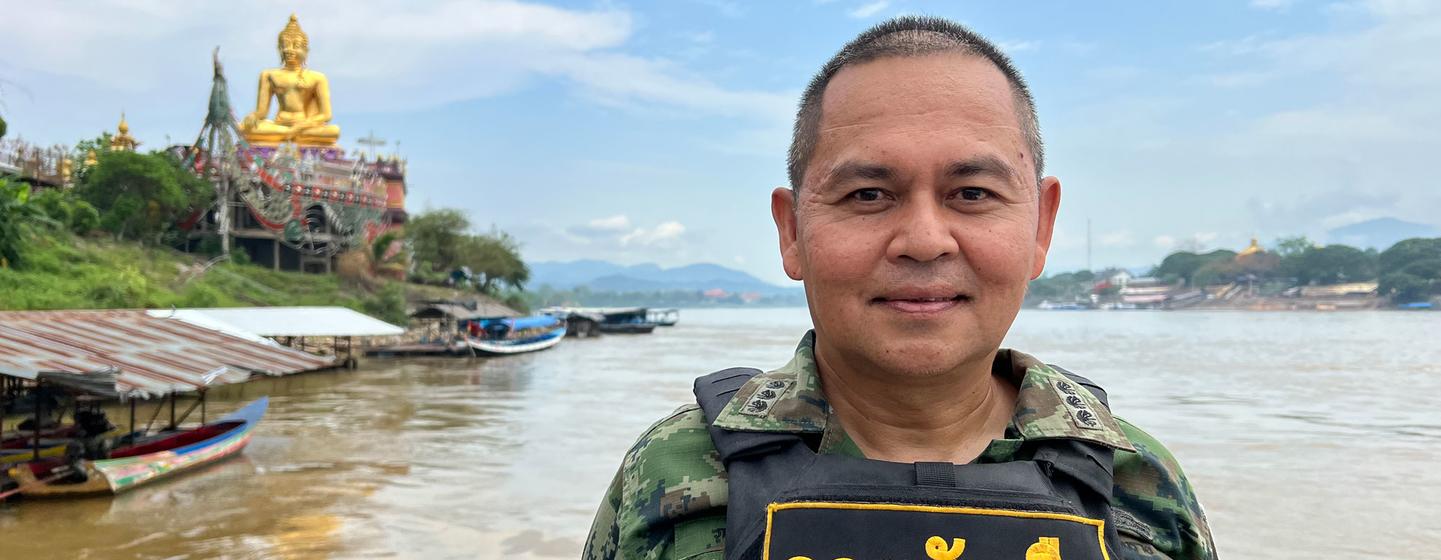
Bangkok (Thailand), 2 June 2023 – A Thai Navy launch travels at high speed down the muddy brown waters of the Mekong River close to the border town of Chiang Saen in the north of Thailand. To the right is Laos, where huge construction projects funded by foreign investment are rising out of the lush undergrowth along the riverbank and ahead to the left are the dense jungles of Myanmar.

This is the storied Golden Triangle where historically opium was grown to produce heroin for export but where, in recent years, the trade of even deadlier and more profitable synthetic drugs has taken over.

Thailand, Laos and Myanmar are at the frontlines of illicit trade in Asia dominated by transnational organized crime syndicates.

RIVER SEIZURE

UN News/Daniel Dickinson | Captain Phakorn Maniam is deployed to the Thai Navy Mekong Riverine Unit

UN News/Daniel Dickinson | Captain Phakorn Maniam is deployed to the Thai Navy Mekong Riverine Unit

RCEP- Regional Comprehensive Economic Partnership  – a boon or a bust for sustainable trade?

gtreview.com ASIA / 18-04-23 / BY ELEANOR WRAGG

As the Regional Comprehensive Economic Partnership (RCEP) machine whirrs into life and trade flows within the bloc increase, could its paucity of explicit ESG provisions lead to a lowering of sustainability ambitions for trade? Eleanor Wragg reports.

Just over a year has passed since RCEP, the world’s largest trade agreement, came into force. Covering a third of the world’s population and linking together least developed countries (LDCs) such as Laos, Cambodia and Myanmar to wealthier nations like Australia, China, South Korea and Japan, the deal promises to inject new impetus into regional integration and cement the position of ‘Factory Asia’ at the centre of the world’s supply chains.

The well-documented linkages between trade liberalisation and increased productivity, wages and employment could help some of RCEP’s poorest countries inch closer to achieving United Nations Sustainable Development Goals (SDGs) 1 – no poverty, and 8 – decent work and economic growth.

However, unlike most recent preferential trade pacts, RCEP does not contain provisions on topics such as the environment or labour rights, raising questions about the extent to which it balances economic interest with social and environmental protections.

A shot in the arm for Asian trade

Thrashed out over eight long years of painstaking negotiations between the 10 Asean member states, Australia, China, Japan, New Zealand, South Korea as well as India – which walked away from talks before they were finalised – RCEP streamlines the tangled web of bilateral trade agreements among its signatories into a bumper megadeal that spans 510 pages of agreement text and thousands upon thousands of pages of associated schedules.

Tiếp tục đọc “RCEP- Regional Comprehensive Economic Partnership  – a boon or a bust for sustainable trade?”