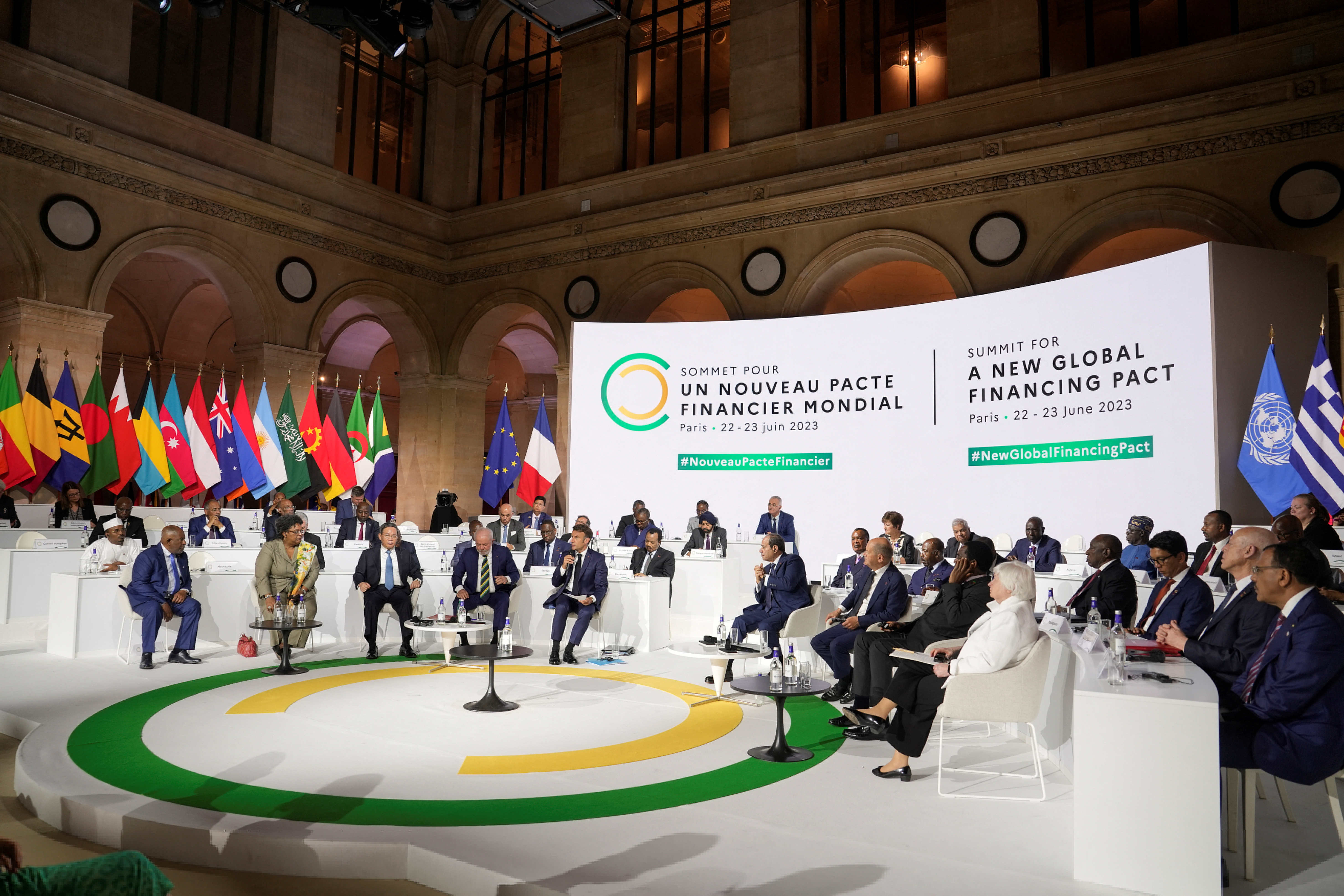
World leaders and finance bosses attend the closing session of the New Global Financial Pact Summit, Friday, June 23, 2023 in Paris, France. The aim of the two-day climate and finance summit was to set up concrete measures to help poor and developing countries whose predicaments have been worsened by the devastating effects of the COVID-19 pandemic and the war in Ukraine better tackle poverty and climate change. Lewis Joly/Pool via REUTERS
Summary
Roadmap for genuine change’ -Barbados’ Persaud
Eyes on IMO meet as shipping tax idea gathers steam
Critics say summit fell short of world’s needs
PARIS, June 23 (Reuters) – A Paris summit to discuss reforming the world’s financial system scored some notable wins that should tee up greater action before climate talks later this year, though some participants were disappointed with progress to address poorer states’ debt.
The Summit for a New Global Financing Pact saw French President Macron host around 40 leaders, many from the Global South, to debate changes to multilateral finance institutions in the face of climate change and other development challenges.
Much of the discussion centred on the key requests of developing nations, framed through the “Bridgetown Initiative” led by Barbados leader Mia Mottley, and her adviser Avinash Persaud said he was pleased with the outcome of the talks.
“It’s a roadmap for genuine change,” he told Reuters on the sidelines of the talks. “What’s emerged here is a real … understanding of the scale and pace of what is required.”
Among the highlights were confirmation that the richer world will likely hit a long-overdue target of providing $100 billion annually in climate finance to poorer countries, a long-delayed debt deal for Zambia, and a package to boost Senegal’s renewable energy capacity.
The World Bank and others also said they would start adding clauses to lending terms that allow vulnerable states to suspend debt repayments when natural disaster strikes.
Yet it was the wording of the final statement from attendees and subtle changes in the tone of discussions behind the scenes that gave hope to Persaud that even greater change was coming.
Specifically, for the first time, the document acknowledged the potential need for richer countries to provide fresh money to multilateral development institutions like the World Bank. This came alongside a plan to draw on more of their current assets, to the tune of $200 billion over 10 years.
Another first was in the explicit target for multilateral development banks to leverage “at least” $100 billion a year in private sector capital when they lend.
A reference was also made to finding “new avenues for international taxation”, as well as other Bridgetown Initiative requests including offering investors foreign exchange guarantees.
“That was widely discussed here and (there’s) lots of support behind an initiative that’s happening outside of Paris, at the International Maritime Organisation in a couple weeks time, on a levy on shipping emissions,” Persaud added.
Still, the summit was not without its critics.
“Unfortunately, the Paris Summit has not provided the breakthrough needed to find the funding for our planet’s survival,” Teresa Anderson, Global Lead on Climate Justice for ActionAid International, said, pointing to new funding pledges being loans or temporary debt relief instead of grants.
All eyes now turn to more traditional events later in the year, including the International Monetary Fund and World Bank annual meetings, a G20 meeting in September and the COP28 climate talks in Dubai.
Persaud said his focus would be on making sure the plan to scale up multilateral development bank lending was in place by the time of annual meetings in October, and that pilot work began on reducing the cost of capital for developing countries.
The summit, held against a backdrop of criticism that the world is moving far too slowly to address climate change, was a success in that it delivered a roadmap requiring specific actions by specific dates, some observers said.
“They’ve got a clear timetable of what they want to see happen and it’s that timeline that puts the pressure on and means that it’s harder to just kick things into the long grass,” said Sonia Dunlop from think tank E3G.
Reporting by Simon Jessop, Leigh Thomas and Tommy Reggiori Wilkes, editing by Mark Heinrich
I'm from Hanoi, Viet Nam.
I'm an author of Dot Chuoi Non (dotchuoinon.com/author/hangbelu/), a blog on Positive thinking, founded by Dr. Tran Dinh Hoanh, an attorney in Washington DC.
I'm a co-founder of Conversations on Vietnam Development - cvdvn.net, a virtual think tank. I am a co-founder of two companies in Viet Nam working on children education services. I advise companies on STEAM education, English language education for children and students in Vietnam.
I'm studying the Buddha's teaching and the teaching of Jesus. I practice mindful living including meditation.
I hold a PhD on Sustainable Energy Systems from University of Lisbon and Aalto University.
I graduated from Hanoi University of Technology on Environmental Engineering. I obtained a Master degree of the same major from Stanford University and Nanyang Technological University.
My English-language blog at: hangbelu.wordpress/.
I play table tennis as a hobby.
Xem tất cả bài viết bởi Đào Thu Hằng


 CVD
CVD 